Horizontal vs Vertical Scaling: Complete Guide for System Design
When building modern applications, scalability becomes one of the most critical challenges. As traffic grows, systems must handle more users, data, and requests efficiently. This is where scaling strategies come into play.
The two most important scaling techniques in system design are Vertical Scaling and Horizontal Scaling. Understanding the difference between them is essential for designing high-performance and reliable systems.
What is Vertical Scaling?
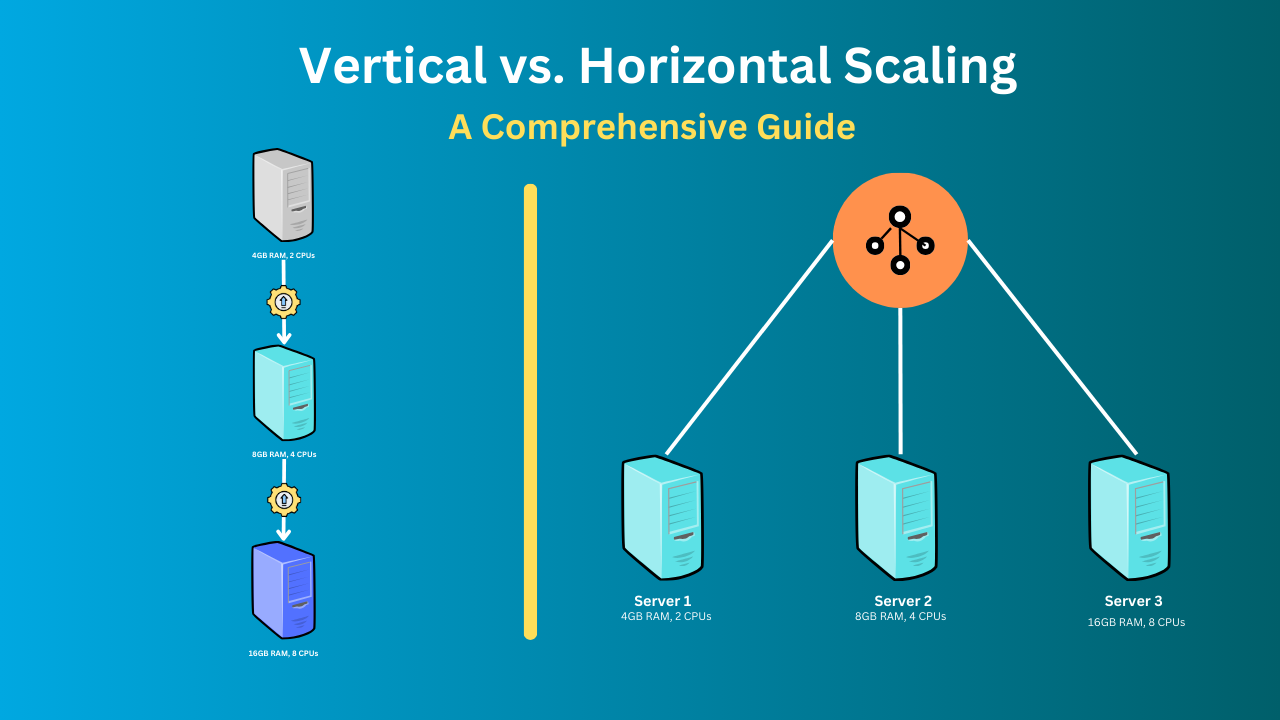
Vertical scaling, also known as scaling up, means increasing the power of a single server. This includes upgrading CPU, RAM, storage, or network bandwidth.
Instead of adding more machines, you make one machine stronger. This approach is commonly used in the early stages of application development.
Advantages of Vertical Scaling
- Simple to implement without changing system architecture
- No need to manage multiple servers
- Works well for monolithic applications
- Quick to upgrade and deploy
Disadvantages of Vertical Scaling
- Limited by hardware capacity
- Single point of failure
- Expensive high-end machines
- Downtime required during upgrades
What is Horizontal Scaling?
Horizontal scaling, also known as scaling out, involves adding multiple servers to distribute the load. Instead of relying on one powerful machine, multiple machines work together.
This approach is used in distributed systems where traffic is handled by multiple servers through load balancing.
Advantages of Horizontal Scaling
- Almost unlimited scalability
- High availability and fault tolerance
- Better load distribution
- No downtime during scaling
Disadvantages of Horizontal Scaling
- Complex system architecture
- Difficult debugging across services
- Data consistency challenges
- Higher initial setup effort
Horizontal vs Vertical Scaling (Key Differences)
| Feature | Vertical Scaling | Horizontal Scaling |
|---|---|---|
| Approach | Upgrade one machine | Add multiple machines |
| Scalability | Limited | Almost unlimited |
| Complexity | Low | High |
| Fault Tolerance | Low | High |
Real-World Example
Large companies like Amazon, Netflix, and Google use horizontal scaling to handle millions of users globally. These systems rely on distributed architectures and load balancing to ensure performance and availability.
However, there have been cases where companies optimized their systems by reducing unnecessary complexity and moving certain services back to simpler architectures to reduce costs and improve performance.
When Should You Use Each?
- Use Vertical Scaling: For small applications, MVPs, and early-stage startups
- Use Horizontal Scaling: For large-scale systems with high traffic
- Best Approach: Use a hybrid model combining both strategies
Final Thoughts
Vertical scaling is simple and effective for smaller systems, but it has limitations. Horizontal scaling provides better scalability, reliability, and performance for large applications, although it introduces complexity.
Most modern systems start with vertical scaling and gradually transition to horizontal scaling as they grow. The key is to choose the approach that best fits your system’s requirements.