Gold vs Fixed Deposit (FD) in 2026: Which Investment Is Better for Indian Investors?
By Satyapal Khakhal, Financial Writer | Updated: May 5, 2026
Two of the most popular investment choices for Indian households have always been gold and fixed deposits. Gold carries deep cultural significance — bought at weddings, gifted at festivals, and held across generations as a store of wealth. Fixed deposits, on the other hand, are the backbone of conservative investing in India, trusted for their guaranteed returns and zero market risk. In 2026, with gold prices near historic highs and FD interest rates ranging from 6.5% to over 8% across different banks, choosing between the two has become a genuine dilemma for millions of Indian investors.
This guide compares gold and fixed deposits across all key parameters — returns, risk, liquidity, taxation, and suitability — so you can make an informed choice based on your specific financial goals.
Gold vs FD in 2026: Quick Comparison at a Glance
| Parameter | Gold | Fixed Deposit (FD) |
|---|---|---|
| Returns | ~9–12% annualised (last 2 years); not guaranteed | 6.5% – 8.3% p.a.; guaranteed |
| Risk level | Medium (price fluctuates daily) | Very low (no market risk) |
| Liquidity | High (can sell anytime) | Medium (penalty on early withdrawal) |
| Inflation hedge | Excellent (historically beats inflation) | Poor to moderate (often below real inflation) |
| Tax on gains | 12.5% LTCG after 2 years; STCG at slab rate | Interest fully taxable at income slab rate |
| Regular income | No (only capital appreciation) | Yes (monthly, quarterly, or annual payouts) |
| Minimum investment | ₹1 (digital gold) to ₹5,000+ (physical) | ₹1,000 – ₹10,000 (varies by bank) |
| Deposit insurance | Not applicable | Up to ₹5 lakh per bank (DICGC) |
Returns: How Have Gold and FDs Actually Performed?
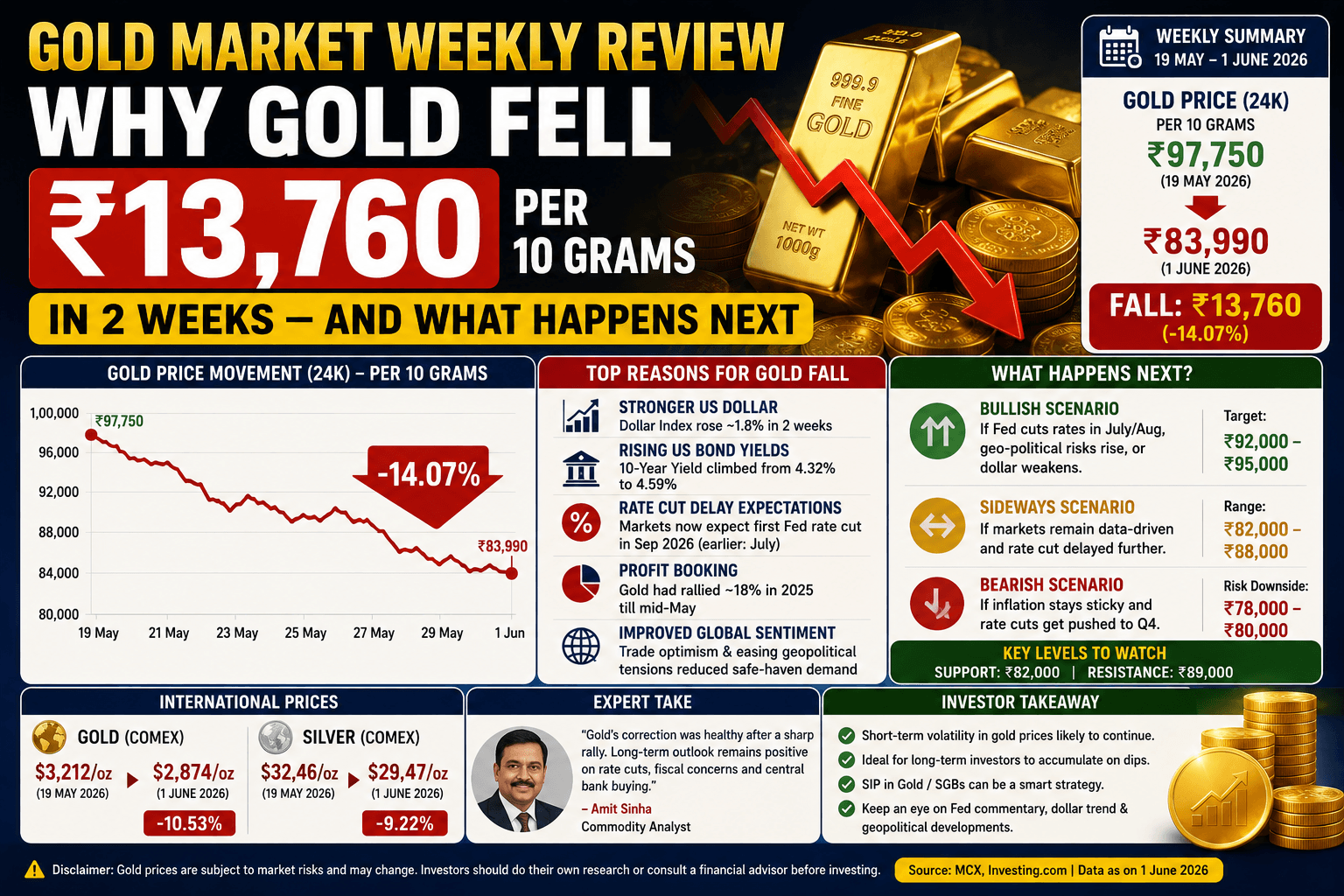
Over the past two years, gold has been the clear winner in terms of absolute returns. Gold prices in India rose from approximately ₹6,800 per gram in January 2024 to over ₹15,000 per gram by early 2026 — a gain of more than 120% in just over two years. Even over the longer 20-year period from 2003 to 2023, gold delivered an annualised return of approximately 9.1% according to World Gold Council data, comfortably ahead of average FD rates during the same period.
Fixed deposits, meanwhile, are offering more competitive rates in 2026 than they have in several years. Small Finance Banks are currently leading the interest rate spectrum, with Suryoday Small Finance Bank topping the chart at 7.90%, followed by Jana Small Finance Bank at 7.77%. State Bank of India offers rates going up to 7.05% for the 5–10 year tenure for senior citizens, while ICICI Bank offers 7.10% for 3–5 years. For regular depositors at large public and private banks, effective rates currently range from 6.5% to 7.4%.
However, FD returns must be viewed net of taxes. If you consider a 6% inflation rate and an FD earning 7% interest, after tax at the 20% slab rate, your net return is approximately 5.6% — which is below inflation, resulting in negative real gains. Gold, by contrast, is not taxed until you sell, and long-term capital gains after two years are taxed at a flat 12.5% — significantly lower than the income slab rates applied to FD interest.
Current FD Interest Rates in India (May 2026)
Here is a snapshot of indicative FD rates from major banks and institutions as of May 2026:
| Bank / Institution | Best Rate (General) | Best Rate (Senior Citizens) | Tenure |
|---|---|---|---|
| SBI | 6.50% | 7.05% | 5–10 years |
| HDFC Bank | 7.00% | 7.50% | 3 years |
| ICICI Bank | 6.50% | 7.10% | 3–5 years |
| Suryoday Small Finance Bank | 7.90% | 8.10% | 5 years |
| Jana Small Finance Bank | 7.77% | 8.27% | Select tenures |
| Post Office FD | 7.50% | 7.50% | 5 years |
Rates are indicative as of May 2026 and subject to change. Verify the latest rates directly with the bank before investing.
Risk: Which Is Safer?
Fixed deposits are among the safest financial instruments available in India. Your principal is not exposed to market fluctuations, and your returns are guaranteed from the day you book the FD. Bank deposits are also covered by DICGC insurance up to ₹5 lakh per depositor per bank, which means your money is protected even if a bank were to fail — though this scenario is extremely rare for scheduled commercial banks.
Gold carries a different kind of risk. While it has been an outstanding performer over the long term, its price moves daily based on international market prices, currency movements, and investor sentiment. In any given month, gold can fall 3–5% without warning. Over shorter time horizons of 6–18 months, gold can and does disappoint. Anyone who bought gold at the peak of the 2020 rally in August and sold in 2021 would have seen a significant short-term loss. The lesson is that gold rewards patience but punishes short-term thinking.
For investors who cannot tolerate any uncertainty about the value of their investment — such as retirees living off their savings, or those saving for a fixed expense within 12 months — FDs are the appropriate choice. For investors with a 3–5 year horizon who can ride out short-term price swings, gold has historically rewarded that patience.
Liquidity: Which Can You Access Faster?
Gold is highly liquid in most of its forms. Digital gold can be sold within minutes through an app. Gold ETFs trade on stock exchanges during market hours. Physical gold can be sold at any jeweller or bank, though you may not get the best price quickly without shopping around. The key advantage of gold is that you are not penalised for selling early — you simply get the market price on the day you sell.
Fixed deposits are less flexible. Most FDs allow premature withdrawal, but this typically attracts a penalty of 0.5–1% reduction in the interest rate, and you lose the benefit of the higher long-term rate you were earning. Some special FDs — such as tax-saver FDs with a 5-year lock-in — do not allow premature withdrawal at all. If you anticipate needing the money before maturity, this is a significant limitation.
For investors who need quick access to funds in an emergency, gold (particularly digital gold or gold ETFs) offers superior liquidity compared to most FD products.
Taxation: Where Gold Has the Advantage
Taxation is one of the most important but least discussed differences between gold and FDs, and it strongly favours gold for investors in higher income tax brackets.
FD interest is added to your total income and taxed at your applicable income tax slab rate — 20% or 30% for most working professionals. If you earn ₹60,000 in annual FD interest and are in the 20% slab, you effectively keep only ₹48,000. Banks also deduct TDS at 10% if your annual FD interest exceeds ₹40,000 (₹50,000 for senior citizens), meaning the tax is collected before you even receive the interest.
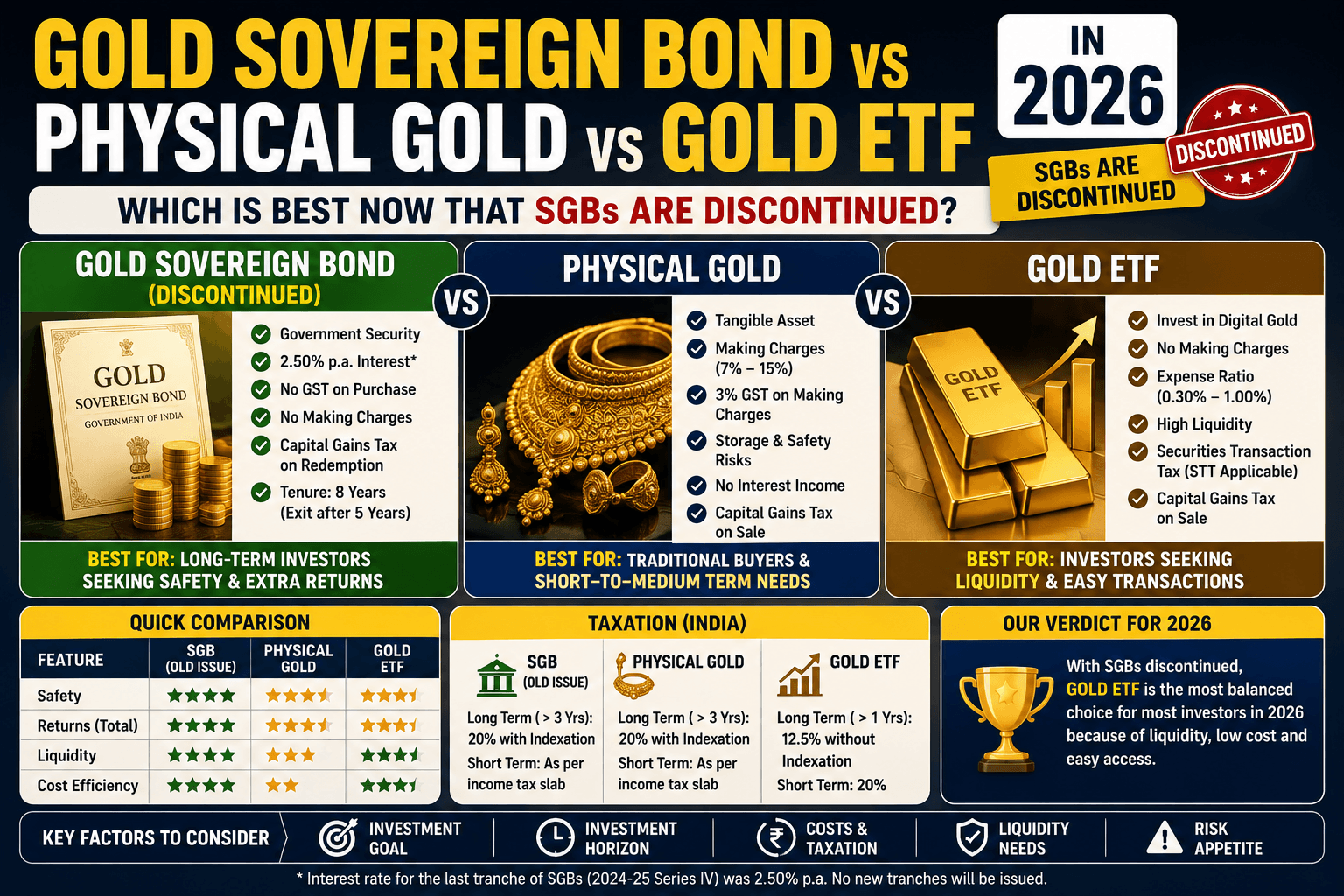
Gold gains, by contrast, are taxed only when you sell. If you hold gold for more than two years, profits are taxed at a flat 12.5% long-term capital gains rate. If you hold Sovereign Gold Bonds to maturity (8 years), the capital gains are completely exempt from tax — making SGBs the most tax-efficient way to invest in gold in India.
For an investor in the 30% tax bracket comparing a 7% FD and gold that also returns 7% in the same period, the post-tax return on the FD is approximately 4.9%, while the post-tax return on gold (held over 2 years) is approximately 6.1%. The difference compounds significantly over longer holding periods.
Gold vs FD: Which Is Right for You?
The honest answer is that both have a legitimate place in a well-rounded investment portfolio, and the right choice depends entirely on your situation.
Choose FD if: You need guaranteed returns for a specific goal within 1–3 years (such as a home down payment or your child's school fees). You are a retiree or conservative investor who cannot afford any risk to your principal. You want regular monthly or quarterly income from your investment. You are in the lower income tax brackets (below 20%) where FD tax drag is less significant.
Choose Gold if: Your investment horizon is 3 years or longer. You want protection against inflation and rupee depreciation over time. You are building long-term wealth and can tolerate short-term price volatility. You are in the 20–30% tax bracket and want to minimise investment tax outgo. You want an asset that performs well during periods of global uncertainty or market stress.
Consider both if: Most financial planners in India recommend holding 10–15% of your investment portfolio in gold for diversification, with the remainder in instruments like FDs, mutual funds, and equities based on your risk profile. The two assets tend to behave differently in most market environments — when equity markets fall and uncertainty rises, gold tends to appreciate, while FDs provide stable income regardless of market conditions. Together, they reduce overall portfolio risk while maintaining reasonable return potential.
Best Ways to Invest in Gold in 2026
Sovereign Gold Bonds (SGBs): The gold investment with the best overall value for long-term investors. SGBs pay 2.5% annual interest in addition to gold price appreciation, and capital gains at maturity are fully tax-free. Issued by the Reserve Bank of India in periodic tranches. Not suitable for investors who may need to sell before maturity.
Gold ETFs: Listed on stock exchanges, gold ETFs track domestic gold prices with no making charges and very low expense ratios. Can be bought and sold instantly during market hours. Suitable for investors with a demat account who want liquid, cost-efficient gold exposure.
Digital Gold: Available through MMTC-PAMP, SafeGold, and payment apps in amounts starting from ₹1. Good for systematic, small-amount investing. Note that digital gold is not regulated by SEBI, so stick to reputed platforms.
Physical Gold: Best for jewellery needs and gifting. Always buy BIS hallmarked jewellery and insist on a proper bill. Compare making charges (standard 8–12% for plain designs) before buying. Gold coins and bars from banks offer purity guarantees.
Frequently Asked Questions
Is gold better than FD for long-term investment in India?
Historically, yes. Over 10–20 year periods, gold has generally delivered higher returns than FDs in India, with the added benefit of acting as an inflation hedge. However, gold carries short-term price risk that FDs do not. For long-term wealth building where you can hold through volatility, gold has a track record of outperforming FDs on a post-tax basis.
Can I get regular income from gold like I do from an FD?
Regular physical gold and digital gold do not provide periodic income — they only generate returns when you sell at a higher price. Sovereign Gold Bonds are an exception, paying 2.5% annual interest on the initial issue price. FDs remain the better choice if regular monthly or quarterly income is a priority.
Should I break my FD to invest in gold at current prices?
Generally, no. Breaking an FD early attracts penalties and forfeits the higher interest rate you were earning. If you want gold exposure, it is better to invest new money or wait until your FD matures naturally. Disrupting a stable guaranteed return to chase an asset that has already rallied significantly is a high-risk strategy that rarely works well for retail investors.
What is the safest form of gold investment in India?
Sovereign Gold Bonds are the safest form of gold investment as they are issued and backed by the Government of India, carry no storage or purity risk, and offer tax-free maturity gains. For those who want physical gold, BIS hallmarked coins or bars from reputed jewellers or banks carry the best purity assurance.
Conclusion: Use Both, Not Just One
Gold and fixed deposits are not competitors — they are complements. Gold protects your wealth against inflation, currency depreciation, and long-term economic uncertainty. Fixed deposits protect your capital in the short to medium term and provide guaranteed income. The investors who have done best over the past decade in India are typically those who held both, rebalancing their allocation based on their changing needs rather than chasing whichever asset happened to be performing best at any given moment.
In 2026, with gold near record highs and FD rates more competitive than they have been in years, both assets offer genuine value — just for different purposes and different investor profiles. Define your goal, your time horizon, and your tax situation first, and the right choice will usually become clear.
For more investment comparisons: Live Gold Rate Today | Silver Rate Today
Disclaimer: This article is for informational and educational purposes only and does not constitute financial or investment advice. Returns mentioned are historical and not indicative of future performance. Fixed deposit rates are subject to change without notice. Please verify current rates with your bank and consult a SEBI-registered financial advisor before making any investment decisions.