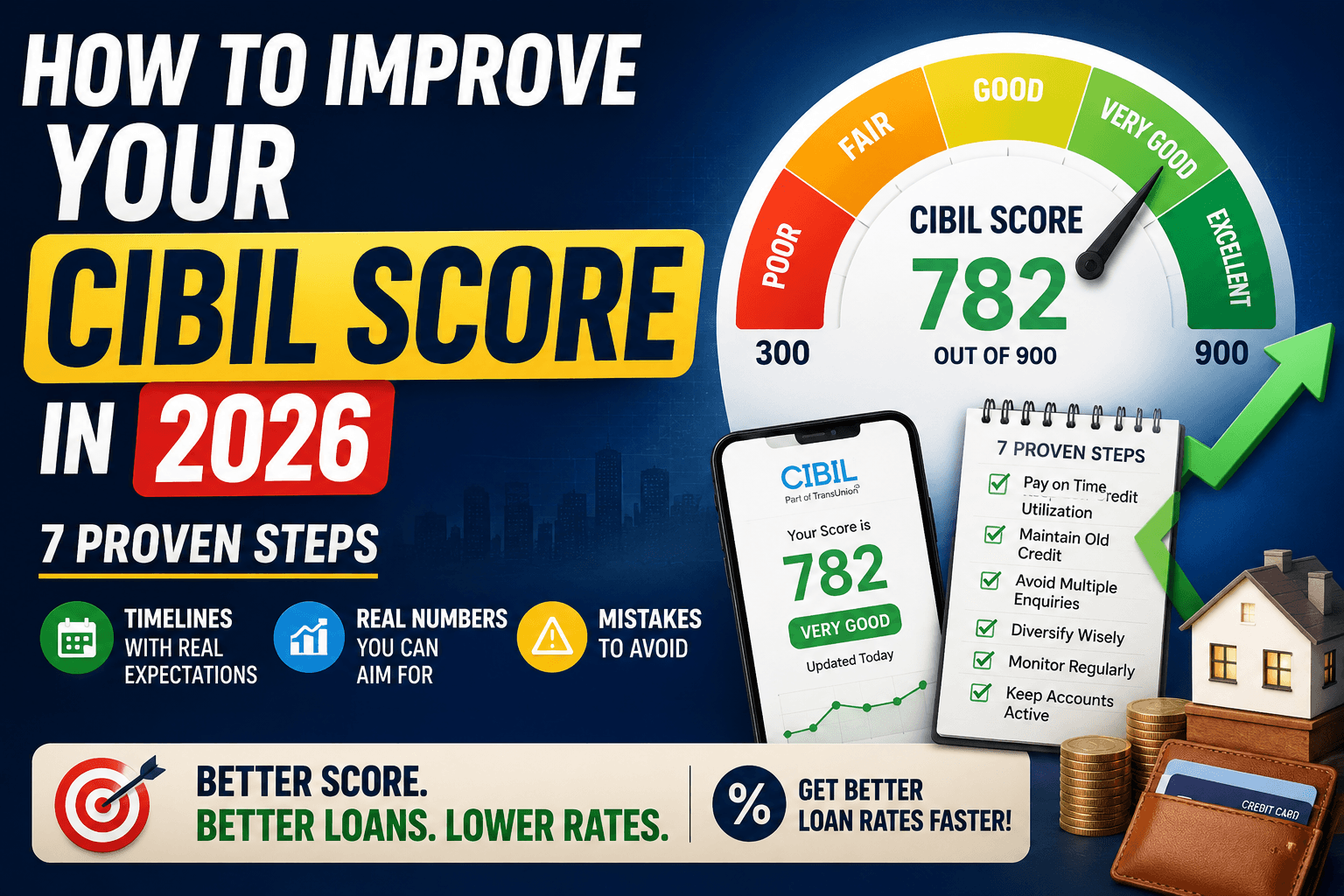
How to Improve Your CIBIL Score in 2026 — 7 Proven Steps (With Real Timelines)
By Satyapal Khakhal, Personal Finance Writer | Last Updated: 28 May 2026
This guide uses CIBIL score methodology documentation from TransUnion CIBIL, RBI guidelines on credit information, and data from India's four licensed credit bureaus — TransUnion CIBIL, Equifax, Experian, and CRIF High Mark. All timelines are estimates based on typical credit recovery patterns. Individual results vary based on specific credit history and lender reporting cycles. gpaisa.in is not a SEBI-registered advisor and this article is for informational purposes only.
I have seen this happen more times than I can count: someone applies for a home loan or a premium credit card, gets rejected or offered a rate 1.5% higher than advertised, and only then checks their CIBIL score. It is 680. Or 710. They had no idea.
A CIBIL score is not just a number on a report. At 750+, you qualify for SBI home loans at 8.75%. At 700, you pay 9.25–9.50%. On a ₹60 lakh loan over 20 years, that 0.50% difference costs you approximately ₹4.2 lakh more in total interest. A credit card with airport lounge access, zero forex markup, and ₹10,000+ in annual rewards is available only above 750. Below 700, the best cards you can access are entry-level with capped benefits.
The good news: CIBIL scores are entirely within your control, and the factors that move them are well understood. This guide tells you exactly what to do, in what order, and how long each step actually takes to show results on your report.
How CIBIL Scores Work: The Foundation You Need to Understand
Your CIBIL score runs from 300 to 900. Lenders in India treat the following ranges differently:
| Score range | Rating | What it means in practice |
|---|---|---|
| 750–900 | Excellent | Best loan rates, premium credit cards, instant approvals |
| 700–749 | Good | Most loans approved, rates 0.25–0.75% higher than best |
| 650–699 | Fair | Loans approved with conditions, higher rates, limited card options |
| 600–649 | Poor | Rejections common, NBFCs only, very high rates |
| Below 600 | Very poor | Most lenders decline, requires secured credit to rebuild |
Your score is calculated from five factors. Understanding the weightage tells you exactly where to focus your effort:
| Factor | Approximate weightage | What it measures |
|---|---|---|
| Payment history | ~35% | Whether you pay EMIs and credit card bills on time |
| Credit utilisation | ~30% | How much of your available credit limit you use |
| Credit age | ~15% | How long your credit accounts have been active |
| Credit mix | ~10% | Balance of secured (home/auto loan) vs unsecured (credit cards) credit |
| New credit enquiries | ~10% | How many times lenders have checked your score recently |
Payment history and credit utilisation together account for approximately 65% of your score. This means two actions — paying on time and reducing your utilisation — will move your score more than anything else. The other three factors matter but are slower to influence.
Step 1: Get Your Full CIBIL Report and Audit It for Errors
Before you can improve your score, you need to know exactly what is in your report — because errors are more common than most people realise. A 2023 study by the RBI ombudsman noted that credit report inaccuracies were among the most frequent financial complaints from consumers.
You are entitled to one free CIBIL report per year at cibil.com. For continuous monitoring, CIBIL charges ₹550/year for monthly updates. Alternatively, apps like OneScore, CRED, and Paisabazaar provide free credit score checks (they pull from CIBIL, Experian, or Equifax depending on the platform).
When you get your report, check for these specific errors:
- Accounts you do not recognise — could indicate identity fraud or a data entry error linking someone else's account to your PAN
- Loans marked as active that you have fully repaid — lenders sometimes fail to update the "closed" status, which artificially increases your outstanding debt
- Missed payments incorrectly reported — you paid on time but the lender's system shows a delay due to a processing lag
- Duplicate accounts — the same loan appearing twice inflates your outstanding balance
- Wrong personal details — incorrect PAN, address, or date of birth can cause your file to be merged with another person's
- Settled accounts shown as "written off" — "settled" (you paid less than the full amount) and "written off" (lender gave up on recovery) are both negative, but written off is worse and sometimes applied incorrectly
If you find an error, raise a dispute directly on the CIBIL website under "Dispute Centre." CIBIL is legally required to investigate and respond within 30 days. The lender will be contacted to verify the information. If the lender confirms the error, CIBIL updates your report — this can add 20–50 points immediately for significant errors like a wrongly marked missed payment.
Timeline: Error correction takes 30–45 days after dispute submission. Do this first — it costs nothing and can be the fastest score improvement available to you.
Step 2: Pay Every Bill on Time — Without Exception
Payment history is 35% of your CIBIL score. A single missed payment on a credit card or EMI can drop your score by 50–100 points. A payment that is 90+ days overdue (classified as NPA — Non-Performing Asset) can drop it by 100–150 points and stays on your report for 7 years.
The impact is asymmetric: building a good payment history takes years of consistent on-time payments, but a single miss can erase months of progress in one reporting cycle.
The practical system that eliminates missed payments:
- Set up auto-pay for the minimum amount due on every credit card, immediately. This ensures you never miss a payment even if you forget to manually pay. You can always pay more manually — the auto-pay is just protection against accidental misses.
- Set EMI payment reminders 3 days before the due date — not the day of. Banks sometimes take 1–2 business days to process NACH debits, and a processing delay on the due date itself can result in a reported late payment.
- Do not close the auto-pay mandate when your credit card is near its limit. A returned auto-pay due to insufficient funds is treated the same as a missed payment.
- Check your payment due dates after any bank system change — mergers, new banking platforms, or card replacements occasionally reset auto-pay mandates without notification.
Timeline: Each on-time payment is reported to CIBIL within 30–45 days. After 6 consecutive on-time payments, the pattern begins to positively influence your score. Full benefit of a clean payment history takes 12–24 months of consistent payments to show maximum impact.
Step 3: Reduce Your Credit Utilisation Below 30%
Credit utilisation ratio — how much of your total available credit limit you are using — accounts for approximately 30% of your CIBIL score. This is the fastest-moving factor in your score, because it is recalculated every time your lender reports your balance to CIBIL (typically monthly).
The target is below 30% overall, and below 30% on each individual card. If your combined credit limit across all cards is ₹3,00,000 and your outstanding balance at statement generation is ₹1,20,000 — your utilisation is 40%, which actively hurts your score. Reducing that outstanding to ₹80,000 brings you to 26.6% — into the healthy zone.
Practical ways to reduce utilisation:
- Pay your credit card balance before the statement generation date, not just by the payment due date. CIBIL records the balance as of statement generation — if you carry ₹90,000 on a ₹1,00,000 limit card for 25 days and pay it off on day 26 (the due date), your reported utilisation was still 90% for that month. Pay before statement generation to show a lower balance.
- Request a credit limit increase on your existing cards without increasing spending. If your limit goes from ₹1,00,000 to ₹1,50,000 but your spending stays at ₹30,000, your utilisation drops from 30% to 20% instantly. Most banks offer limit increases after 6–12 months of good repayment history — request it through net banking or the bank app.
- Distribute spending across multiple cards rather than concentrating on one. Two cards with 25% utilisation each score better than one card at 50% utilisation even if the total outstanding is identical.
- Do not close old credit cards to "simplify" your finances. Closing a card reduces your total available credit limit, which increases your utilisation ratio even if your spending does not change. An old unused card with zero balance is actively helping your score by keeping your available limit high.
Timeline: Utilisation improvements reflect within 30–45 days of the next statement cycle. Reducing utilisation from 60% to below 30% can add 30–60 points within 2 billing cycles.
Step 4: Stop Applying for Multiple Loans and Cards Simultaneously
Every time you apply for a credit card, personal loan, or any credit product, the lender makes a "hard enquiry" on your CIBIL report. This is recorded and visible to all future lenders. Each hard enquiry reduces your score by approximately 5–10 points and stays on your report for 2 years.
The problem compounds when you apply to multiple lenders in a short period — which many people do, shopping around for the best rate. Five loan applications in one month means five hard enquiries, which can knock 30–50 points off your score and signals to lenders that you are in financial distress and urgently seeking credit.
The correct approach to loan shopping:
- Use eligibility checkers before applying. Most banks — HDFC, SBI, ICICI, Axis — offer online eligibility checks that use "soft enquiries" which do not affect your CIBIL score. Use these to shortlist 1–2 lenders before making a formal application.
- Apply to only one lender at a time. If rejected, wait 90 days before applying elsewhere. Multiple applications within 30 days are heavily penalised.
- Avoid applying for credit you do not need. Pre-approved credit card offers, personal loan top-ups, and "instant loan" pop-ups all trigger hard enquiries if you proceed. A pre-approved offer means the bank has pre-screened you — accepting it still creates a hard enquiry on your file.
- Check your score before major applications. Know where you stand before you apply — if your score is 700, applying for an HDFC Infinia (requires 750+) will result in rejection and a hard enquiry that further damages your score.
Timeline: Enquiry impact reduces after 12 months and disappears from calculation after 24 months. The quickest recovery is simply to stop making new applications for 6–12 months while building the other positive factors.
Step 5: Build Credit Age — Do Not Close Your Oldest Accounts
Credit age — the average age of all your credit accounts — accounts for approximately 15% of your score. Older credit relationships signal stability and trustworthiness to lenders. Closing old accounts, even ones you no longer use, reduces your average credit age and can negatively impact your score.
The most common mistake: closing a credit card that was your first card, obtained 8 years ago, because you now have better cards. Closing it wipes out those 8 years of credit history from the average age calculation and removes the positive payment history associated with that account.
What to do instead:
- Keep old credit cards active with occasional small purchases. Use them once every 3–6 months for a small transaction and pay immediately. This keeps the account active without annual fee triggers and maintains the credit age benefit.
- If an old card has a high annual fee you want to avoid, ask the bank for a downgrade to a no-fee variant rather than closure. Many banks offer free basic cards (like SBI SimplySave → SBI SimplyCLICK) that preserve the account age while eliminating the fee.
- Do not rush to close credit accounts after paying off a loan. A closed home loan account with a perfect repayment history continues to positively influence your score for years even after closure — the closed status itself is fine. What you should not close is active revolving credit (credit cards) that are in good standing.
Timeline: Credit age improves automatically with time. The only action required is to not close old accounts — the benefit accrues passively as long as the accounts remain open and in good standing.
Step 6: Maintain a Healthy Mix of Secured and Unsecured Credit
Credit mix accounts for approximately 10% of your CIBIL score. Lenders view borrowers with both secured credit (home loan, car loan — backed by an asset) and unsecured credit (credit cards, personal loans) as more creditworthy than those with only one type. The reasoning: someone who has successfully managed a home loan EMI for years alongside a credit card demonstrates broader financial management capability.
This does not mean you should take loans you do not need to improve your credit mix. But it does mean:
- If you have only credit cards and no loan history, taking a small personal loan (even a short-tenure one for a planned purchase) and repaying it on time adds secured credit history to your profile.
- If you have only a home loan and no credit card, getting a credit card and using it responsibly significantly strengthens your mix.
- A credit card against a fixed deposit (secured credit card) is an excellent tool for people with no credit history at all — it builds the profile without requiring an unsecured approval and without the risk of overspending since the limit is backed by your own FD.
Secured credit cards for building credit history: HDFC MoneyBack+ against FD, SBI Unnati Card against SBI FD, and ICICI Bank Coral Credit Card against ICICI FD are commonly used. The FD of ₹20,000–₹50,000 gets the card approved regardless of existing credit score, and 12 months of on-time payments on this card can move a score from 600 to 680+ and set the foundation for better unsecured products.
Timeline: Adding a new credit type shows impact after 6–12 months of repayment history on the new account.
Step 7: Resolve Any Settled or Written-Off Accounts
If your CIBIL report shows any account marked "settled" (you paid less than the full outstanding through a settlement with the lender) or "written off" (lender charged off the debt), these are severe negative marks that significantly suppress your score and remain on your report for 7 years.
Many people are unaware that a credit card settlement from years ago is still actively hurting their score. Others have genuinely forgotten about small unpaid dues from an old phone connection or a retail store card.
How to address these:
- For "settled" accounts: Contact the original lender, pay the remaining outstanding balance (the amount waived in the settlement), and request a "No Dues Certificate" and a written confirmation that they will update the CIBIL status from "Settled" to "Closed." Get this in writing. Then raise an update request with CIBIL attaching the lender's confirmation. A "Settled" account upgraded to "Closed/Fully Paid" removes one of the most damaging marks on your report.
- For "written off" accounts: More complex — the debt may have been sold to a collection agency. Obtain the current outstanding from CIBIL report, contact the lender or collection agency, negotiate and pay, and follow the same process for status update. "Written off" accounts that are subsequently fully paid still show as "Closed — Written Off" rather than a clean closure, but the damage to your score reduces significantly once the account is resolved.
- For small unknown dues: Check the CIBIL report for lenders you do not recognise. Telecom companies (old Airtel/Vodafone postpaid dues), retail store credit (Bajaj Finance EMI cards), and small NBFC personal loans sometimes appear that borrowers have genuinely forgotten. These are often small amounts — ₹2,000 to ₹10,000 — that are cheap to resolve and remove a significant negative mark.
Timeline: Once a settled/written-off account is resolved and the lender updates CIBIL, the score impact improves within 45–60 days. The account will still show in your history but the status change from negative to resolved can add 40–80 points depending on the severity of the original mark.
Realistic Score Improvement Timelines
One of the most common misconceptions about CIBIL scores is that they can be improved quickly. They cannot — genuinely. The factors that move scores most (payment history, credit age) are built over months and years, not days. Anyone offering "instant CIBIL score improvement" for a fee is misleading you.
Here is what realistic improvement looks like for different starting positions:
| Starting score | Primary actions | Score after 6 months | Score after 12 months | Score after 24 months |
|---|---|---|---|---|
| 750+ (already good) | Maintain — pay on time, keep utilisation below 30% | 750–780 | 760–800 | 780–820 |
| 700–749 | Fix errors + reduce utilisation + stop new enquiries | 720–750 | 740–770 | 760–800 |
| 650–699 | Above + resolve any settled accounts | 670–710 | 700–740 | 730–770 |
| 600–649 | All steps + secured credit card to rebuild | 630–660 | 660–700 | 700–740 |
| Below 600 | All steps + 12+ months of clean payment history required | 620–640 | 650–680 | 690–730 |
These are realistic ranges based on consistent action. Starting from a very low score with defaults or written-off accounts takes longer. Error corrections can accelerate improvement significantly.
What Does NOT Improve Your CIBIL Score
As important as knowing what works is knowing what does not — because there is significant misinformation about CIBIL improvement, and acting on bad advice can actively make things worse.
- Checking your own score does not hurt it. Self-checks are "soft enquiries" with zero impact. Check as often as you want.
- Closing credit cards does not improve your score. Closing cards reduces available credit (increasing utilisation) and reduces credit age. Both are negative.
- Paid services promising to "fix" or "delete" negative items cannot do what they claim if those items are accurate. CIBIL cannot delete accurate negative information — only the lender can, and only if there was a genuine error. These services take fees for actions you can do yourself for free.
- Taking a personal loan to "build credit" when you have high credit card utilisation makes things worse — you are adding a new liability before reducing existing debt, and the application creates a hard enquiry.
- Salary increases do not directly affect CIBIL scores. CIBIL does not track income — only credit behaviour. A higher salary improves debt-to-income ratio which affects loan eligibility, but not the CIBIL score calculation itself.
- Using debit cards and UPI has zero impact on CIBIL scores. Only credit products (credit cards, loans, overdrafts) are reported to credit bureaus.
The Compound Effect: What a Good CIBIL Score Is Actually Worth
The financial benefit of a 750+ CIBIL score is not abstract — it translates to real rupees. Here is the actual value across common financial products:
| Product | CIBIL 700 | CIBIL 750+ | Financial difference |
|---|---|---|---|
| Home loan ₹60L, 20 years | 9.25% → EMI ₹54,912 | 8.75% → EMI ₹52,823 | ₹5.02 lakh total interest saved |
| Car loan ₹8L, 5 years | 10.5% → EMI ₹17,157 | 9.0% → EMI ₹16,607 | ₹33,000 total interest saved |
| Personal loan ₹5L, 3 years | 16% → EMI ₹17,579 | 12% → EMI ₹16,607 | ₹34,992 total interest saved |
| Credit card access | Entry/mid-tier cards only | Premium cards: HDFC Regalia, Axis Atlas class | ₹10,000–₹30,000 in annual rewards/benefits |
On a home loan alone, the difference between a 700 and 750+ score is worth over ₹5 lakh in total interest. That is more than most people earn in 2–3 months. The 12–24 months of disciplined credit behaviour required to move from 700 to 750+ is an investment with a very clear and measurable return.
Your Action Plan: What to Do This Week
Rather than trying to implement all seven steps at once, here is a sequenced action plan:
This week: Get your free CIBIL report from cibil.com. Read it completely. Note any errors, any settled accounts, any accounts you do not recognise.
Week 2: Raise disputes for any errors found. Set up auto-pay for the minimum amount on every credit card. Calculate your current credit utilisation and identify which card or cards are above 30%.
Month 1: Pay down the highest-utilisation card first. Request a credit limit increase on your oldest card if you have had it for 12+ months with clean payment history. Stop all unnecessary credit applications.
Month 2–3: If you have any settled or written-off accounts, contact those lenders and begin the resolution process. This takes time but has significant score impact once resolved.
Month 4–6: Review your report again. Dispute resolution should be reflected. Utilisation reduction should show. Continue making every payment on time without exception.
Month 6–12: If you started below 650, consider adding a secured credit card from your primary bank to build an additional positive payment history. Continue everything else. By month 12 of clean behaviour, you should see a meaningful improvement from your starting score.
Frequently Asked Questions
How long does it take to improve a CIBIL score from 650 to 750?
Typically 12–18 months of consistent on-time payments, reduced credit utilisation below 30%, and no new hard enquiries. If your report has errors that can be corrected, it can happen faster. If there are settled or written-off accounts, resolving them is essential and adds 3–6 months to the timeline.
Does checking my CIBIL score reduce it?
No. Checking your own score is a "soft enquiry" and has absolutely no impact on your CIBIL score. You can and should check it regularly. Only "hard enquiries" — made by lenders when you apply for credit — affect your score.
What is the minimum CIBIL score for a home loan in India?
Most major banks (SBI, HDFC, ICICI) require a minimum of 650–700 to approve a home loan, but you only qualify for the best advertised rates above 750. Some NBFCs may approve below 650 but at significantly higher rates (10.5–12% vs 8.75–9.0%). A 750+ score is the threshold that unlocks genuinely competitive home loan offers.
Can I improve my CIBIL score without a credit card?
Yes — consistent repayment of any loan (home loan, car loan, personal loan, education loan) builds payment history. However, credit cards are the most efficient tool because you can control utilisation precisely and demonstrate consistent monthly repayment without taking on long-term debt. If you do not have a credit card, consider a secured card against an FD as the starting point.
Does a loan rejection affect my CIBIL score?
A rejection itself does not affect your score, but the hard enquiry made by the lender before rejecting does — by approximately 5–10 points. Applying to multiple lenders after a rejection (to find one who will approve) creates multiple hard enquiries in quick succession, which compounds the damage. Wait 90 days after any rejection before reapplying.
How do I remove a settled account from my CIBIL report?
A settled account cannot be deleted if it is accurate — but it can be upgraded. Pay the remaining outstanding, obtain written confirmation from the lender, and request them to update the status to "Closed" with CIBIL. Once updated, the account remains in your history but as "Closed" rather than "Settled" — which significantly reduces its negative impact on your score.
What CIBIL score do I need for HDFC Regalia or Axis Atlas credit card?
Premium credit cards in India typically require 750+ CIBIL score. HDFC Regalia, Axis Atlas equivalent cards (HSBC TravelOne, Axis Reserve), and similar premium travel cards generally will not be approved below 750, and even then income eligibility requirements must also be met. Below 750, mid-tier options like HDFC MoneyBack, SBI SimplyCLICK, or ICICI Coral are more realistic targets while you build your score.
Use our calculators: Home Loan EMI Calculator | FD Calculator | SIP Calculator
Related reading: Best Credit Cards in India 2026 | HDFC Pixel Play Credit Card Review | Home Loan vs Rent in India 2026
Disclaimer: This article is for informational and educational purposes only and does not constitute financial or credit advice. CIBIL score calculation methodologies, lender criteria, and credit product eligibility are subject to change. All timelines and score improvement ranges are estimates based on typical patterns — individual results vary. Please verify all credit information directly with TransUnion CIBIL and the relevant lenders. gpaisa.in is not registered with SEBI and does not provide personalised financial advice.