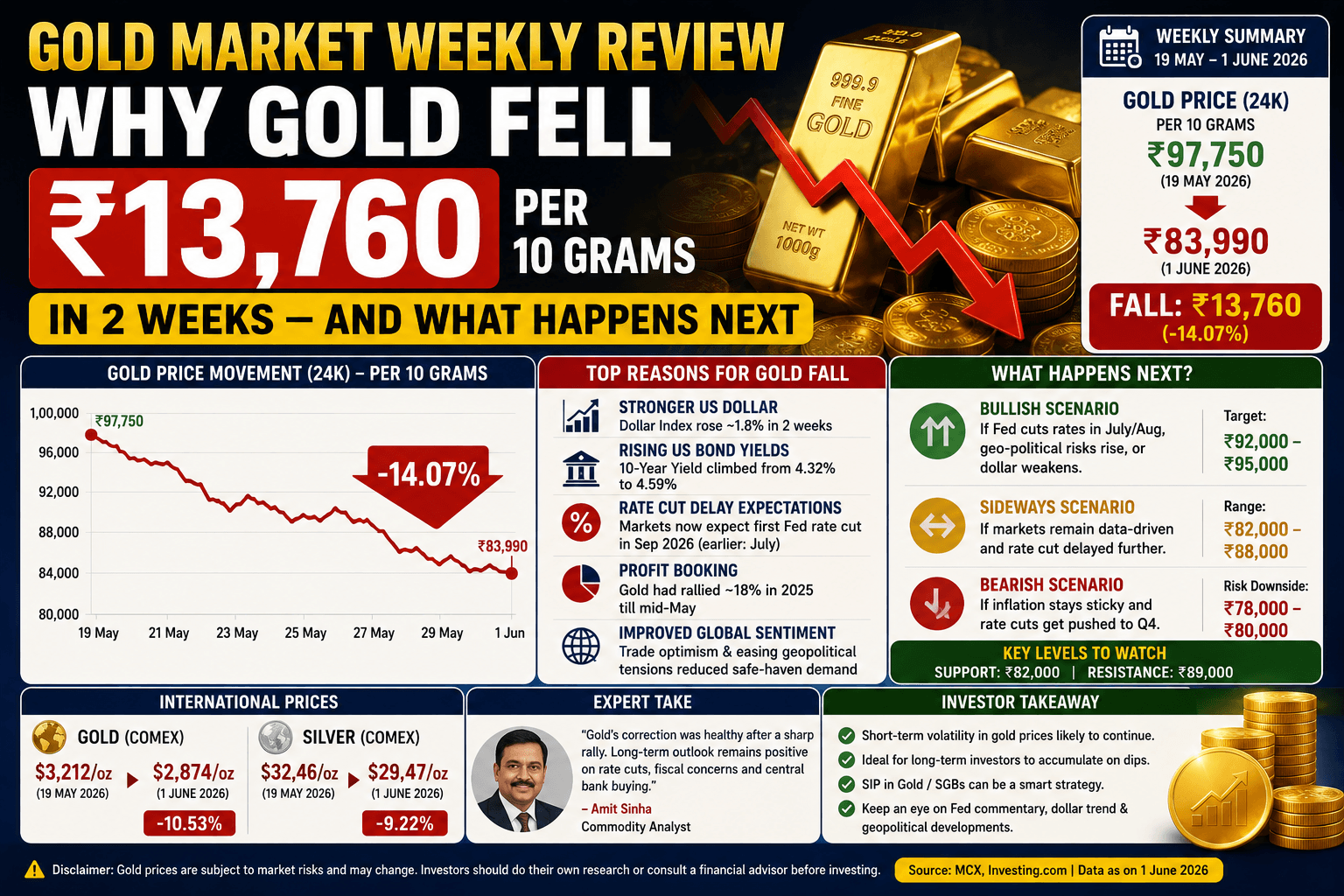
Gold Market Weekly Review (June 7–14, 2026): Why Gold Fell ₹13,760 Per 10 Grams and What Happens Next
By Satyapal Khakhal, Personal Finance Writer | Published: 14 June 2026
Price data sourced from IBJA, MCX, BullionVault, and Goodreturns as of June 14, 2026. Global gold price in USD from JM Bullion spot data. US economic data from Bureau of Labor Statistics. Fed policy data from CME FedWatch Tool. This article is for informational purposes only. gpaisa.in is not registered with SEBI.
Gold investors in India have had a difficult two weeks. The metal that opened June at ₹1,59,590 per 10 grams in Delhi has dropped to ₹1,45,830 on June 13 — a fall of ₹13,760 in just 13 days. For someone holding 100 grams of gold, that is ₹1,37,600 of paper loss in under a fortnight.
Today — June 14 — gold has bounced back ₹3,400 to ₹1,49,230 per 10 grams in Delhi. But the question every Indian gold investor and buyer is asking is the same: what caused this sharp fall, is the worst over, and what should I do now?
Here is the complete picture — every factor that drove gold lower this week, with real data and what it means for Indian buyers.
Gold Price Performance: June 1–14, 2026
| Date | 24K Gold Delhi (₹/10g) | Global Gold (USD/oz) | Change from previous day |
|---|---|---|---|
| June 1, 2026 | ₹1,59,590 | ~$4,480 | Month opening |
| June 5, 2026 | ~₹1,53,200 | $4,315 | −3.5% (payrolls shock day) |
| June 8, 2026 | ~₹1,52,800 | $4,316 | Flat — consolidating |
| June 13, 2026 | ₹1,45,830 | ~$4,200 | Monthly low |
| June 14, 2026 (today) | ₹1,49,230 | $4,224 | +₹3,400 recovery |
Prices from IBJA, MCX and Goodreturns. Delhi prices include local state levies. Data as of June 14, 2026.
In global terms, gold has now fallen approximately 24% from its all-time high of $5,589 per ounce reached on January 28, 2026. In India, the fall from the June 1 opening of ₹1,59,590 to the June 13 low of ₹1,45,780 represents an 8.6% decline in just two weeks. Gold has also closed below its 200-day moving average for the first time since October 2023 — a technically bearish signal that traders are watching closely.
The 5 Factors That Drove Gold Lower This Week
Factor 1 — The US Payrolls Shock (The Primary Driver)
The single biggest blow to gold this week came from an unexpected source: the US labour market.
On June 6, the US Bureau of Labor Statistics released the May 2026 Non-Farm Payrolls report. The number: 172,000 jobs added — exactly double what Wall Street economists had forecast. April's figure was also revised upward.
Why does a US jobs number matter for Indian gold prices? Because a strong US labour market means the Federal Reserve is less likely to cut interest rates — and more likely to raise them. Higher US interest rates make the US dollar more attractive to global investors, pulling money out of gold and into dollar-denominated assets.
The immediate market reaction was violent:
- Gold fell 3.5% to $4,315 on June 5 — its lowest price since March 2026
- US stock markets opened sharply lower — worst weekly drop since late March
- Silver fell to below $69.50/oz — lowest since end-March
- Government bond prices fell, pushing yields to their highest in 2 weeks
The payrolls number essentially erased all of gold's 2026 gains in a single trading session. BullionVault reported that gold "erased its year-to-date gains" on the day of the release.
Factor 2 — Fed Rate Hike Expectations Surge
Before the payrolls report, markets had been pricing in a small possibility of Federal Reserve rate cuts at upcoming meetings. After 172,000 jobs — double consensus — those expectations reversed completely.
According to CME FedWatch data as of June 9, 2026:
- 99.4% probability: Fed keeps rates unchanged at June 16–17 FOMC meeting
- 70% probability: At least one rate hike by December 2026
This matters enormously for gold. Gold earns no interest — it competes with interest-bearing assets like US Treasury bonds. When the probability of rate hikes rises, Treasury yields rise, and gold becomes relatively less attractive. Investors reduce gold exposure and move into higher-yielding assets.
Adding to the uncertainty: June 16–17 marks the first FOMC meeting chaired by Kevin Warsh, the new Federal Reserve Chair. Markets are uncertain what tone Warsh will set. Any hint of hawkishness — more aggressive rate hikes — would push gold lower. Any dovish signal could trigger a rally.
Factor 3 — US Inflation at 4.2% — Highest Since April 2023
The May 2026 US Consumer Price Index (CPI) released on June 10 showed inflation at 4.2% year-on-year — the highest reading since April 2023, driven almost entirely by a 23.5% surge in energy prices tied to the ongoing Iran conflict.
Normally, high inflation is good for gold — it pushes investors toward inflation hedges. But this inflation reading created a confusing signal for gold:
- The energy-driven inflation cannot be fixed by the Fed raising rates (the Fed cannot lower oil prices)
- Core CPI — which strips out food and energy — came in at 2.9%, slightly below estimates
- Bond markets understood this distinction: Treasury yields barely moved after the CPI release
- But the headline 4.2% number gave the Fed political cover to maintain a hawkish stance
The result was an unhelpful environment for gold: inflation high enough to justify Fed hawkishness, but not high enough to drive safe-haven demand into gold strongly.
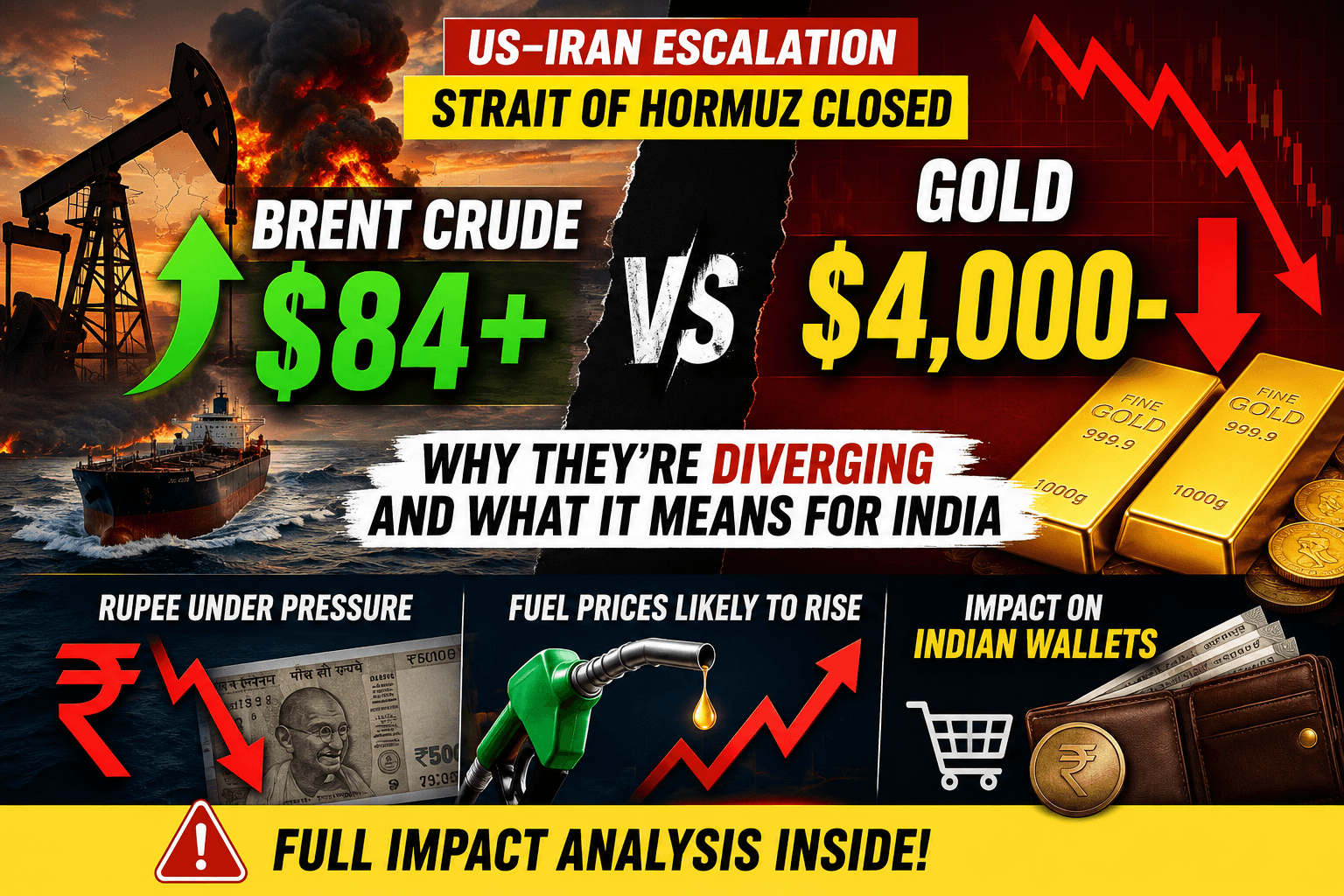
Factor 4 — Iran Conflict: Oil Up, Risk Sentiment Mixed
The ongoing Iran conflict has had a paradoxical effect on gold in June 2026. It drove oil prices sharply higher — which fed into the energy-driven CPI spike described above. But its impact on gold has been complex.
Since the Iran conflict began, gold has actually dropped nearly 18% from the levels reached at the conflict's onset. This counterintuitive pattern has surprised many analysts who expected geopolitical risk to push gold higher.
The explanation: the Iran conflict drove oil higher → which pushed US inflation higher → which made the Fed more hawkish → which strengthened the dollar → which pushed gold lower. The chain of effects moved against gold despite the surface-level expectation that geopolitical uncertainty should support it.
Global jewellery demand has also weakened significantly. World Gold Council data for Q1 2026 showed jewellery demand down 24% globally from Q4 2025 — India down 18%, China down 32%, Middle East down 23%. High prices are suppressing buying demand from gold's two largest consumer markets.
Factor 5 — Strong Dollar Hitting Indian Gold Prices
The US dollar strengthened sharply following the payrolls data and rising rate hike expectations. A stronger dollar creates a direct headwind for Indian gold prices through two channels:
Channel 1 — International prices: Gold is priced globally in US dollars. A stronger dollar makes gold more expensive in dollar terms relative to other assets, which suppresses dollar gold demand and prices.
Channel 2 — Rupee conversion: When the dollar strengthens against the rupee, the same dollar gold price converts to more rupees. With USD/INR at approximately ₹95.6, any dollar weakening would provide relief to Indian gold prices — but dollar strength compounds the pain.
For Indian gold buyers, the net effect has been a double impact: lower global gold prices in dollars AND a relatively stable-to-weak rupee, which has kept the INR gold price from falling as much as the dollar price would suggest.
Why India's Gold Price Fell Less Than the Global Price
An interesting pattern in the June 2026 gold correction: Indian gold prices have fallen less sharply in percentage terms than global dollar prices. Here is why:
| Market | Peak (Jan 28, 2026) | June 13, 2026 | Decline |
|---|---|---|---|
| Global (USD/oz) | $5,589 | ~$4,200 | −24.9% |
| India (₹/10g, Delhi) | ~₹1,85,000 (estimated Jan peak) | ₹1,45,830 | ~−21.2% |
| India (₹/10g, June correction only) | ₹1,59,590 (June 1) | ₹1,45,830 (June 13) | −8.6% |
The buffer comes from the rupee — a weaker rupee means importing the same dollar gold costs more rupees, partially offsetting the dollar price decline. India's import duty structure also adds a floor to domestic prices that the international market does not have.
Today's Recovery — What Caused the ₹3,400 Bounce on June 14
Gold recovered ₹3,400 today — Delhi price moving from ₹1,45,830 to ₹1,49,230. In global terms, spot gold is at $4,224.41 as of today's early trading.
The bounce is driven by:
- Technical buying: Gold had fallen to significant support levels and attracted bargain hunters who see the current price as oversold
- Position ahead of FOMC: Some investors are re-entering gold positions ahead of the June 16–17 Federal Reserve meeting, betting that Warsh may strike a less hawkish tone than feared
- Dollar stabilisation: The dollar's strength paused, allowing gold to recover partially
- Physical buying in India: At these lower prices, some jewellers and retail buyers re-entered the market after sitting on the sidelines since the June correction began
Whether this bounce sustains or is temporary depends almost entirely on what the Fed signals at its June 16–17 meeting.
The Critical Event Next Week: FOMC June 16–17
The June 16–17 Federal Reserve FOMC meeting is the single most important event for gold in the near term. Markets currently price a 97–99% probability that rates will be held unchanged. The rate decision itself is unlikely to surprise.
What matters is the tone of Kevin Warsh's post-meeting press conference — his first as Fed Chair. Three scenarios:
| Warsh scenario | What he says | Expected gold reaction |
|---|---|---|
| Hawkish | "We are prepared to raise rates if inflation persists" | Gold falls further — possible test of $4,000/oz |
| Neutral | "We will remain data-dependent, watching CPI and employment" | Gold consolidates at current levels — limited movement |
| Dovish | "The energy-driven inflation is not structural — we see no need for hikes" | Gold rallies — possible move back toward $4,400–$4,500/oz |
The base case among analysts is neutral-to-slightly-hawkish — which suggests gold may remain under pressure through June before stabilising.
Central Bank Gold Buying: The Long-Term Positive
Amidst the short-term price pressure, one structural positive for gold remains intact: central bank buying. World Gold Council data shows central banks bought a net 244 tonnes in Q1 2026 — above both the prior quarter and the five-year average. In April, central banks returned to net buying with 17 tonnes. China has added to its gold reserves for 18 consecutive months, making April its largest purchase since December 2024. Poland's National Bank has accumulated 45 tonnes year-to-date, now at 595 tonnes (30% of total holdings), working toward a 700-tonne target.
This central bank demand provides a structural floor for gold that retail selling and Fed-driven corrections have historically not permanently breached.
What Should Indian Gold Investors and Buyers Do Right Now?
If you were planning to buy for a near-term need (wedding, gift in next 3 months):
The current correction — gold at ₹1,45,000–₹1,50,000 range per 10g in Delhi — represents a genuine discount from the June 1 opening of ₹1,59,590. Buying in tranches (one-third now, one-third in two weeks, one-third after the FOMC outcome is clear) reduces the risk of buying at either the top or the absolute bottom.
If you hold existing gold:
The 24% fall from the January ATH of $5,589 has been painful on paper. However, gold at $4,224 globally and ₹1,49,230/10g in India is still 30%+ higher than where it was 12 months ago. Long-term holders should note that J.P. Morgan's current year-end 2026 gold price target is $6,000/oz — implying 42% upside from current levels if their forecast proves correct.
If you are a systematic gold SIP investor:
Continue the SIP. Corrections are precisely when rupee-cost averaging works in your favour — your fixed monthly amount buys more grams when prices are lower. Stopping a gold SIP during a 10–15% correction has historically been a poor decision that retail investors repeatedly regret.
If you are considering a large one-time purchase:
Wait for the FOMC outcome on June 17 before committing a large lump sum. The Fed meeting will set the direction for gold through July. If Warsh is hawkish, better prices may be available after the meeting. If dovish, acting before the meeting would have been optimal. Given this uncertainty, partial positions now and after the meeting is the lower-risk approach.
Frequently Asked Questions
Why did gold fall so much this week in India?
Five factors combined: a US jobs report showing 172,000 jobs added (double expectations), rising Fed rate hike probability to 70% by December 2026, US inflation at a 3-year high of 4.2%, dollar strength following the payrolls data, and weak jewellery demand from India and China. Gold in Delhi fell from ₹1,59,590 on June 1 to ₹1,45,830 on June 13 — a decline of ₹13,760 per 10 grams.
Is this a good time to buy gold in India?
The current ₹1,45,000–₹1,50,000 range per 10g in Delhi represents an 8–9% discount from the June 1 level. However, the FOMC meeting on June 16–17 could push prices lower (if hawkish) or trigger a rally (if neutral or dovish). Buying in tranches before and after the FOMC reduces timing risk for near-term buyers. For long-term investors, the structural case for gold remains intact given central bank buying and geopolitical uncertainty.
What will happen to gold prices after the Fed meeting on June 16–17?
Markets price a 97% probability of no rate change. The direction of gold depends on Fed Chair Kevin Warsh's tone in the press conference. Hawkish language (suggesting potential rate hikes) would pressure gold. Neutral or dovish language would support a recovery. The base case is neutral-to-hawkish, suggesting gold may consolidate near current levels through June before recovering.
How much has gold fallen from its all-time high in 2026?
Global gold peaked at $5,589 per ounce on January 28, 2026. It is currently at approximately $4,224 — a decline of 24.4% from the all-time high. In India, the peak in January was approximately ₹1,85,000 per 10 grams; it currently trades at ₹1,49,230 in Delhi — approximately 19% below the January peak.
What is the gold price today in major Indian cities?
As of June 14, 2026: Delhi — ₹1,49,230/10g; Mumbai — approximately ₹1,48,590/10g; Chennai/Coimbatore — approximately ₹1,51,200/10g (Tamil Nadu consistently records the highest prices). Check gpaisa.in's live gold rate page for your city's current price updated in real time.
See live rates: Gold Rate Today India | Gold Rate Delhi | Gold Rate Mumbai | Gold Rate Bangalore
Related reading: Why Falling Rupee Makes Gold Expensive | Gold ETF vs Physical Gold vs SGB in 2026 | Gold vs FD — Which is Better?
Disclaimer: Gold price data in this article is sourced from IBJA, MCX, BullionVault, Goodreturns, and JM Bullion as of June 14, 2026 and may have changed since publication. This article is for informational and educational purposes only and does not constitute investment advice. Gold investment carries market risk. Please consult a SEBI-registered financial advisor before making investment decisions. gpaisa.in is not registered with SEBI. Past gold price performance is not indicative of future returns.