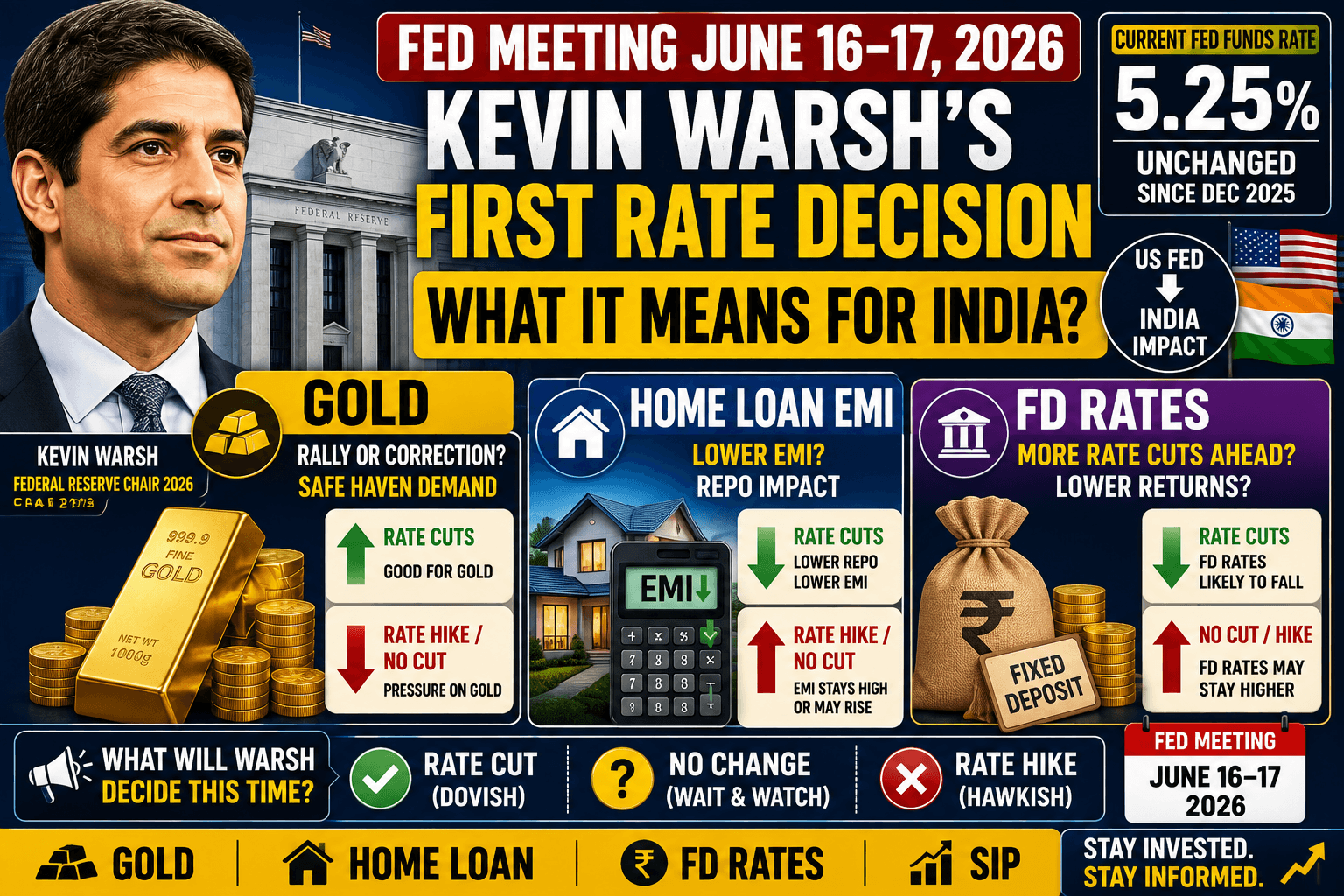
Fed Meeting June 16–17, 2026: What Kevin Warsh's First FOMC Decision Means for Gold, Home Loan EMI and FD Rates in India
By Satyapal Khakhal, Personal Finance Writer | Published: 14 June 2026
FOMC data from CME FedWatch Tool, Conference Board, and EskiSignal FOMC Preview as of June 14, 2026. Fed funds rate data from Federal Reserve official website. Gold price from IBJA and MCX. Impact analysis is illustrative — financial markets are inherently unpredictable. This article is for informational purposes only. gpaisa.in is not registered with SEBI.
In approximately 48 hours — on Wednesday, June 17, 2026 at 11:30 PM IST — the United States Federal Reserve will announce its latest interest rate decision. For most Indians, an American central bank meeting might seem distant and irrelevant. But the June 16–17 FOMC meeting will directly affect the price of gold you are considering buying, the EMI on your home loan, the interest rate on your FD renewal, and the performance of your SIP portfolio.
This meeting carries extra weight for two reasons. First, it is Kevin Warsh's inaugural FOMC meeting as the new Federal Reserve Chair — replacing Jerome Powell. Markets do not know yet how Warsh will communicate or what tone he will set. Second, it includes an updated dot plot — the Fed's projection of where interest rates are headed — which has not been revised since March 2026, before the Iran conflict drove oil prices sharply higher.
Here is everything Indian investors need to know before the decision drops Wednesday night.
What Is the FOMC and Why Does It Matter for India?
The Federal Open Market Committee is the monetary policy arm of the US Federal Reserve — America's central bank. Eight times a year, it meets to decide whether to raise, cut, or hold the US federal funds rate — the benchmark interest rate for the world's largest economy.
This rate matters for India through four direct channels:
| Channel | How it connects to India | Your financial product affected |
|---|---|---|
| Gold prices | Higher US rates → stronger dollar → gold falls globally → India gold cheaper in USD but rupee impact varies | Gold jewellery, Gold ETF, SGB |
| USD/INR exchange rate | Higher US rates attract capital to USD → rupee weakens → imported gold costs more in rupees | Gold, crude oil, import-driven inflation |
| RBI policy | RBI watches Fed closely — if Fed signals rate hikes, RBI may pause its own rate cuts to protect the rupee | Home loan EMI, car loan, FD rates |
| Indian equity markets | Fed hawkishness typically triggers FPI outflows from Indian equities → Nifty falls → SIP NAV drops temporarily | Mutual fund SIP, ELSS |
What the Fed Is Expected to Do on June 17
The base case — held by virtually every major institution — is no rate change. The federal funds rate will remain at 3.50%–3.75%, where it has been since December 2025.
| Institution | June 17 prediction | Year-end 2026 view |
|---|---|---|
| CME FedWatch Tool (market consensus) | Hold at 3.50%–3.75% (92%+ probability) | 70% probability of at least one rate hike by December |
| JPMorgan | Hold | Gold target $6,000/oz by Q4 2026 |
| Conference Board | Hold — easing bias likely removed from statement | Dot plot may show zero cuts in 2026 |
| Former Fed officials survey (Kiplinger/Duke) | Hold | 17 of 32 expect a rate hike will be appropriate in 2026 |
| Goldman Sachs | Hold | Commerzbank target $4,800 year-end |
Sources: CME FedWatch Tool June 9, 2026; Conference Board FOMC Preview June 13, 2026; Kiplinger Fed Meeting Coverage June 14, 2026.
The rate decision itself is unlikely to surprise. What matters enormously is what Kevin Warsh says in his 2:30 PM ET press conference (midnight IST, June 17–18) and what the updated dot plot reveals about where FOMC members see rates going in the second half of 2026.
The Dot Plot — The Number That Will Actually Move Markets
The dot plot is a chart showing each of the 19 FOMC members' anonymous projections for where the federal funds rate should be at year-end 2026 and 2027. The March 2026 dot plot showed the median member expected one rate cut of 0.25% in 2026.
Since March, two things have changed significantly:
- The Iran conflict drove oil and energy prices sharply higher, pushing US CPI to 4.2% in May — highest since April 2023
- May payrolls came in at 172,000 — double consensus — showing a strong labour market
If most FOMC members revise their dot plot to show zero cuts in 2026 — or worse, show that one or more members now expect a rate hike — markets could react sharply. This is the scenario most likely to push gold lower and strengthen the dollar.
Conversely, if the dot plot still shows at least one cut expected in 2026, it would be seen as dovish relative to expectations — supporting a gold recovery.
Kevin Warsh's First Press Conference — What to Watch For
Kevin Warsh is not just a new Fed Chair — he is a known critic of the Fed's communication style and a historically more hawkish voice than Jerome Powell. His first press conference on June 17 will set the tone for how the Fed communicates for years.
Four specific things that will move Indian financial markets:
1. How he describes the Iran-driven inflation: If Warsh calls it "transitory" or "supply-driven" (language suggesting the Fed won't fight it with rate hikes), gold could rally. If he calls it a "sustained inflation risk," gold falls.
2. Whether he removes the "easing bias": The FOMC statement for the past three meetings has contained language suggesting rates could be cut. The Conference Board expects this easing language to be removed — replacing it with neutral language. Neutral = negative for gold short-term.
3. Any mention of rate hikes: Markets currently price 70% probability of a rate hike by December. If Warsh explicitly opens the door to hikes, gold could fall ₹3,000–₹5,000 per 10 grams within 48 hours. If he explicitly closes that door, gold could recover ₹5,000–₹8,000 from current levels.
4. Communication style change: Warsh is expected to revamp how the Fed communicates. A clearer, more direct style could reduce market uncertainty — which is historically positive for gold as a hedge against uncertainty.
Three Scenarios and What Each Means for Your Money
Scenario A — Hawkish Surprise (Probability: 20–25%)
Dot plot shows zero cuts or a rate hike signal. Warsh explicitly mentions rates may need to rise if Iran-driven inflation persists.
| Asset | Expected impact | Magnitude |
|---|---|---|
| Gold (India, per 10g) | Falls | ₹3,000–₹6,000 decline from ₹1,49,230 |
| USD/INR | Rupee weakens | ₹95.6 → ₹97–₹98 possible |
| Nifty 50 | Falls | 1–2% immediate reaction |
| Home loan rates (India) | Upward pressure | RBI may signal rate pause or hike in August |
| FD rates (India) | May stabilise or rise | Banks stop cutting deposit rates |
Scenario B — Neutral as Expected (Probability: 55–60%)
Hold confirmed. Easing bias removed but no explicit rate hike guidance. Dot plot shows zero cuts in 2026 but no hike projections.
| Asset | Expected impact | Magnitude |
|---|---|---|
| Gold (India, per 10g) | Small recovery | ₹1,000–₹2,000 uptick from current ₹1,49,230 |
| USD/INR | Stable | Stays near ₹95.6 |
| Nifty 50 | Flat to slightly positive | No major reaction |
| Home loan rates (India) | Unchanged | Current 8.50% SBI rate holds |
| FD rates (India) | Unchanged | Post Office 7.50% remains the best option |
Scenario C — Dovish Surprise (Probability: 15–20%)
Dot plot still shows one cut in 2026. Warsh characterises Iran-driven inflation as temporary and not requiring a policy response.
| Asset | Expected impact | Magnitude |
|---|---|---|
| Gold (India, per 10g) | Rallies | ₹5,000–₹8,000 recovery toward ₹1,57,000 |
| USD/INR | Rupee strengthens | ₹95.6 → ₹93–₹94 possible |
| Nifty 50 | Rallies | 1–2% positive reaction |
| Home loan rates (India) | Downward pressure | RBI rate cut path reopens |
| FD rates (India) | May fall further | Banks resume lowering deposit rates |
What Does This Mean for RBI and Your Home Loan?
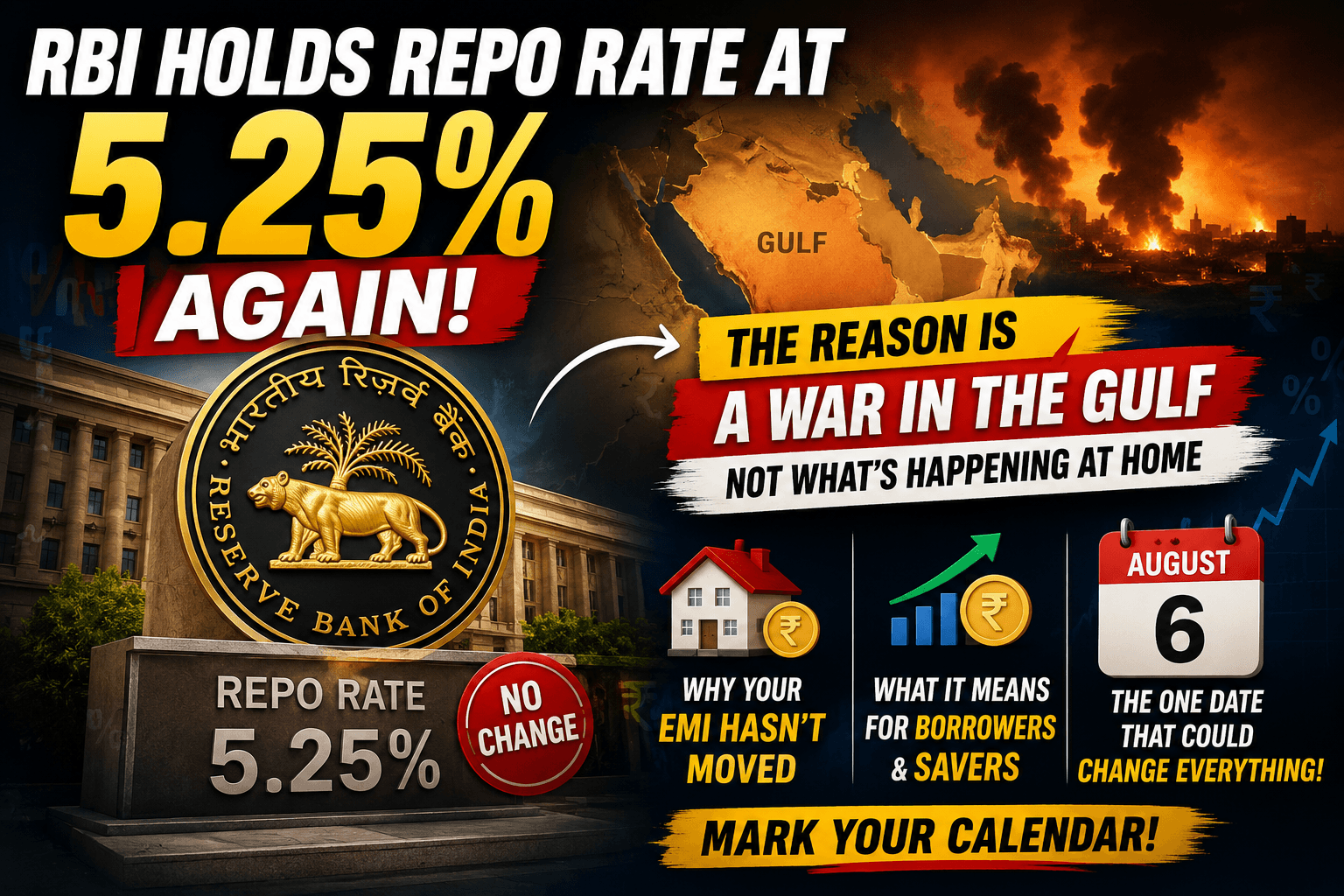
India's RBI has already cut rates by 125 basis points since February 2025, bringing the repo rate to 5.25%. The RBI's next MPC meeting is in August 2026. Whether they cut, hold, or signal a hike depends significantly on what the Fed does this week.
The transmission works like this: if the Fed signals rate hikes, the interest rate differential between the US and India narrows. A narrower differential makes Indian assets less attractive to foreign investors, causing capital outflows and rupee depreciation. To protect the rupee, the RBI may need to pause its own rate cuts — or even consider a hike.
For existing home loan borrowers on floating EBLR-linked rates: the base case (neutral Fed) means your EMI is unlikely to change through August. A hawkish surprise could delay the next RBI cut, keeping EMIs at current levels longer. A dovish surprise could accelerate another RBI cut — potentially reducing your EMI further.
Use gpaisa.in's Home Loan Calculator to model your EMI at different rate scenarios.
What Does This Mean for Gold Buyers in India?
Gold in Delhi is currently at ₹1,49,230 per 10 grams — down from the June 1 high of ₹1,59,590. The FOMC decision on June 17 will set the direction for the next 4–6 weeks of gold price movement.
Practical guidance for different buyer profiles:
Wedding purchase planned in next 30 days: The risk of a hawkish surprise pushing gold another ₹3,000–₹5,000 lower is real. But so is the risk of a dovish surprise pushing it ₹5,000–₹8,000 higher. Splitting your purchase — 50% before June 17 decision, 50% after — reduces your exposure to either scenario. Current levels (₹1,48,000–₹1,50,000) are meaningfully below the June 1 high.
Investment gold purchase for 3–5 years: The FOMC timing matters less for a multi-year horizon. JP Morgan's year-end target of $6,000/oz implies significant upside from current $4,224 levels regardless of this week's Fed tone. For long-term investors, current prices represent a 25% discount from January's all-time high.
Existing gold SIP investor: Continue. Monthly SIP averaging means you benefit from lower prices this month — your fixed rupee amount buys more grams. The FOMC outcome does not change the long-term case for gold SIP.
What Does This Mean for FD Investors?
The current best FD rates in India — Post Office 5-year at 7.50%, SBI at 6.25%, HDFC at 6.35% — were set during India's own rate cut cycle. If the Fed's hawkish tone causes the RBI to pause rate cuts, FD rates may stabilise near current levels rather than falling further.
The implication for FD investors: locking in longer-tenure FDs now — before any potential rate rise scenario removes current rates — may be the more conservative strategy. Post Office 5-year TD at 7.50% remains the best government-backed rate available, and it has been unchanged through eight consecutive quarterly reviews. See our detailed Best FD Rates June 2026 comparison for the full picture.
Key Times to Watch on June 17
| Event | US time (ET) | India time (IST) |
|---|---|---|
| FOMC rate decision released | 2:00 PM ET | 11:30 PM IST (June 17–18 midnight) |
| Updated dot plot released | 2:00 PM ET | 11:30 PM IST |
| Kevin Warsh press conference begins | 2:30 PM ET | 12:00 AM IST (June 18) |
| MCX gold market opens (India reaction) | — | 9:00 AM IST June 18 |
| Nifty 50 opens (Indian equity reaction) | — | 9:15 AM IST June 18 |
The most important signals will come from Warsh's tone in the press conference — not the rate decision itself. Indian investors waking up on June 18 should check the MCX gold opening rate and gpaisa.in's live gold rate page before making any buying or selling decisions.
Frequently Asked Questions
Will the Fed cut rates on June 17, 2026?
No — markets price a 92%+ probability of a hold at 3.50%–3.75%, unchanged since December 2025. The rate decision is almost certain to be a hold. What matters is the updated dot plot showing where FOMC members see rates going in H2 2026 and Warsh's tone in his press conference.
How will the FOMC decision affect gold prices in India on June 18?
A hawkish Warsh (signalling potential rate hikes) could push gold ₹3,000–₹6,000 lower. A neutral outcome (hold with no explicit hike guidance) may see gold flat or slightly up. A dovish surprise could trigger a ₹5,000–₹8,000 rally from current ₹1,49,230 levels. The dot plot update will be the key trigger — watch for whether the median projection still shows one cut or shifts to zero cuts.
Will the Fed decision affect RBI and Indian home loan rates?
Not immediately. The Fed is widely expected to leave policy rates unchanged, which means no immediate pressure on RBI. However, if Warsh signals a hawkish shift or the dot plot shows rate hike expectations, the RBI may postpone its next rate cut (currently expected at the August 2026 MPC meeting) to protect the rupee from capital outflows.
Who is Kevin Warsh and why does his first meeting matter?
Kevin Warsh presides over his first FOMC meeting as Chair on June 16–17. He is known for a more hawkish stance than Powell and is expected to revamp the Fed's communication style. Markets are uncertain how he will frame the Iran-driven inflation — as temporary or as a structural risk requiring policy action. His tone will set expectations for Fed communication for years ahead.
What is the dot plot and why does it matter for gold?
The dot plot shows each of the 19 FOMC members' projections for where the federal funds rate should be at year-end. The March 2026 dot plot projected one 25 bps cut in 2026. If May CPI prints hot, members may revise cut expectations away. A shift from one expected cut to zero expected cuts — or a hike projection — would be read as hawkish and could push gold lower. A dot plot showing cuts still expected would be positive for gold.
Check live rates after the decision: Live Gold Rate India | FD Calculator | Home Loan Calculator
Related: Gold Weekly Review: Why Gold Fell ₹13,760 This Week | RBI Repo Rate 5.25% — Impact on EMI and FD | Best FD Rates June 2026
Disclaimer: Financial market predictions in this article are based on analyst consensus data as of June 14, 2026. Actual FOMC decisions and market reactions may differ significantly from scenarios described. This article is for informational and educational purposes only and does not constitute financial or investment advice. Gold, equity, and currency markets carry significant risk. Please consult a SEBI-registered financial advisor before making investment decisions. gpaisa.in is not registered with SEBI.