PPF vs ELSS vs Tax-Saving FD: Best Section 80C Investment in 2026
By Satyapal Khakhal, Personal Finance Writer | Last Updated: 6 June 2026
PPF interest rate from Ministry of Finance notification (April–June 2026). ELSS return data from AMFI India and Value Research as of May 2026. Tax-saving FD rates from official bank websites. Tax provisions from Income Tax Act as applicable for FY 2026-27. This article is for informational purposes only. gpaisa.in is not registered with SEBI.
Critical 2026 Update — Read This First: Section 80C deductions are available ONLY under the old tax regime. The new tax regime — which has been the default since FY 2024-25 — does not allow Section 80C deductions including PPF, ELSS, and Tax-Saving FDs. If you have opted for the new regime, this entire comparison does not apply to your tax situation. Verify which regime you are filing under before making any 80C investment decision.
Every year between January and March, millions of Indian salaried employees scramble to complete their Section 80C investments before the financial year deadline. The same three options come up every time — PPF, ELSS, and Tax-Saving FD. And every year, people make the same decision based on habit rather than analysis.
The right answer depends on four variables specific to your situation: your tax bracket, your investment horizon, your risk tolerance, and how much of your 80C limit is already consumed by other instruments like EPF, life insurance premiums, and home loan principal repayment. This article works through each variable with real 2026 numbers so you can make the decision correctly for your specific profile.
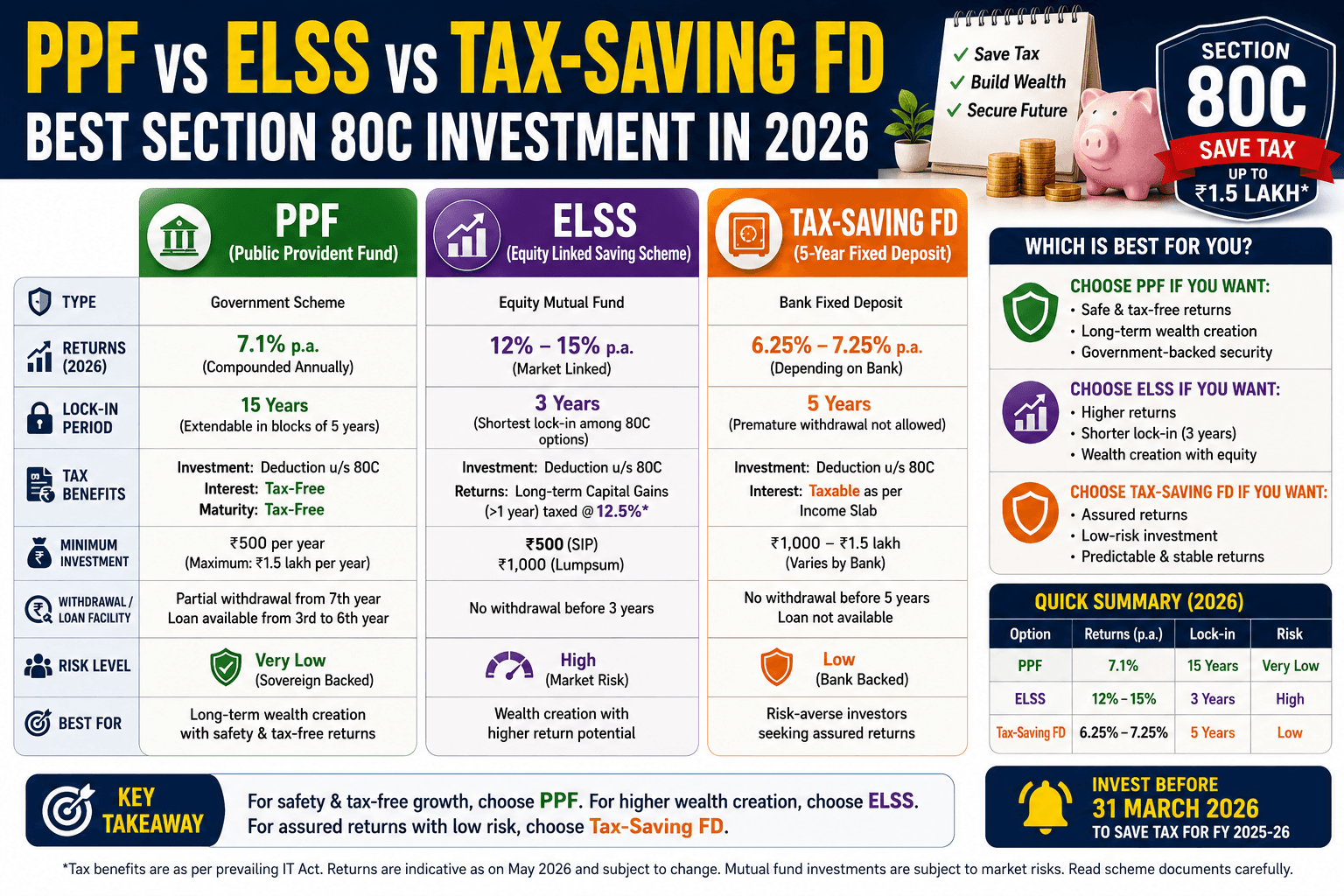
Quick Reference: The Three Options at a Glance
| Feature | PPF | ELSS | Tax-Saving FD |
|---|---|---|---|
| Current return rate | 7.1% p.a. (guaranteed) | 12–15% CAGR (historical, not guaranteed) | 6.25–7.50% p.a. (guaranteed) |
| Lock-in period | 15 years (partial withdrawal from year 7) | 3 years (mandatory) | 5 years (mandatory) |
| 80C deduction limit | Up to ₹1.5 lakh/year | Up to ₹1.5 lakh/year | Up to ₹1.5 lakh/year |
| Returns taxable? | No — fully exempt (EEE) | 10% LTCG above ₹1.25 lakh/year | Yes — interest taxed at slab rate |
| Risk level | Zero (government backed) | High (equity market linked) | Zero (DICGC insured up to ₹5L) |
| Minimum investment | ₹500/year | ₹500/month SIP | ₹100 (most banks) |
| Loan against investment | Yes (from year 3) | No (lock-in) | Yes (most banks) |
| Premature withdrawal | Partial from year 7 only | Not allowed during 3-year lock-in | Not allowed |
| Best suited for | Conservative, long-term, tax-free corpus | Aggressive, 7+ year horizon, wealth creation | Conservative, 5-year need, guaranteed returns |
The Tax Regime Question: The Most Important Factor Nobody Discusses
Before comparing PPF, ELSS, and Tax-Saving FD with each other, you need to answer one question: are you filing under the old tax regime or the new tax regime?
The new tax regime became the default from FY 2024-25. Under the new regime, Section 80C deductions — for all instruments including PPF, ELSS, and Tax-Saving FD — are not available. If you have opted for the new regime, the tax-saving benefit of these instruments disappears completely.
| Tax regime | 80C deduction available? | Implication |
|---|---|---|
| Old tax regime (opted in) | Yes — up to ₹1.5 lakh | Full 80C analysis applies. Choose based on returns and lock-in. |
| New tax regime (default) | No | PPF and ELSS still make sense as investments but NOT for tax saving. Tax-Saving FD becomes pointless — a regular FD is strictly better (no lock-in, same rate). |
For a salaried employee in the 30% tax bracket on the old regime, the ₹1.5 lakh deduction saves ₹46,800 in tax (₹1,50,000 × 31.2% including cess). This is the real monetary value of 80C — your effective return on any 80C instrument includes this upfront tax saving, which changes the comparison significantly.
For someone in the 20% bracket, the saving is ₹31,200. For the 10% bracket, ₹15,600. The higher your tax bracket, the more the upfront tax saving tilts the comparison in favour of any 80C instrument over its non-80C equivalent.
PPF in 2026: The Safe Foundation
The Public Provident Fund is India's oldest and most trusted tax-saving instrument. It has been around since 1968 and has never missed an interest payment. For conservative investors who want a guaranteed, tax-free return with government backing, PPF remains the gold standard.
Current PPF Details — June 2026
| Parameter | Current value |
|---|---|
| Interest rate (April–June 2026) | 7.1% p.a. (compounded annually) |
| Minimum annual contribution | ₹500 |
| Maximum annual contribution | ₹1,50,000 |
| Account tenure | 15 years (extendable in 5-year blocks) |
| Partial withdrawal | Allowed from year 7 onwards (up to 50% of balance) |
| Loan facility | Year 3–6 (up to 25% of balance two years prior) |
| Tax treatment | EEE — Exempt at investment, Exempt on interest, Exempt at maturity |
| Where to open | Post Office, SBI, HDFC, ICICI, Axis, and most scheduled banks |
What ₹1.5 lakh/year in PPF actually grows to:
| Years | Total invested | Maturity at 7.1% (approx) | Tax-free interest earned |
|---|---|---|---|
| 5 years | ₹7,50,000 | ₹8,89,587 | ₹1,39,587 |
| 10 years | ₹15,00,000 | ₹21,48,452 | ₹6,48,452 |
| 15 years (maturity) | ₹22,50,000 | ₹40,68,209 | ₹18,18,209 |
| 20 years (extended) | ₹30,00,000 | ₹66,58,288 | ₹36,58,288 |
| 25 years (extended) | ₹37,50,000 | ₹1,03,08,015 | ₹65,58,015 |
Calculations assume 7.1% rate throughout. PPF rate is reviewed quarterly by the Finance Ministry and can change. Past rate history shows rates between 6.40% and 12% over the last 30 years.
PPF's real strength is the EEE tax treatment. Every rupee of interest earned is tax-free — unlike FD interest (taxed at slab rate) and ELSS gains (10% LTCG above ₹1.25 lakh). For someone in the 30% bracket, a 7.1% tax-free return from PPF is equivalent to a 10.3% pre-tax return. No bank FD or debt instrument in India offers 10.3% — making PPF genuinely competitive on a post-tax basis despite its modest headline rate.
PPF's main drawback is the 15-year lock-in. Your money is largely inaccessible for 15 years. Partial withdrawal from year 7 helps, but PPF is not suitable if you might need the money in under 10 years. It is also not suitable if you need to create significant wealth — at 7.1%, PPF cannot beat inflation-adjusted equity returns over long periods.
ELSS in 2026: The High-Return, High-Risk Option
Equity Linked Savings Scheme (ELSS) funds are diversified equity mutual funds with a mandatory 3-year lock-in that qualify for Section 80C deduction. They are the only 80C instrument that invests in equities — and therefore the only one capable of delivering inflation-beating double-digit returns over long periods.
The 3-year lock-in is the shortest of any 80C instrument — shorter than PPF (15 years), Tax-Saving FD (5 years), NSC (5 years), and NPS (till retirement). This makes ELSS the most liquid long-term 80C option for investors who may need access after 3 years.
Best ELSS Funds in India — June 2026
| Fund | 3-year CAGR | 5-year CAGR | Expense ratio (direct) | AUM |
|---|---|---|---|---|
| Mirae Asset Tax Saver Fund | ~18% | ~20% | 0.53% | ₹25,000+ crore |
| Quant Tax Plan | ~28% | ~32% | 0.57% | ₹10,000+ crore |
| Canara Robeco Equity Tax Saver | ~16% | ~19% | 0.61% | ₹8,000+ crore |
| HDFC Tax Saver | ~20% | ~20% | 0.98% | ₹15,000+ crore |
| Axis Long Term Equity Fund | ~13% | ~15% | 0.67% | ₹32,000+ crore |
| DSP Tax Saver Fund | ~17% | ~19% | 0.81% | ₹15,000+ crore |
Returns as of May 2026, direct plan, growth option. Source: Value Research, AMFI India. Past performance does not indicate future returns.
What ₹1.5 lakh/year in ELSS grows to (historical 12% CAGR assumption):
| Years | Total invested | Value at 12% CAGR | Value at 15% CAGR | LTCG tax (approximate) |
|---|---|---|---|---|
| 3 years (minimum) | ₹4,50,000 | ₹6,36,398 | ₹6,97,219 | ~₹18,640 (12%) / ~₹24,722 (15%) |
| 5 years | ₹7,50,000 | ₹12,11,552 | ₹14,23,498 | ~₹46,155 (12%) / ~₹67,350 (15%) |
| 10 years | ₹15,00,000 | ₹29,96,923 | ₹40,92,211 | ~₹1,49,692 (12%) / ~₹2,59,221 (15%) |
| 15 years | ₹22,50,000 | ₹62,07,906 | ₹1,00,98,072 | ~₹3,95,791 (12%) / ~₹7,84,807 (15%) |
LTCG calculated at 10% on gains above ₹1.25 lakh per year on equity instruments. Actual tax depends on gains realised in that financial year across all equity investments. Consult a tax advisor.
The ELSS advantage is compounding at equity returns over long periods. At 15% CAGR over 15 years, ₹22.5 lakh invested becomes over ₹1 crore — a corpus that PPF at 7.1% cannot match (PPF delivers ₹40.7 lakh on the same investment). The gap widens dramatically over longer horizons.
The ELSS risk is equity volatility. ELSS funds can fall 30–50% in market corrections. The 3-year lock-in means you cannot exit during a crash — which is actually a behavioural advantage (prevents panic selling) but psychologically difficult. ELSS investors must genuinely accept that their investment may be worth less than what they put in during the lock-in period, and must have the conviction to hold through that.
Tax-Saving FD in 2026: The Simple Option
Tax-Saving Fixed Deposits — also called 5-year Tax Saving FDs — are regular bank FDs with a mandatory 5-year lock-in that qualify for Section 80C deduction. They are the simplest 80C instrument available: fixed rate, guaranteed return, no market risk, available at every bank branch.
Current Tax-Saving FD Rates — June 2026
| Bank | General rate (5 year) | Senior citizen rate |
|---|---|---|
| Post Office (5-year TD) | 7.50% | 7.50% (same rate) |
| SBI (Tax Saving FD) | 6.25% | 7.05% (WeCare scheme) |
| HDFC Bank | 6.40% | 6.90% |
| ICICI Bank | 6.10% | 6.60% |
| Axis Bank | 6.25% | 6.75% |
| Bank of Baroda | 6.50% | 7.15% |
| Yes Bank | 6.50% | 7.00% |
Rates as of May 2026. Verify on official bank websites before investing. Post Office 5-year TD has the same features and tax benefits as bank Tax-Saving FDs.
What ₹1.5 lakh in a Tax-Saving FD actually returns after tax:
| Bank / Rate | Maturity (5 years) | Interest earned | Tax on interest (30% bracket) | Net post-tax return |
|---|---|---|---|---|
| Post Office TD (7.50%) | ₹2,16,219 | ₹66,219 | ₹19,866 | ₹46,353 (net) → 5.48% effective |
| HDFC Bank (6.40%) | ₹2,05,513 | ₹55,513 | ₹16,654 | ₹38,859 (net) → 4.69% effective |
| SBI (6.25%) | ₹2,03,948 | ₹53,948 | ₹16,184 | ₹37,764 (net) → 4.56% effective |
Interest calculated with quarterly compounding. Post-tax return is the effective annual yield after 30% income tax on interest earned. Actual tax depends on total income and other factors.
This table reveals the most important insight about Tax-Saving FDs: the post-tax return for investors in the 30% bracket is genuinely poor. After paying 30% tax on interest, the effective return on an HDFC 5-year Tax-Saving FD is only 4.69% per year — which is below the long-term average inflation rate of 5–6%. In real terms, a 30% bracket investor is losing purchasing power by holding a Tax-Saving FD.
For investors in the 10% bracket, the post-tax return is approximately 5.75% on HDFC FD — more acceptable, but still low compared to PPF's 7.1% fully tax-free.
The only scenario where Tax-Saving FD genuinely wins: Senior citizens who need guaranteed income, are in a lower tax bracket (income below ₹7 lakh after deductions), and want the simplest possible 5-year fixed return. The Post Office 5-year TD at 7.50% is particularly compelling for this profile.
The Real Comparison: Post-Tax, Post-Lock-In Returns
The only fair comparison adjusts for both taxes and lock-in period. Here is the comparison for ₹1.5 lakh invested in each instrument for an investor in the 30% tax bracket on the old regime:
| Instrument | Lock-in | Value after 5 years | Value after 15 years | Effective post-tax annual return |
|---|---|---|---|---|
| PPF (7.1%, tax-free) | 15 years | ₹2,12,924 | ₹4,06,821 | 7.1% (fully tax-free) |
| ELSS (12% CAGR assumed) | 3 years | ₹2,64,588 | ₹8,16,228 (after LTCG) | ~10.5% post-tax |
| ELSS (15% CAGR assumed) | 3 years | ₹3,01,856 | ₹14,52,265 (after LTCG) | ~13.2% post-tax |
| Tax-Saving FD HDFC (6.40%) | 5 years | ₹1,93,909 (after 30% tax) | N/A (reinvest at lower rates?) | 4.69% post-tax |
| Post Office TD (7.50%) | 5 years | ₹1,96,353 (after 30% tax) | N/A | 5.48% post-tax |
The numbers are stark. For a 30% bracket investor over 15 years, ELSS at even a modest 12% CAGR delivers ₹8.16 lakh from ₹1.5 lakh invested — versus PPF's ₹4.07 lakh and Tax-Saving FD's significantly less. The difference is the power of equity compounding over long periods.
The caveat is always risk. ELSS could deliver 8% over 15 years if markets underperform — in which case PPF wins. The historical equity return range in India is 10–18% CAGR over 15-year periods on the Nifty 50, with very few 15-year periods delivering below 10%. But past performance is not a guarantee.
The Section 80C Tax Saving: How It Changes the Real Return
Here is the calculation most people miss: the upfront tax saving from Section 80C is itself part of your return. When you invest ₹1.5 lakh in any 80C instrument on the old regime at 30% tax bracket, you save ₹46,800 in tax. This ₹46,800 is available for investment elsewhere — and it changes the effective cost of your 80C investment.
Effective cost of a ₹1.5 lakh 80C investment (30% bracket):
₹1,50,000 invested − ₹46,800 tax saved = ₹1,03,200 effective cost
From this perspective, you are investing ₹1,03,200 and receiving a return on ₹1,50,000 worth of growth. This makes even PPF's 7.1% significantly more attractive on an effective return basis — you are getting ₹4,06,821 at maturity from an effective outlay of ₹1,03,200.
This also changes how you should think about Tax-Saving FDs: yes, the interest is taxed, but the upfront ₹46,800 tax saving partially compensates — making the effective return better than the headline post-tax rate suggests. For conservative investors who value certainty, this calculation makes Tax-Saving FDs more reasonable than they initially appear.
Who Should Choose What: The Decision Matrix
| Profile | Best 80C choice | Why |
|---|---|---|
| 30% bracket, 15+ year horizon, equity-comfortable | ELSS (primary) + PPF (secondary) | Maximise long-term wealth while building tax-free safe corpus |
| 30% bracket, 10–15 year horizon, moderate risk | PPF (primary) + ELSS (partial) | Guaranteed tax-free base with equity upside |
| 20% bracket, any horizon, equity-comfortable | ELSS | Shortest lock-in, best long-term return potential |
| 10% bracket, conservative | PPF or Post Office TD | Low tax on FD interest reduces its disadvantage; PPF still better |
| Senior citizen, fixed income needed | Post Office 5-year TD (7.50%) or SBI WeCare FD | Guaranteed income, government-backed, senior citizen rate premium |
| New to investing, wants simplicity | PPF | One account, automatic compounding, no decisions needed |
| Has short investment horizon (under 5 years) | None of the three — all have 3–15 year lock-ins | Look at SCSS (Senior Citizen Savings Scheme), NSC, or liquid funds instead |
| New tax regime user | ELSS or PPF for returns — NOT for 80C saving | 80C deduction not available; invest based on return merit alone |
The Smart Strategy: Combine All Three
For most investors with the full ₹1.5 lakh 80C limit available, the optimal strategy is not choosing one instrument — it is allocating across all three based on goals:
Allocation suggestion for a 30% bracket salaried investor aged 30–40:
- EPF: Already consuming part of 80C limit automatically (typically ₹50,000–₹70,000/year for most salaried employees)
- ELSS SIP: ₹5,000–₹7,000/month for remaining limit — maximise equity compounding for long-term wealth
- PPF: Minimum ₹500/year to keep account active as a tax-free emergency corpus option after year 7
- Tax-Saving FD: Only if you have specific need for guaranteed returns in the 5-year window and are in 10% or lower bracket
For investors aged 50+: Shift allocation toward PPF and Tax-Saving FD — approaching retirement reduces your ability to ride out equity volatility. ELSS is less suitable when you are within 5–7 years of needing the money.
The One Trap to Avoid: Investing for 80C Alone
The biggest mistake Indian investors make with 80C is choosing instruments based purely on tax saving without considering the investment merit. A Tax-Saving FD at 6.40% that earns 4.69% post-tax is not a good investment for a 30% bracket investor — the ₹46,800 tax saving is real, but you could save the same tax through PPF or ELSS and get significantly better returns.
Conversely, investing in ELSS solely to save ₹46,800 in tax, without genuine tolerance for equity volatility and a minimum 5–7 year investment mindset, is a mistake. ELSS investors who panic and want to exit after the 3-year lock-in during a market correction make the worst possible decision — selling at a loss after the lock-in just as equity recovery typically begins.
The correct framework: choose the 80C instrument that serves your investment goals first. The tax saving is a bonus — not the primary reason to invest.
Use gpaisa.in's Calculators for Your Exact Numbers
Every figure in this article uses illustrative calculations. Your actual returns depend on your specific investment amounts, timing, and tax situation. Use these calculators for precise figures:
- gpaisa.in PPF Calculator — exact maturity for any annual contribution and rate
- gpaisa.in SIP Calculator — ELSS maturity at any assumed return rate
- gpaisa.in FD Calculator — Tax-Saving FD maturity with TDS calculation
Frequently Asked Questions
Which is better in 2026 — PPF or ELSS?
For investors with a 10+ year horizon and equity comfort, ELSS historically delivers significantly higher returns (12–15% CAGR vs PPF's 7.1%). For conservative investors who need guaranteed returns and full tax-free maturity, PPF is better. The best answer for most investors is both — ELSS as the primary 80C instrument for growth and PPF as a secondary safe corpus.
Is Section 80C available under the new tax regime in 2026?
No. Section 80C deductions including PPF, ELSS, and Tax-Saving FD are not available under the new tax regime which has been the default since FY 2024-25. If you have opted for the new regime, these instruments can still be used as investments — but they provide no tax deduction benefit. Verify which regime you are filing under with your employer or CA.
What is the current PPF interest rate in 2026?
7.1% per annum compounded annually for April–June 2026. The Finance Ministry reviews PPF rates quarterly — it has remained at 7.1% since April 2020. Check the Ministry of Finance notification before the start of each quarter for any revision.
Can I withdraw from ELSS before 3 years?
No. The 3-year lock-in on ELSS is mandatory and cannot be broken for any reason. Each SIP instalment has its own 3-year lock-in from the date of that specific investment — so a 12-month SIP in ELSS means the first instalment unlocks after 3 years but the 12th instalment unlocks 3 years after it was invested, not 3 years after you started.
Is Tax-Saving FD worth it in 2026?
For investors in the 30% tax bracket on the old regime, Tax-Saving FD delivers only 4.69–5.48% effective post-tax return — below PPF's 7.1% tax-free equivalent of 10.3% pre-tax. For conservative investors in the 10% bracket, it is more reasonable. Post Office 5-year TD at 7.50% is the best Tax-Saving FD rate currently available with government backing.
What is the maximum I can invest in ELSS for 80C?
You can invest any amount in ELSS but the Section 80C deduction is capped at ₹1.5 lakh across all instruments combined. Investment above ₹1.5 lakh in ELSS does not provide additional 80C deduction but is still a valid equity mutual fund investment subject to normal LTCG taxation rules.
Related reading: Best FD Rates India June 2026 | How to Improve Your CIBIL Score | SIP vs Gold 2026 | SIP Calculator
Disclaimer: Tax provisions, PPF interest rates, and ELSS return figures are subject to change. All return calculations in this article are illustrative based on assumptions stated. Past mutual fund returns do not indicate future performance. This article is for informational and educational purposes only and does not constitute tax or investment advice. Please consult a SEBI-registered financial advisor and a qualified CA before making investment decisions. gpaisa.in is not registered with SEBI.