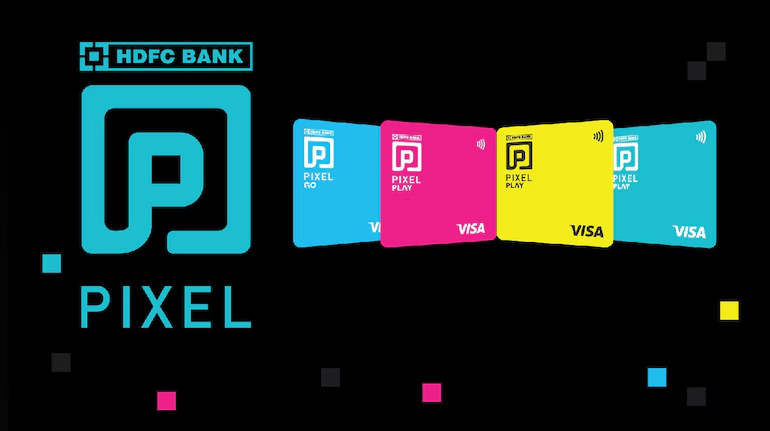
HDFC Pixel Play Credit Card Review (2026): Customisable Cashback, Real Earnings & Honest Verdict
By Satyapal Khakhal, Personal Finance Writer | Last Updated: 26 May 2026
I have been using the HDFC Pixel Play Credit Card personally and have earned cashback across multiple categories. This review is based on direct cardholder experience combined with publicly available card terms from HDFC Bank as of May 2026. gpaisa.in is not affiliated with HDFC Bank and receives no compensation for this review.
Most cashback credit cards in India make a choice for you. The HDFC Millennia gives you 5% on Amazon and Flipkart. The SBI Cashback card gives you 5% on all online spends. The HDFC Swiggy card gives you 10% on Swiggy. These are good cards — but their value is predetermined. If your spending does not match their fixed categories, you leave money on the table every month.
The HDFC Pixel Play Credit Card takes a different approach: it lets you choose which category earns 5% cashback, and you can change that choice every month. Spend heavily on dining this month? Pick dining. Planning a holiday next month? Switch to travel. Buying a new laptop? Select electronics. The flexibility is genuine — and in my experience using this card, it is the feature that makes it worth holding over most alternatives in its fee bracket.
This review covers how the category selection actually works in practice (not just in theory), what cashback I have personally earned, where the card falls short, and who should and should not apply.
HDFC Pixel Play Credit Card: Quick Overview
| Feature | Details |
|---|---|
| Joining fee | ₹500 + GST |
| Annual renewal fee | ₹500 + GST (waived on ₹1 lakh annual spend) |
| Card network | Visa |
| Cashback on chosen category | 5% (capped at ₹1,000/month) |
| Cashback on all other spends | 1% |
| Cashback type | Direct statement credit — no points conversion |
| Category change frequency | Once per month via HDFC app or website |
| Available categories | Dining, grocery, electronics, fashion/lifestyle, travel, fuel (surcharge waiver), entertainment, and others |
| Fuel surcharge waiver | 1% on transactions ₹400–₹5,000 |
| Foreign transaction markup | 3.5% |
| Welcome benefit | Cashback or voucher on first transaction (verify current offer on HDFC website) |
| Best suited for | Salaried professionals with variable monthly spending across categories |
The Core Feature: How Category Selection Actually Works
The Pixel Play's defining feature — choosing your own 5% cashback category — sounds almost too good to be simple. In practice, it is straightforward, but there are operational details that matter.
Each month, you log into the HDFC Bank app or netbanking portal and select one preferred category from the available list. Your selection applies to all transactions in that category for the remainder of that billing cycle. The 5% cashback on your chosen category is capped at ₹1,000 per month — meaning you earn maximum benefit on ₹20,000 of spending in that category. Beyond that cap, additional spending in the same category earns at the base 1% rate.
The category change window typically opens at the start of each billing cycle. You can change once per month — you cannot switch mid-month if you realise a different category would have been more profitable that week. This requires a small amount of planning: before each billing cycle begins, spend two minutes thinking about where your biggest discretionary expense will fall that month and select accordingly.
In practice, I have found the planning aspect takes almost no effort once you establish a habit. I check my upcoming month — if there is a trip planned, I select travel. If it is a normal month with regular restaurant meals, I select dining. During the October–November festive season, electronics or fashion typically makes sense for the big purchases. The flexibility genuinely delivers value because it follows your actual life rather than forcing you to change your behaviour to fit a fixed category.
Cashback I Have Personally Earned: Real Numbers
I want to be specific here because most credit card reviews either quote hypothetical examples or avoid numbers entirely. Here is what the card has actually delivered in my usage.
On months where I selected dining as my preferred category and spent approximately ₹8,000–₹12,000 at restaurants, I earned ₹400–₹600 in cashback from the dining category alone. At a ₹500 annual fee, that is the entire annual fee recovered in one good month of restaurant spending.
On a month where I was buying electronics — a laptop purchase — I switched to the electronics category and earned ₹850 cashback on that single transaction against the ₹1,000 cap. That month's cashback alone was worth more than the card's annual fee.
Base cashback on non-selected categories adds a consistent 1% across general spending — groceries, utility payments where eligible, online shopping outside the category selection. Over a month with ₹20,000 in non-category spending, this adds ₹200 to the statement credit automatically.
The cashback credits directly to your statement — you do not need to convert points, request redemption, or wait for a catalogue. It appears as a negative line item on your bill within a few days of qualifying transactions. This simplicity is something I genuinely appreciate compared to cards where you spend significant time tracking points expiry and redemption ratios.
The 5% Category in Detail: What Qualifies and What Does Not
Understanding exactly which transactions qualify for 5% within your chosen category matters more than most reviews acknowledge. HDFC defines category eligibility by merchant category codes (MCCs), not by how you mentally categorise a purchase.
Dining: Covers restaurants, cafes, and food establishments with the correct MCC. Swiggy and Zomato delivery orders typically qualify under dining. Hotel restaurants billed separately usually qualify. A food court bill at a mall may or may not qualify depending on how the merchant is coded. When in doubt, the HDFC app transaction detail shows which category the spend was assigned to.
Grocery: Covers supermarkets and grocery stores — Big Bazaar, DMart, Reliance Fresh, Spencer's, and similar chains. Kirana stores with proper POS terminals typically qualify. Blinkit, Swiggy Instamart, and BigBasket usually qualify under grocery MCC. Note that some online grocery platforms code as e-commerce rather than grocery — verify the category assignment on your first transaction.
Electronics: Covers electronics retailers — Croma, Reliance Digital, Apple stores, and most electronics-focused purchases. Online electronics on Amazon and Flipkart may code as e-commerce rather than electronics MCC depending on the seller — this is an important distinction if you are planning a large online electronics purchase and want it to qualify for 5%.
Travel: Covers airlines, hotel bookings, travel agents, and OTA platforms like MakeMyTrip, Yatra, and Cleartrip. This is one of the most valuable category selections for anyone planning a holiday — 5% on a ₹20,000 flight booking saves ₹1,000 in one transaction.
Fashion/Lifestyle: Covers apparel, footwear, and lifestyle brands. Useful for festive season clothing purchases, wedding shopping, and lifestyle stores. Myntra, Ajio, and branded apparel stores typically qualify.
The honest caveat: MCC coding is determined by the merchant, not by HDFC. Occasionally a purchase you expect to qualify for 5% does not because the merchant has registered under a different MCC. This is rare but worth knowing — check your transaction detail in the HDFC app after the first purchase in any new merchant to confirm the category assigned.
Fees and the Waiver: Is This Card Effectively Free?
The ₹500 annual fee with a ₹1 lakh spend waiver is one of the most accessible fee structures in the Indian credit card market. ₹1 lakh annually is approximately ₹8,333 per month — a figure that most salaried professionals using a credit card for everyday spending will reach without effort.
| Charge | Amount |
|---|---|
| Joining fee | ₹500 + GST |
| Annual renewal fee | ₹500 + GST (waived on ₹1 lakh spend) |
| Interest on revolving credit | 3.49%–3.75% per month (varies by profile) |
| Late payment fee | Up to ₹1,300 depending on outstanding |
| Cash advance fee | 2.5% of amount (minimum ₹500) |
| Forex markup | 3.5% on international transactions |
| Fuel surcharge waiver | 1% waiver on ₹400–₹5,000 fuel transactions |
| Add-on card fee | ₹250 per add-on card annually |
For most active cardholders spending ₹8,000–₹10,000 per month on the card, the annual fee is waived and the card costs nothing to hold. In that scenario, the 5% cashback on your chosen category is pure return with no fee offset required.
The 3.5% forex markup is the card's clearest weakness for international use. If you travel abroad and use the Pixel Play for international transactions, you pay 3.5% in markup charges — which completely negates the 5% cashback and then some. Do not use this card internationally. Pair it with a zero-markup option like the Niyo Global card or HDFC Regalia for international transactions.
Real Savings Calculation: Three Spending Profiles
Profile A — Regular diner (spends ₹10,000/month at restaurants, ₹15,000 other):
Category selected: Dining
5% on ₹10,000 dining = ₹500 cashback
1% on ₹15,000 other = ₹150 cashback
Monthly total: ₹650 | Annual total: ₹7,800
Annual fee (waived at ₹1L spend): ₹0
Net annual benefit: ₹7,800. The card pays for itself in 9 days of dining.
Profile B — Variable spender (mix of travel, grocery, dining each month):
Optimised category selection each month: dining in normal months, travel before trips, electronics for big purchases
Conservative estimate: ₹600 average cashback per month from chosen category + ₹150 base
Annual total: ₹9,000
Annual fee: ₹0 (waived)
Net annual benefit: ₹9,000. Category flexibility is worth ₹1,200 more annually than a fixed-category card at similar cashback rates.
Profile C — Occasional credit card user (₹5,000/month total spend):
5% on ₹3,000 chosen category = ₹150
1% on ₹2,000 other = ₹20
Monthly total: ₹170 | Annual total: ₹2,040
Annual fee: ₹500 (spend below ₹1L waiver threshold)
Net annual benefit: ₹1,540. Still positive, but less compelling. For low spenders, the fee waiver threshold requires conscious effort.
How It Compares: Pixel Play vs Other Entry-Level Cashback Cards
| Feature | HDFC Pixel Play | HDFC Millennia | SBI Cashback Card | Axis ACE |
|---|---|---|---|---|
| Annual fee | ₹500 | ₹1,000 | ₹999 | ₹499 |
| Fee waiver | ₹1L spend | ₹1L spend | ₹2L spend | ₹2L spend |
| Top cashback rate | 5% (chosen category) | 5% (Amazon, Flipkart, Myntra etc.) | 5% (all online spends) | 5% (bill pay via GPay) |
| Cashback flexibility | High — choose monthly | Fixed — e-commerce only | Fixed — all online | Fixed — GPay bills |
| Monthly 5% cap | ₹1,000 | ₹1,000 | ₹5,000 | ₹500 |
| Cashback type | Direct statement credit | CashPoints (statement) | Direct statement credit | Direct statement credit |
| Lounge access | No | No | No | 4 domestic/year |
| Best for | Variable spenders | Amazon/Flipkart shoppers | Heavy online shoppers | Bill payers via GPay |
The comparison reveals the Pixel Play's specific niche clearly. It wins on flexibility — no other card in this fee bracket lets you choose where the 5% lands each month. It loses on the monthly 5% cap (₹1,000) compared to the SBI Cashback card (₹5,000) — if you spend heavily in a single online category, the SBI card delivers more absolute cashback. And it loses on the Axis ACE's utility bill strength — if you pay electricity, phone, and internet bills via Google Pay, the ACE's 5% on GPay transactions is hard to beat.
The Pixel Play wins for the person whose spending does not fit neatly into one box. If some months you spend big on dining, others on travel, others on electronics — the ability to follow your spending with the 5% category is worth more than a fixed higher cap in one category you may not always use.
My Personal Recommendation
I use the HDFC Pixel Play as part of a two-card setup — Pixel Play for the chosen category spend each month, and a separate travel card for flight and hotel bookings that earn miles. This combination covers most spending categories efficiently without paying high annual fees on multiple premium cards.
If you are looking for a single entry-level card that does not require you to optimise your spending behaviour around fixed categories, the Pixel Play is one of the most sensible choices available in India in 2026. The ₹500 fee is low, the ₹1 lakh waiver is achievable, the cashback is direct and simple, and the category flexibility means the card works for you rather than the other way around.
The one thing I would tell anyone applying: spend one minute at the start of each billing cycle to select your category for the month. This is the only active action the card requires. Skip it, and the system defaults to whatever HDFC assigned — which may not be your highest-spend category. That single habit is what separates cardholders who extract full value from those who do not.
Who Should Get This Card
The HDFC Pixel Play makes clear sense for salaried professionals with monthly credit card spending of ₹8,000–₹25,000 across variable categories — dining, grocery, travel, and online shopping in different proportions each month. For this profile, the category flexibility delivers consistently higher cashback than any fixed-category alternative in the same fee bracket. It is also an excellent choice for someone new to credit cards who wants a simple, low-risk introduction to cashback rewards without navigating points systems or complex redemption rules.
It works particularly well as a secondary card alongside a travel card — use the Pixel Play for domestic everyday spending in your chosen category, and a miles-earning card for travel and international transactions.
Who Should Avoid This Card
The card is less suitable in four situations. Heavy online shoppers who concentrate their spend on Amazon and Flipkart every single month will likely do better with the HDFC Millennia's fixed 5% on those platforms without needing to remember a monthly category switch. People who spend the majority of their budget on utility bills via Google Pay will extract more value from the Axis ACE's 5% GPay cashback. Anyone who wants more than ₹1,000 per month in 5% category cashback — meaning they spend more than ₹20,000 in one category consistently — should look at the SBI Cashback card's higher ₹5,000 monthly cap. And people who frequently carry a balance should not use any rewards card — the 3.49–3.75% monthly interest rate will erase cashback earnings immediately.
The Honest Verdict
The HDFC Pixel Play Credit Card is a genuinely well-designed entry-level cashback card that delivers on its core promise. The choose-your-category feature is not a gimmick — it is a practical tool that lets you align 5% cashback with your actual spending priorities each month. The ₹500 annual fee disappears at ₹1 lakh spend, and the direct statement credit cashback makes the value immediately tangible without any redemption complexity.
It is not the highest-return card available — the SBI Cashback card's ₹5,000 monthly cap at 5% beats it for volume shoppers, and the Axis ACE is more targeted for utility bill payers. But for someone who wants flexibility, simplicity, and consistent cashback without paying a premium annual fee, the Pixel Play is one of my personal recommendations in the entry-level segment.
Rating: 4.0 / 5
Best for: Variable spenders, first-time cashback card users, secondary card holders
Not for: Balance carriers, heavy international travellers, single-category heavy spenders above ₹20,000/month
Frequently Asked Questions
What is the annual fee of the HDFC Pixel Play Credit Card?
₹500 plus GST for both joining and renewal. The renewal fee is waived if you spend ₹1 lakh or more in the preceding year — approximately ₹8,333 per month. Most active cardholders clear this threshold naturally and hold the card at zero annual cost.
How does the choose-your-category cashback work?
You select one preferred category per month from the HDFC Bank app or netbanking. Your chosen category earns 5% cashback capped at ₹1,000 per month (maximum cashback on ₹20,000 of spend). All other eligible spends earn 1%. You can change your category once per month — plan your selection at the start of each billing cycle based on your biggest upcoming expense.
What is the monthly cashback cap?
5% cashback on your chosen category is capped at ₹1,000 per month. The 1% base cashback has a separate cap — verify the current limit on the HDFC website. Cashback credits directly to your statement within a few days of qualifying transactions.
Is the HDFC Pixel Play good for beginners?
Yes — it is one of the best entry-level cashback cards in 2026. Low ₹500 fee, easy ₹1 lakh waiver, direct statement cashback (no points to manage), and category flexibility. No complex reward ecosystems or transfer partner knowledge required.
What spending categories are excluded from cashback?
Fuel (surcharge waiver applies but no cashback), utility bills, rent, insurance, EMIs, government payments, cash advances, and wallet loads earn zero cashback — standard exclusions across HDFC cards. Calculate your eligible spend before estimating returns.
How does the Pixel Play compare to the HDFC Millennia card?
Millennia (₹1,000 fee) gives fixed 5% on Amazon, Flipkart, and select e-commerce platforms — best for consistent online shoppers. Pixel Play (₹500 fee) gives flexible 5% on your chosen category each month — best for variable spenders. If you predominantly shop online on Amazon/Flipkart every month, Millennia's higher cap and fixed rate may be more convenient. If your spending varies, Pixel Play's flexibility wins.
Related reading: Best Credit Cards in India 2026 | IndusInd EazyDiner Credit Card Review | HSBC TravelOne Review 2026
Disclaimer: This review reflects the author's personal experience with the HDFC Pixel Play Credit Card and publicly available card terms as of May 2026. Individual cashback earnings will vary based on spending patterns, MCC coding, and HDFC's current cashback terms. Credit card features, fees, cashback rates, categories, caps, and eligibility criteria are subject to change by HDFC Bank at any time without prior notice. Please verify all current terms directly on the official HDFC Bank website or by calling HDFC customer service before applying. gpaisa.in is not affiliated with HDFC Bank and receives no compensation for this review.