Best FD Rates in India — June 2026: SBI, HDFC, ICICI, Post Office Compared
By Satyapal Khakhal, Personal Finance Writer | Last Updated: 29 May 2026
FD interest rate data sourced from official bank websites, RBI policy announcements, and PaisaBazaar rate tracker as of May 2026. Rates are for domestic retail term deposits below ₹3 crore unless otherwise stated. Rates are subject to change — verify on official bank websites before investing. This article is for informational purposes only. gpaisa.in is not registered with SEBI.
Fixed deposit rates in India have been declining since mid-2025. The RBI cut the repo rate three times between April and December 2025 — a total of 75 basis points — and banks have passed these cuts on to depositors in the form of lower FD rates. SBI, HDFC, ICICI, and Bank of Baroda have all revised rates downward since July 2025.
For FD investors in June 2026, this means one thing: the rates available today are lower than what was available 12 months ago, and the window to lock in higher rates by comparing across banks and choosing the right tenure is more important than ever. Post Office Time Deposits continue to offer the best government-backed rate at 7.50% for 5 years — unchanged since the Finance Ministry review in March 2026.
This article gives you the complete, current comparison across all major FD providers so you can make an informed decision for your specific investment goal.
Quick Summary: Best FD Rates — June 2026
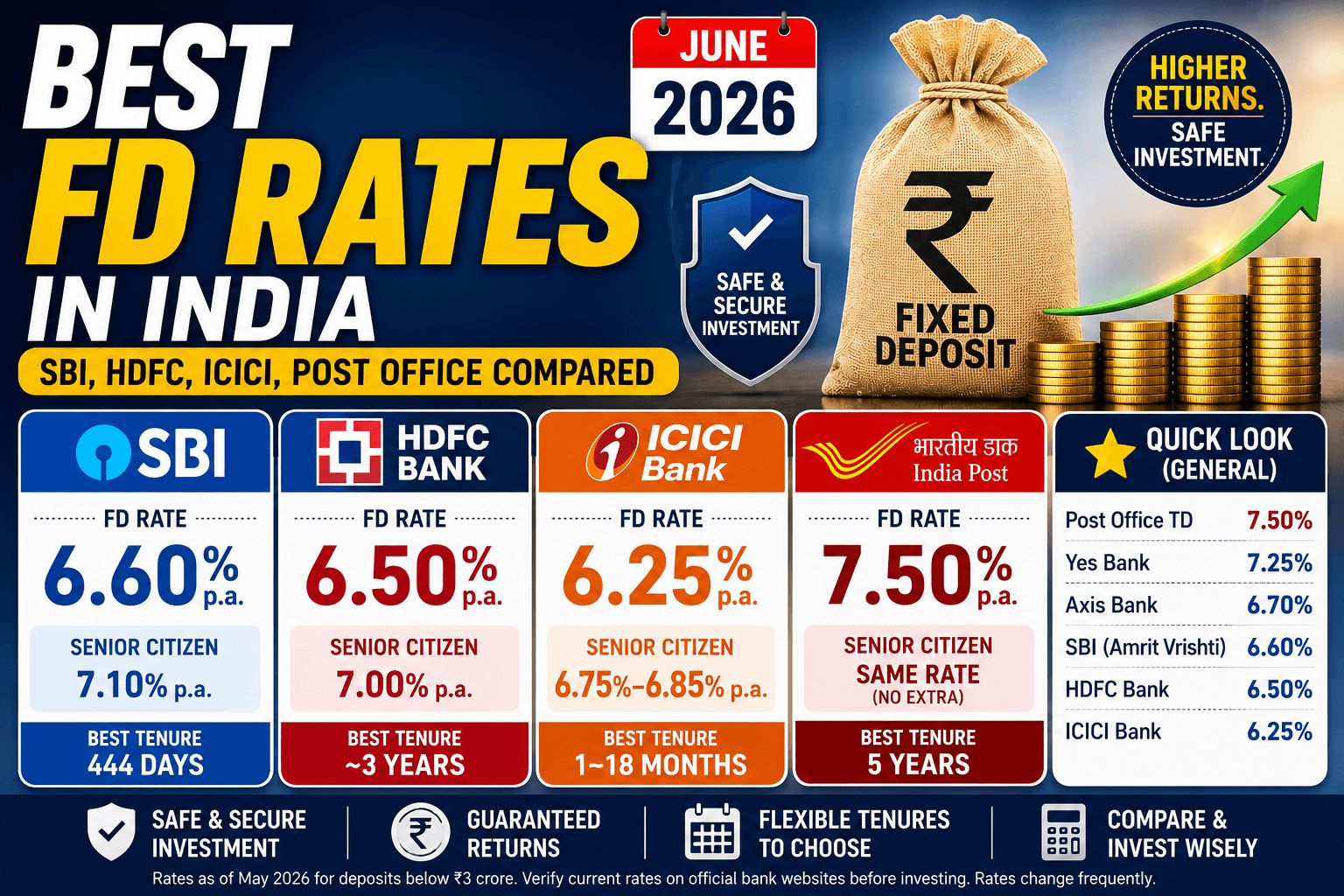
| Bank / Institution | Best rate (general) | Best rate (senior citizen) | Best tenure for highest rate |
|---|---|---|---|
| Post Office TD | 7.50% | Same rate (no extra) | 5 years |
| SBI (Amrit Vrishti) | 6.60% | 7.10% | 444 days |
| SBI (regular) | 6.45% | 6.95% | 1–3 years |
| HDFC Bank | 6.50% | 7.00% | ~3 years |
| ICICI Bank | 6.25% | 6.75%–6.85% | 1–18 months |
| Axis Bank | 6.70% | 7.20% | Select tenure |
| Kotak Mahindra Bank | 6.50% | 7.00% | 390 days |
| Bank of Baroda | 6.50% | 7.15% | 399 days |
| Yes Bank | 7.25% | 7.75% | 12–18 months |
| Small Finance Banks | 7.50%–8.25% | 8.00%–8.75% | Varies by bank |
Rates as of May 2026 for deposits below ₹3 crore. Verify current rates on official bank websites before investing. Rates change frequently.
Why FD Rates Have Been Falling in 2025–26
Understanding why rates are where they are helps you decide whether to lock in now or wait. The RBI reduced the repo rate — the benchmark rate at which it lends to commercial banks — from 6.50% to 5.75% between April and December 2025 across three consecutive monetary policy committee cuts. When the repo rate falls, banks' cost of funds reduces, and they pass this reduction to depositors through lower FD rates.
SBI reduced its retail FD rates multiple times between June 2025 and March 2026. HDFC Bank similarly revised rates downward on select tenures. ICICI Bank's 1-year rate, which was 7.10% in early 2025, now sits at 6.25% for the same tenure.
The key question for investors: will rates fall further? Most analysts expect one more 25 basis point repo rate cut in FY 2026-27 if inflation remains contained. This could push SBI and HDFC rates another 15–25 basis points lower. If you are considering a long-term FD, locking in today's rates before another potential cut may make sense — especially for the Post Office 5-year TD at 7.50%, which is a government-set rate that tends to lag RBI rate movements.
SBI FD Rates — June 2026
State Bank of India is India's largest bank and a benchmark for FD rates across the industry. SBI's rates for retail deposits below ₹3 crore effective from March–May 2026 are as follows:
| Tenure | General (% p.a.) | Senior Citizen (% p.a.) |
|---|---|---|
| 7 days to 45 days | 3.05% | 3.55% |
| 46 days to 179 days | 4.50% | 5.00% |
| 180 days to 210 days | 5.25% | 5.75% |
| 211 days to less than 1 year | 5.75% | 6.25% |
| 1 year to less than 2 years | 6.30% | 6.80% |
| 2 years to less than 3 years | 6.40% | 6.90% |
| 3 years to less than 5 years | 6.25% | 6.75% |
| 5 years to 10 years | 6.25% | 7.05% (WeCare scheme) |
| 444 days (Amrit Vrishti) | 6.60% | 7.10% |
Source: SBI official website and PolicYBazaar tracker, May 2026. The Amrit Vrishti 444-day scheme is SBI's current special tenure FD. Verify availability as special schemes are periodically withdrawn.
SBI FD verdict: Best for risk-averse investors who prioritise safety and liquidity over maximum yield. SBI deposits are backed by the Government of India's implicit guarantee as a public sector bank. The 444-day Amrit Vrishti scheme at 6.60% is currently SBI's most competitive offering. Senior citizens benefit from the WeCare scheme's 7.05% on 5-year deposits — among the better public sector bank rates for the category.
HDFC Bank FD Rates — June 2026
HDFC Bank is India's largest private sector bank by assets. It revised FD rates downward through 2025 following RBI repo rate reductions.
| Tenure | General (% p.a.) | Senior Citizen (% p.a.) |
|---|---|---|
| 7 days to 14 days | 3.00% | 3.50% |
| 15 days to 29 days | 3.00% | 3.50% |
| 30 days to 45 days | 3.50% | 4.00% |
| 6 months to less than 9 months | 5.75% | 6.25% |
| 9 months to less than 1 year | 6.00% | 6.50% |
| 1 year to less than 15 months | 6.35% | 6.85% |
| 15 months to less than 18 months | 6.35% | 6.85% |
| 18 months to less than 21 months | 6.35% | 6.85% |
| 2 years to less than 3 years | 6.40% | 6.90% |
| ~3 years (select tenure) | 6.50% | 7.00% |
| 5 years | 6.40% | 6.90% |
Source: HDFC Bank official website and PaisaBazaar tracker, May 2026. HDFC Bank periodically introduces special tenures with higher rates — check the bank's website for current specials.
HDFC Bank FD verdict: Competitive with SBI across most tenures, with the 3-year deposit at 6.50% being the current sweet spot for general customers. HDFC Bank offers convenient digital FD opening through its mobile banking app. The 0.50% senior citizen premium is standard across most tenures.
ICICI Bank FD Rates — June 2026
ICICI Bank revised rates significantly through 2025–26. Its current 1-year rate of 6.25% is notably lower than the 7.10% it offered in early 2025, reflecting the cumulative impact of multiple rate revisions.
| Tenure | General (% p.a.) | Senior Citizen (% p.a.) |
|---|---|---|
| 7 days to 29 days | 3.00% | 3.50% |
| 30 days to 90 days | 3.50% | 4.00% |
| 91 days to 184 days | 4.75% | 5.25% |
| 185 days to less than 1 year | 5.50% | 6.00% |
| 1 year to less than 18 months | 6.25% | 6.75%–6.85% |
| 18 months to 2 years | 6.25% | 6.75% |
| 2 years to 3 years | 6.25% | 6.75% |
| 3 years to 5 years | 6.10% | 6.60% |
| 5 years to 10 years | 6.10% | 6.60% |
Source: ICICI Bank official website and PolicYBazaar tracker, May 2026. ICICI Bank revised rates effective March 10, 2026.
ICICI Bank FD verdict: Currently the weakest among the three large private banks for FD rates, with the 1-year rate at 6.25% vs HDFC at 6.35% and Axis at higher levels. ICICI FDs are popular for their digital opening process and integration with ICICI banking ecosystem. If rate maximisation is your priority, ICICI is not the best choice at current rate levels — Axis Bank and Kotak offer better rates at comparable safety levels.
Post Office Time Deposit — June 2026: Still India's Best Government-Backed FD Rate
The Post Office Time Deposit (TD) — officially called the National Savings Time Deposit — is India's best government-backed FD option by rate, particularly for the 5-year tenure. The Finance Ministry kept rates unchanged for April–June 2026, meaning the 7.50% rate on 5-year deposits remains available.
| Tenure | Interest rate (% p.a.) | Compounding |
|---|---|---|
| 1 year | 6.90% | Quarterly, paid annually |
| 2 years | 7.00% | Quarterly, paid annually |
| 3 years | 7.10% | Quarterly, paid annually |
| 5 years | 7.50% | Quarterly, paid annually |
Source: Ministry of Finance notification, March 30, 2026. Rates valid April 1 – June 30, 2026.
Why Post Office TD stands out: The 5-year rate of 7.50% is higher than every major scheduled bank's best rate by 50–90 basis points. It is backed by the sovereign guarantee of the Government of India — the highest possible credit quality. The 5-year Post Office TD also qualifies for Section 80C tax deduction up to ₹1.5 lakh per year, making it a genuine triple benefit: high rate + government guarantee + tax saving.
The trade-off: Post Office TDs have less flexible digital access compared to bank FDs — you typically need an India Post Payments Bank account or a post office branch for booking and management. Early withdrawal is allowed only after 6 months, vs 7 days for most bank FDs. For long-term, planned investments of 3–5 years where liquidity is not required, these trade-offs are worth the rate advantage.
Axis Bank and Kotak — Worth Considering in June 2026
Two banks that often get overlooked in FD comparisons but currently offer better rates than SBI and ICICI on several tenures:
| Bank | Best rate (general) | Best rate (senior) | Tenure for best rate |
|---|---|---|---|
| Axis Bank | 6.70% | 7.20% | Special tenure (verify current) |
| Kotak Mahindra Bank | 6.50% | 7.00% | 390 days |
| Bank of Baroda | 6.50% | 7.15% | 399 days |
| Yes Bank | 7.25% | 7.75% | 12–18 months |
Yes Bank note: Yes Bank's 7.25% rate for 12–18 months is the highest among scheduled commercial banks currently — significantly above SBI, HDFC, and ICICI. Yes Bank has been under RBI's enhanced oversight following its 2020 reconstruction, but has fully stabilised under its current management. DICGC insurance covers up to ₹5 lakh per depositor. Investors comfortable with a private sector bank in this range should note that Yes Bank's FD rates represent genuine value if the amount stays within DICGC coverage limits.
Small Finance Banks: High Rates, Higher Risk Profile
Small Finance Banks (SFBs) are licensed by the RBI and their deposits are covered by DICGC insurance up to ₹5 lakh — the same protection as scheduled commercial banks. However, they are newer institutions with less operating history and smaller balance sheets. Their higher FD rates reflect this additional risk premium.
| Small Finance Bank | Highest rate (general) | Senior citizen rate |
|---|---|---|
| Utkarsh Small Finance Bank | 8.25% | 8.75% |
| Jana Small Finance Bank | 8.00% | 8.50% |
| Suryoday Small Finance Bank | 8.00% | 8.60% |
| Equitas Small Finance Bank | 7.60% | 8.10% |
| ESAF Small Finance Bank | 7.60% | 8.10% |
| Bandhan Bank | 7.40% | 7.90% |
Should you invest in Small Finance Bank FDs? The short answer: yes, within DICGC limits (₹5 lakh per depositor per bank including interest). Beyond ₹5 lakh at any single SFB, the risk-reward calculation changes — the excess is uninsured, and in the event of a bank failure, recovery above the insured limit is uncertain and lengthy. For amounts below ₹5 lakh, SFB FDs offer genuinely superior rates backed by the same DICGC protection as large bank FDs.
FD Maturity Calculator: What ₹1 Lakh Grows To — June 2026 Rates
For a quick reference, here is what a ₹1 lakh FD grows to at current best rates for key tenures (quarterly compounding):
| Bank / Institution | Rate | ₹1L after 1 year | ₹1L after 3 years | ₹1L after 5 years |
|---|---|---|---|---|
| Post Office TD | 6.90% / 7.10% / 7.50% | ₹1,07,100 | ₹1,22,900 | ₹1,43,600 |
| SBI (Amrit Vrishti / best) | 6.60% | ₹1,06,760 | ₹1,21,200 | ₹1,38,200 |
| HDFC Bank | 6.50% | ₹1,06,660 | ₹1,20,800 | ₹1,37,600 |
| Yes Bank | 7.25% | ₹1,07,480 | ₹1,23,800 | ₹1,41,700 |
| Utkarsh SFB | 8.25% | ₹1,08,550 | ₹1,27,300 | ₹1,48,800 |
Illustrative calculations using quarterly compounding. Actual maturity values depend on exact compounding frequency and timing. Use gpaisa.in's FD calculator for your exact figures.
Senior Citizen FD Rates — June 2026: Who Offers the Best?
Senior citizens (60 years and above) receive an additional 0.25%–0.60% interest over general rates at most banks. This extra rate is significant — on a ₹10 lakh FD for 5 years, a 0.50% additional rate means approximately ₹28,000 more in interest over the tenure.
| Bank | Senior citizen best rate | Best tenure | Extra over general rate |
|---|---|---|---|
| Utkarsh SFB | 8.75% | Varies | +0.50% |
| Jana SFB | 8.50% | Varies | +0.50% |
| Yes Bank | 7.75% | 12–18 months | +0.50% |
| SBI (WeCare) | 7.05% | 5 years | +0.30% extra on standard +0.50% |
| Bank of Baroda | 7.15% | 399 days | +0.65% |
| HDFC Bank | 7.00% | ~3 years | +0.50% |
| Post Office TD | 7.50% | 5 years | Same as general (no extra) |
Key note for senior citizens: The Post Office 5-year TD at 7.50% does not offer an additional senior citizen rate — the rate is the same for all depositors. However, under Section 80TTB of the Income Tax Act, senior citizens can deduct up to ₹50,000 per year on interest income from deposits (vs ₹40,000 for others). This tax benefit partially compensates for the absence of a higher Post Office rate for seniors.
Tax Benefits on FDs: What You Need to Know in 2026
TDS on FD interest: Banks deduct TDS at 10% (with PAN) if your total FD interest from one bank exceeds ₹40,000 per year (₹50,000 for senior citizens). Without PAN, TDS is 20%. TDS is not your final tax — you must declare FD interest as "Income from Other Sources" in your ITR and pay tax at your applicable slab rate. Submit Form 15G (below 60 years) or Form 15H (senior citizens) if your total income is below the taxable limit to avoid TDS deduction at source.
Section 80C — Tax Saving FDs: Both scheduled bank Tax Saving FDs and the Post Office 5-year TD qualify for Section 80C deduction up to ₹1.5 lakh per year — but only under the old tax regime. Under the new tax regime (default from FY 2024-25), this deduction is not available. Verify which regime you are filing under before making investment decisions based on tax saving.
DICGC insurance: All deposits at scheduled commercial banks and Small Finance Banks are insured by DICGC up to ₹5 lakh per depositor per bank (covering principal + interest combined across all accounts at that bank). Above ₹5 lakh at any single bank, deposits are uninsured. For large FD amounts, spreading across multiple banks provides full DICGC coverage on the entire corpus.
How to Choose the Right FD in June 2026: A Decision Framework
For maximum safety + best rate: Post Office 5-year TD at 7.50% — sovereign guarantee, no bank default risk, Section 80C eligible. Best option for investors with 5-year horizon who do not need early withdrawal flexibility.
For best large bank rate + digital convenience: SBI Amrit Vrishti 444 days at 6.60%, or HDFC Bank 3-year at 6.50%. Both accessible digitally through YONO and HDFC app respectively.
For senior citizens prioritising rate: SBI WeCare at 7.05% (5 years) or Bank of Baroda at 7.15% (399 days) for safety + rate balance. Utkarsh and Jana SFBs at 8.25%–8.75% for rate maximisation within ₹5 lakh DICGC limit.
For short tenure (1 year): Yes Bank at 7.25% is currently the best 1-year rate among scheduled banks — 1% higher than ICICI's current 6.25%. Within DICGC limit, the rate premium is well worth considering.
For amounts above ₹5 lakh: Use large scheduled banks (SBI, HDFC, ICICI, Axis, Kotak) or Post Office — do not concentrate above ₹5 lakh at any SFB or smaller bank unless you are comfortable with uninsured risk above that threshold.
Use gpaisa.in's FD Calculator for Your Exact Maturity Amount
Every investor's FD decision involves specific variables — exact principal, chosen tenure, compounding frequency, and whether TDS applies. Use gpaisa.in's FD Calculator to get:
- Exact maturity amount for any principal, rate, and tenure combination
- Interest earned with TDS deduction calculated
- Senior citizen rate toggle (+0.50%)
- Quarterly vs annual compounding comparison
- Side-by-side comparison across all major bank rates
Frequently Asked Questions
Which bank gives the highest FD interest rate in India in June 2026?
Among scheduled commercial banks, Yes Bank offers the highest rate at 7.25% for 12–18 month tenures for general customers. Among government-backed options, Post Office Time Deposit offers 7.50% for 5 years — the best rate with sovereign guarantee. Among Small Finance Banks, Utkarsh SFB offers up to 8.25% — the highest rate available but with higher risk for amounts above ₹5 lakh DICGC coverage.
Is Post Office FD better than SBI FD in 2026?
For the 5-year tenure, yes — Post Office TD at 7.50% is significantly better than SBI's 6.25%–6.45% for the same tenure. For shorter tenures (1–3 years), SBI and HDFC are more competitive on rates and offer better digital access and early withdrawal flexibility. Post Office TDs cannot be withdrawn for the first 6 months; bank FDs allow withdrawal after 7 days (with penalty).
What is the TDS limit on FD interest in 2026?
₹40,000 per year for general citizens (from any single bank). ₹50,000 for senior citizens. TDS is deducted at 10% with PAN, 20% without. Submit Form 15G (below 60) or Form 15H (senior citizens) if your total income is below the taxable limit to avoid TDS deduction at source.
Are Small Finance Bank FDs safe?
Within the ₹5 lakh DICGC insurance limit per bank — yes, they are as safe as large bank FDs. Above ₹5 lakh at any single SFB, the uninsured amount carries higher risk than equivalent deposits at large scheduled banks. For amounts within the DICGC limit, SFB FDs offer genuinely superior rates.
Should I lock in FD rates now or wait for better rates?
With the RBI potentially cutting repo rates further in FY 2026-27, FD rates are more likely to fall than rise in the near term. Locking in today's rates — especially Post Office 5-year at 7.50% or Yes Bank 1-year at 7.25% — before another potential rate cut makes sense for investors with a clear investment horizon. Interest rate timing is not precise, but the direction of risk is toward lower rates, not higher ones.
What is the minimum FD amount in India?
₹1,000 at SBI and most public sector banks. ₹5,000 at HDFC Bank. ₹10,000 at ICICI Bank. ₹1,000 at Post Office. No maximum limit at most banks for deposits below ₹3 crore (above ₹3 crore, different rate slabs and terms apply).
Use our calculator: FD Calculator — gpaisa.in | Related reading: Gold vs FD in 2026 | SIP vs Gold 2026 | Home Loan vs Rent 2026
Disclaimer: FD interest rates are subject to change by banks and the Finance Ministry at any time. All rates in this article are sourced from publicly available data as of May 2026 and may have changed since publication. This article is for informational purposes only and does not constitute financial or investment advice. Please verify all rates on official bank and Post Office websites before investing. gpaisa.in is not registered with SEBI. Consult a SEBI-registered financial advisor before making investment decisions.