SIP vs Gold Investment in 2026: The Honest Data Comparison Most Articles Won't Show You
By Satyapal Khakhal, Personal Finance Writer | Last Updated: May 2026
This comparison uses return data from IBJA, AMFI, FundsIndia research, Value Research, and Finnovate as of May 2026. All CAGR figures are historical and do not guarantee future performance. Both asset classes are subject to market risk.
Most SIP vs Gold articles in India tell you the same story: equity SIPs deliver 12–15% long-term returns, gold delivers 6–8%, and therefore SIP wins. Invest in SIPs for growth, keep a little gold for safety.
That story was accurate for the 2010–2020 decade. In 2026, it is no longer the complete picture.
The actual data from the past 5 and 10 years tells a different, more complex story — one that should make you think carefully about how much of the conventional wisdom you have accepted without checking the numbers. This article gives you the real data, the honest context, and a framework for thinking about both assets in your portfolio right now.
The Data That Changes Everything — Gold vs Equity Returns 2016–2026
| Asset Class | 1-Year Return | 5-Year CAGR (2021–2026) | 10-Year CAGR (2016–2026) |
|---|---|---|---|
| Gold (Physical / IBJA) | ~104% | ~26% p.a. | ~17.22% p.a. |
| Gold Mutual Funds | ~90%+ | ~24% p.a. | ~15.87% p.a. |
| Small Cap Equity Funds | Varies | ~17.27% p.a. | ~15.95% p.a. |
| Mid Cap Equity Funds | Varies | ~18–20% p.a. | ~13–15% p.a. |
| Flexi Cap Equity Funds | Varies | ~17–19% p.a. | ~13–14% p.a. |
| Large Cap Equity Funds / Nifty 50 | Varies | ~15–16.5% p.a. | ~10–12% p.a. |
Sources: IBJA gold price data, AMFI category returns, FundsIndia research report December 2025, Value Research, Finnovate analysis. Returns are historical CAGR, not SIP XIRR. Past performance does not guarantee future returns.
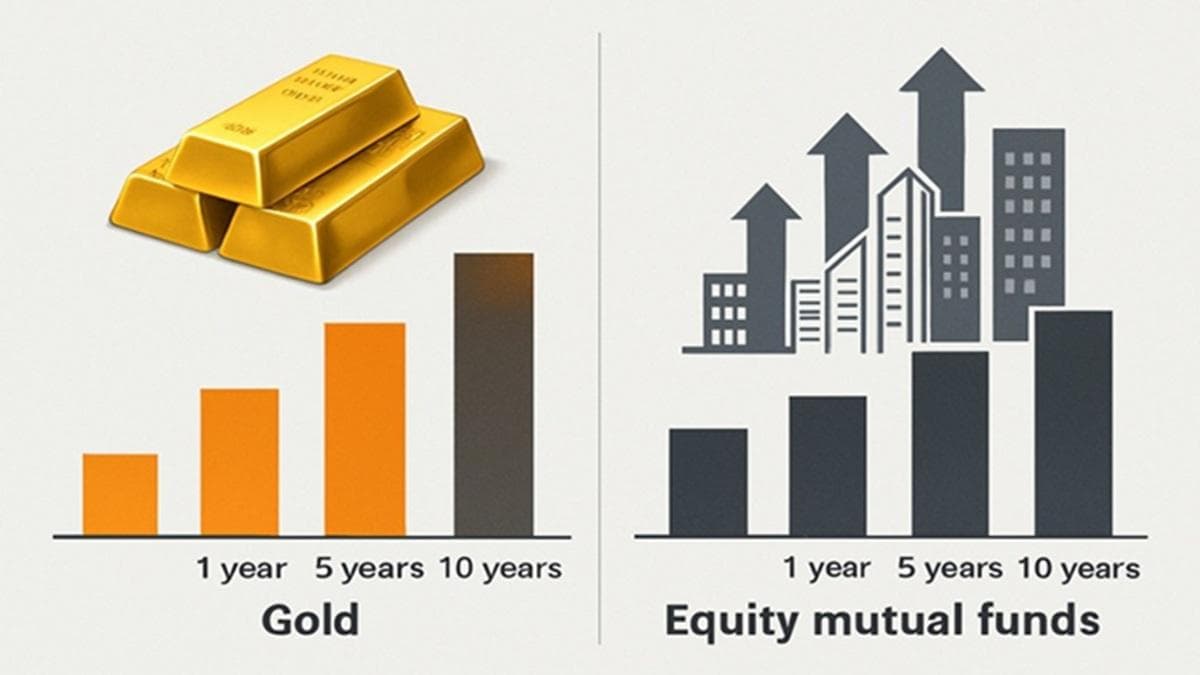
Read that table carefully. Over the past 10 years, gold in India delivered approximately 17.22% CAGR — outperforming every major equity mutual fund category except small cap funds (15.95%). Over the past 5 years, gold's dominance is even clearer at approximately 26% CAGR, compared to 16.5% for Indian equities.
This is not the story you have been told. And understanding why it happened — and whether it will continue — is the most important question any Indian investor should be asking in 2026.
Why Gold Has Outperformed Most Equity in India Over 5–10 Years
Gold's extraordinary recent returns are not random. Three specific factors drove them — and understanding these factors helps you assess whether the same conditions are likely to persist.
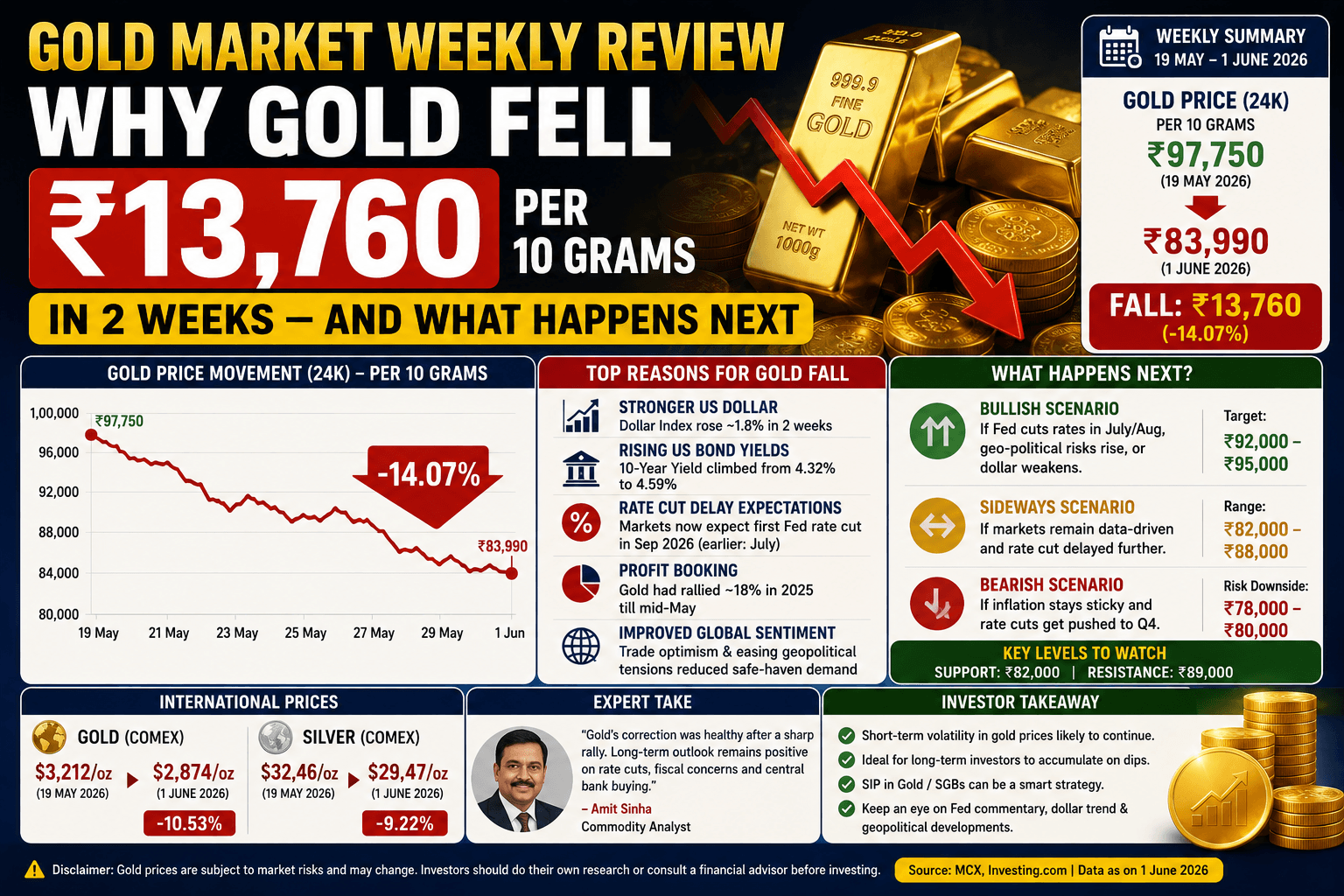
Factor 1 — Rupee depreciation against the dollar. Gold is globally priced in US dollars. When the rupee falls against the dollar, domestic gold prices rise even if international gold prices are flat. The rupee has depreciated from approximately ₹67 per dollar in 2016 to above ₹96 per dollar in 2026 — a 43% depreciation. A significant portion of gold's rupee-denominated returns over this period is a reflection of currency weakness, not gold's own global appreciation. An Indian investor in gold was also, unknowingly, profiting from rupee weakness.
Factor 2 — Geopolitical safe-haven demand. The period 2020–2026 was unusually rich in gold-positive events: COVID-19 (2020), Russia-Ukraine war (2022), US banking stress (2023), US-Iran tensions (2024–2026), and persistent central bank gold buying globally. Each of these events drove institutional and retail safe-haven buying. This level of sustained geopolitical risk is unusual by historical standards — not the baseline expectation for any future decade.
Factor 3 — India's import duty increase. India raised gold import duty to 15% in May 2026, further pushing domestic prices above the international rate. This is a one-time structural price increase that boosted recent returns for existing gold holders — but it also means future returns start from a higher, duty-adjusted base, making identical percentage gains harder to achieve.
The honest assessment: gold's 10-year outperformance in India contains a currency depreciation component, an extraordinary geopolitical premium, and a policy-driven price increase — none of which are repeatable at the same magnitude in the next decade.
Why Equity SIP Returns Look Lower Than They Actually Are — The Tax and Post-Tax Reality
There is another layer to this comparison that most articles ignore: the post-tax return comparison.
Indian equity mutual fund gains are taxed at 12.5% LTCG on profits above ₹1.25 lakh per year (for holdings over one year). After this tax, long-term large cap equity returns of 10–12% become 9–10% post-tax in the hands of investors.
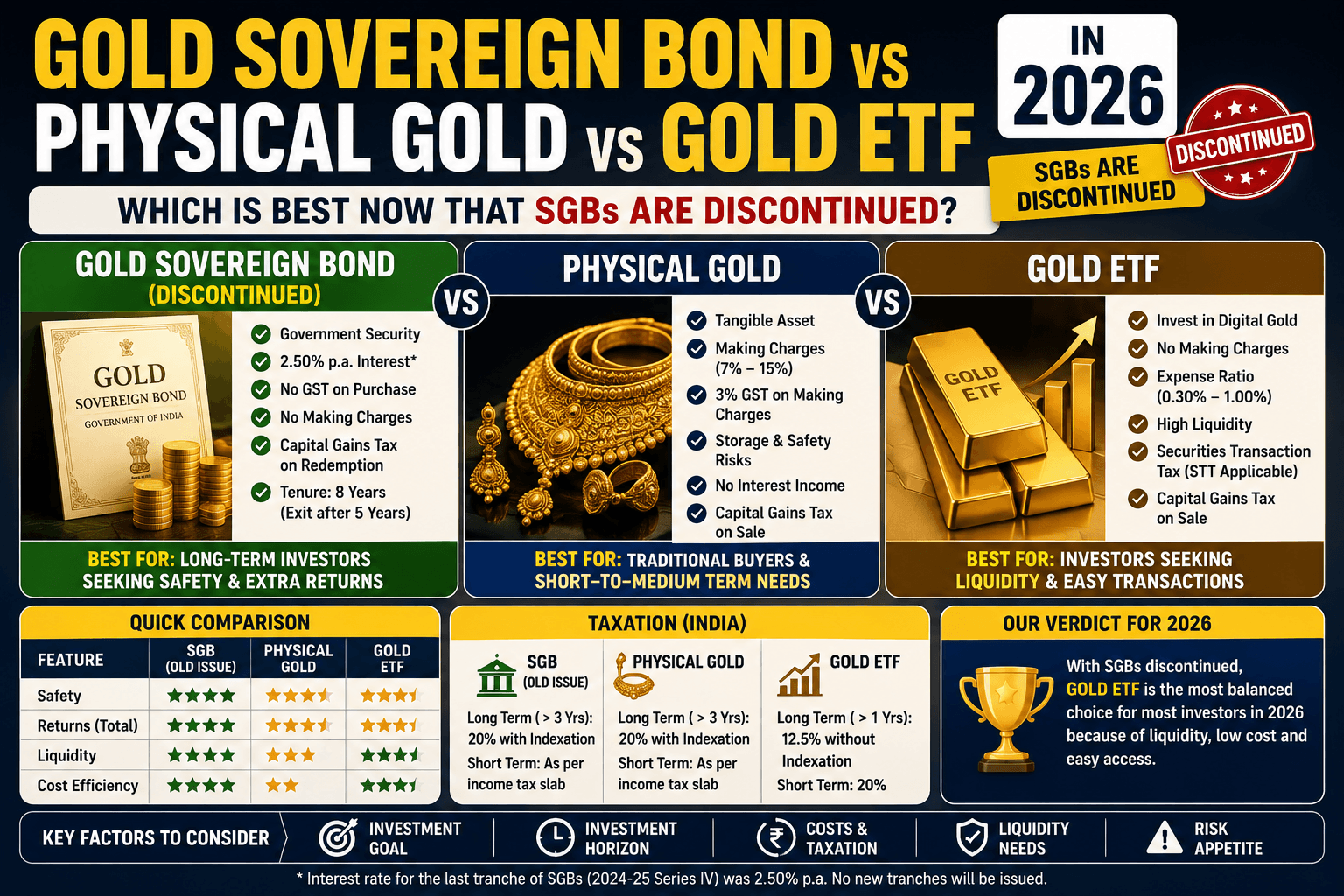
Physical gold gains — sold after 2 years — were traditionally taxed at 20% with indexation benefit. However, post July 2024 Union Budget changes, physical gold is now taxed at 12.5% LTCG without indexation for holdings acquired after that date. Sovereign Gold Bonds remain tax-free on maturity (8 years), which is the most tax-efficient way to hold gold.
Post-tax comparison on a level playing field (assuming similar LTCG rates):
| Asset | Pre-Tax 10-Year CAGR | Effective LTCG Rate | Approximate Post-Tax CAGR |
|---|---|---|---|
| Gold (Physical, post-July 2024 purchase) | ~17% | 12.5% | ~14.9% |
| Sovereign Gold Bonds (8-year maturity) | ~17% + 2.5% interest | 0% on maturity | ~19.5% (most tax-efficient) |
| Large Cap Equity Funds | ~11% | 12.5% | ~9.6% |
| Small Cap Equity Funds | ~16% | 12.5% | ~14% |
| Flexi Cap Equity Funds | ~14% | 12.5% | ~12.25% |
On a post-tax basis, Sovereign Gold Bonds have been the single best-performing mainstream investment available to Indian retail investors over the past 10 years — combining gold price appreciation with 2.5% annual interest and zero capital gains tax at maturity. This is rarely discussed in SIP vs Gold comparisons.
Where Equity SIP Still Has a Genuine Structural Advantage
Despite gold's recent outperformance, there are specific structural reasons why equity SIPs remain superior for certain financial goals — not as marketing claims but as mathematical realities.
Compounding on earnings, not just prices. When a company grows its profits, its stock price typically rises in proportion. The underlying businesses you own through equity funds generate revenue, expand, hire, and innovate. Gold generates no income — it only changes in price. Over a 25–30 year horizon, a growing economy's corporate earnings compound in ways that commodity prices cannot replicate consistently.
Rupee cost averaging works for volatile assets. Gold's volatility has increased significantly in 2026 — the same gold that returned 104% in one year has also seen 15–20% drawdowns in previous years. An SIP into a gold fund or a gold ETF smooths this volatility through regular buying at different price points, just as an equity SIP does.
Inflation-adjusted equity returns over 20 years. India's nominal GDP has grown at approximately 12–14% annually for two decades. Corporate earnings in aggregate roughly track nominal GDP growth. Over 20-year periods, equity has historically delivered real (inflation-adjusted) wealth creation in India at approximately 5–7% per year. Gold over 20 years has delivered approximately 15.1% CAGR — impressive but partly driven by currency and geopolitical factors that may not repeat.
Accessibility and liquidity. A ₹100 SIP in an equity mutual fund is possible. Physical gold requires meaningful capital. Gold ETFs and SGBs improve this, but equity SIPs remain the most accessible disciplined saving instrument for investors starting with small amounts.
The Real Answer — What Allocation Makes Sense in 2026
The question is not "SIP or gold" — it is "how much of each, for which purpose, over what time horizon."
Here is a practical framework based on your primary financial goal:
| Financial Goal | Recommended Allocation | Why |
|---|---|---|
| Retirement in 20+ years | 80–90% equity SIP, 10–20% gold (SGBs) | Long horizon allows equity compounding to maximise; gold as inflation/currency hedge |
| Child's education in 10 years | 60–70% equity SIP, 20–30% gold (SGBs or ETF) | Medium horizon, gold provides downside protection if equity underperforms |
| Wedding expenses in 3–5 years | 30–40% equity (large cap/flexi cap), 40–50% gold, 20% debt | Short horizon, gold more reliable than equity in short-to-medium term recently |
| Emergency / Wealth preservation | 0% equity, 30–50% gold, rest in liquid funds | Capital preservation, not growth — gold + liquid funds appropriate |
| Aggressive wealth creation, 15+ years | 90–95% equity SIP (mid + small cap), 5–10% gold | Maximum growth horizon, equity compounding over 15+ years typically dominates |
The general recommendation from financial planners — allocate 5–15% of your portfolio to gold — holds up well. Gold is not a substitute for equity SIPs for long-term wealth creation. But it is also not the "6–8% low-return defensive asset" it was characterised as in the previous decade. It has earned a meaningful portfolio role based on actual data.
Gold vs SIP — The Specific Scenarios Where Each Wins
Gold wins when:
- The rupee is depreciating against the dollar (gold's INR price rises even if global gold is flat)
- Geopolitical uncertainty is elevated — gold's safe-haven demand increases
- Equity markets are overvalued — gold provides better risk-adjusted returns during corrections
- Your time horizon is 3–5 years — recent data favours gold over equity on medium-term returns
- You are close to a major expense (wedding, property down payment) and cannot afford significant drawdowns
Equity SIP wins when:
- Your investment horizon is 15–20+ years — compounding on corporate earnings builds wealth in ways commodity prices cannot
- You are starting with small amounts — ₹500/month SIP is realistic; meaningful gold investment requires more capital
- India's economic growth story plays out as expected — corporate earnings growth over decades translates to equity returns
- You use tax-efficient structures — index funds in Direct plan with disciplined LTCG harvesting can generate strong post-tax returns
- You want regular disciplined saving forced upon you — SIP auto-debit creates a saving discipline that lump-sum gold purchases cannot replicate
The Best of Both — A Combined Approach With Real Numbers
Consider what ₹10,000 per month invested from May 2016 to May 2026 would have become:
| Allocation | 10-Year SIP CAGR (approx) | Approximate Corpus (₹10K/month, 10 years) |
|---|---|---|
| 100% Nifty 50 Index Fund | ~12% | ~₹23.2L |
| 100% Gold ETF/Fund | ~15.87% | ~₹27.8L |
| 70% Equity SIP + 30% Gold SIP | ~13–14% blended | ~₹24.5–25.5L |
| 100% Small Cap Fund | ~15.95% | ~₹28.0L |
The numbers are closer than most people expect. Gold has been a genuine wealth creator over this period — not just a defensive hedge. The 70/30 portfolio delivered solid blended returns with lower volatility than either pure equity or pure gold, making it psychologically easier to stay invested through market turbulence.
Use our SIP Calculator to model different allocations and time horizons with your specific monthly investment amount.
Frequently Asked Questions
Has gold really outperformed equity SIPs in India recently?
Yes — and this is the fact most SIP vs Gold articles avoid. Over the 10-year period 2016–2026, gold delivered approximately 17.22% CAGR in India, outperforming every major equity mutual fund category except small cap funds (15.95% CAGR). Over the shorter 5-year period, gold's outperformance was even more pronounced at approximately 26% CAGR vs 16.5% for Indian equities. This does not mean gold will continue to outperform in the next decade — the drivers of recent gold performance (rupee depreciation, geopolitical premiums, import duty increases) are partially non-repeatable structural factors.
Which is safer — gold or SIP — for a 5-year investment horizon?
Based on recent data, gold has delivered more consistent returns over 5-year periods in India than large cap equity. For a 5-year horizon with a specific goal at the end (wedding, property, education), a meaningful gold allocation (via Gold ETFs or SGBs) combined with a conservative equity allocation (large cap or balanced advantage fund) is more appropriate than an aggressive equity-only approach. The risk of a 30–40% equity drawdown in year 4 with no time to recover is real.
What is the most tax-efficient way to invest in gold in 2026?
Sovereign Gold Bonds (SGBs) issued by the RBI are the most tax-efficient gold investment — they provide 2.5% annual interest plus gold price appreciation with zero capital gains tax at the 8-year maturity date. Physical gold and gold ETFs are now taxed at 12.5% LTCG (without indexation for purchases after July 2024). If an SGB tranche is available, it is significantly more tax-efficient than any other gold investment form for long-term holders.
Should a beginner invest in SIP or gold first?
For most beginners under 35 with stable income and a 10+ year horizon, start with a systematic investment in a flexi cap or large cap equity fund — the growth potential over long periods still favours equity compounding over commodities. Simultaneously, if an SGB tranche is available, allocate 10–15% of your monthly investment budget to it for the interest income and currency hedge. Do not try to choose between the two — use both for their different roles.
Does SIP in gold mutual funds make sense in 2026?
Gold mutual funds and gold ETFs have delivered strong returns over 5 and 10 years and offer the discipline of regular investing without storage risk or purity concerns. A SIP into a gold ETF — even at ₹500/month — is a practical way to build gold exposure alongside equity SIPs. However, with gold prices elevated after the 15% import duty hike in May 2026, a staged approach (rather than a large lump sum) is more appropriate for new entrants.
Related reading: Best SIP Plans in India 2026 | Live Gold Rate Today | SIP Calculator | Gold vs FD in 2026
Disclaimer: This article is for informational and educational purposes only and does not constitute investment advice. Return figures cited are historical CAGR data from IBJA, AMFI, and research reports and do not guarantee future performance. Both equity mutual funds and gold investments are subject to market risk. Tax treatment is based on Finance Act 2024 provisions and may change. Please consult a SEBI-registered investment advisor before making investment decisions. gpaisa.in is not affiliated with any mutual fund house or gold investment platform.