EPFO Credits 8.25% EPF Interest for FY26 to 34 Crore Accounts — Earliest Ever: Full Details
By Satyapal Khakhal
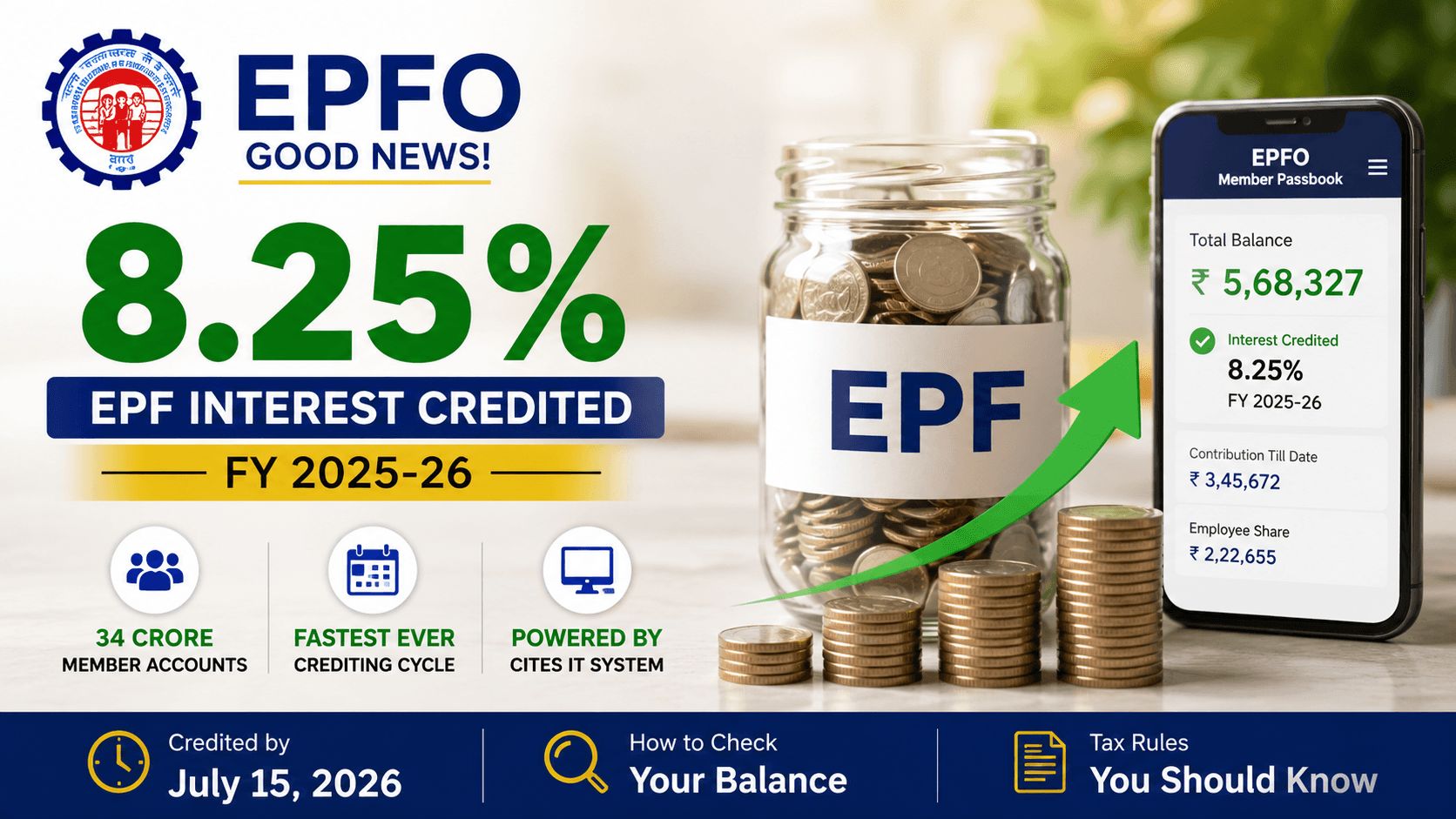
The Employees' Provident Fund Organisation (EPFO) has credited the approved 8.25% interest on Employees' Provident Fund (EPF) deposits for the financial year 2025-26 to nearly 34 crore member accounts by July 15, 2026, according to multiple media reports citing EPFO and government sources. This is, by EPFO's own account and by media reporting, the earliest this annual exercise has ever been completed — a process that in previous years routinely stretched into September or November. Roughly ₹1.44 lakh crore has reportedly been credited to subscriber accounts in this cycle, enabled by EPFO's new centralised IT platform, CITES (Centralised IT Enabled Services).
This article lays out the full timeline of how the 8.25% rate was decided and credited, explains the technology shift behind the faster turnaround, tells you exactly how to check whether your account has been updated, and clarifies the often-misunderstood tax rules on EPF interest.
Quick Summary
- Interest rate approved: 8.25% per annum on EPF deposits for FY 2025-26 — unchanged for the third consecutive year (after 8.25% in FY 2023-24 and FY 2024-25).
- Approved by: EPFO's Central Board of Trustees (CBT), chaired by Union Labour and Employment Minister Dr Mansukh Mandaviya, at its 239th meeting held on March 2, 2026.
- Government ratification: The Ministry of Finance gave its concurrence to the 8.25% rate on June 18, 2026, as required whenever EPF deposits (which carry a government guarantee) change or retain their rate.
- Crediting completed: By July 15, 2026 — reported as the fastest-ever completion of an annual EPF interest credit cycle.
- Amount credited: Approximately ₹1.44 lakh crore, reaching close to 34 crore member accounts (a figure that includes both active and dormant/inactive accounts; EPFO's actively contributing subscriber base is usually cited at around 7-8 crore members).
- Enabling technology: EPFO's new CITES platform, which migrated roughly 123 separate regional field-office databases into one centralised national system.
- What to do: Check your EPF passbook on the official portal, the UMANG app, via SMS, or via a missed call — and don't panic if your passbook takes a few extra days to visually reflect the credit; interest continues to accrue under Paragraph 60 of the EPF Scheme, 1952, regardless of when the passbook display updates.
How the 8.25% Rate Was Decided: The CBT's March 2026 Meeting
Every year, the interest rate payable on EPF balances is first recommended by EPFO's apex decision-making body, the Central Board of Trustees (CBT). At its 239th meeting on March 2, 2026, chaired by Union Labour Minister Dr Mansukh Mandaviya, the CBT recommended retaining the interest rate at 8.25% for FY 2025-26. This marks the third year in a row at this level, following 8.25% for FY 2023-24 and FY 2024-25, after the rate had been cut to 8.15% for FY 2022-23 (then the lowest in about four decades) and to 8.10% for FY 2021-22 (a 40-year low at the time it was announced).
The CBT's recommendation is not final by itself. Because EPF is a government-backed retirement savings instrument and the corpus is invested largely in government securities, corporate bonds and a smaller equity component through ETFs, the Ministry of Finance must examine EPFO's income and surplus projections before formally concurring with the proposed rate. This "ratification" step exists to ensure EPFO does not declare a rate that its investment income cannot sustainably support.
Finance Ministry Ratification: Why Government Sign-off Is Required
According to media reports (including Business Standard and IANS), the Ministry of Finance formally ratified the 8.25% rate for FY 2025-26 on June 18, 2026 — roughly three and a half months after the CBT's recommendation. Only after this concurrence can EPFO's field offices begin the formal process of crediting interest to member accounts. This two-step approval process — CBT recommendation, followed by Finance Ministry ratification — is a standing feature of how EPF interest is fixed every year, and it is one reason the crediting date has historically lagged well behind the start of the financial year.
Readers should note: EPFO and the Labour Ministry are official primary sources for the rate itself; the exact date of Finance Ministry ratification cited above (June 18, 2026) is based on contemporaneous news agency reporting rather than a directly verifiable government press release link at the time of writing, since some official press release pages were inaccessible during research for this article. Readers wanting the primary notification can check the EPFO official website or the Press Information Bureau (PIB) archive.
The Big News: Interest Credited to 34 Crore Accounts by July 15 — A Historic First
The real story this month is not the rate itself — 8.25% was already known since March — but the speed of crediting. EPFO has reportedly completed crediting the FY26 interest to close to 34 crore member accounts by July 15, 2026, with the total amount credited pegged at approximately ₹1.44 lakh crore. Labour Minister Dr Mansukh Mandaviya had publicly indicated that interest would reach member accounts by mid-July through the organisation's new automated system, and EPFO appears to have delivered on that timeline.
To put this in context: in previous years, subscribers routinely waited until September, October or even November for interest declared for a financial year to actually show up in their accounts, even though the rate itself was usually announced earlier in the calendar year. A multi-month gap between rate announcement and actual crediting has been a long-standing subscriber grievance. Completing the exercise by mid-July — within roughly six to seven weeks of the Finance Ministry's ratification — is a marked departure from that pattern, based on currently available reporting.
One clarification worth flagging for readers: the "34 crore accounts" figure refers to EPFO's total historical member account base, which includes a large number of inactive or dormant accounts left behind by employees who have changed jobs, retired, or stopped contributing. EPFO's actively contributing membership — those currently making monthly contributions — is generally cited in official and media commentary at around 7 to 8 crore members. Both figures are legitimate and widely reported, but they measure different things, so it is useful to know which one is being discussed.
Why This Happened Now: Inside EPFO's New CITES System
The technology angle here deserves attention because it explains why 2026 looks different from every prior year. EPFO has been implementing a new backend platform called CITES — Centralised IT Enabled Services. Historically, EPFO's data was fragmented across roughly 123 separate regional and field-office databases, each maintaining its own member records, contribution histories and claim workflows largely in isolation from one another. This fragmentation is widely understood to be a major reason behind EPFO's chronic delays in interest crediting, claim settlement and passbook updates.
Under CITES, these approximately 123 regional databases have reportedly been consolidated into a single centralised national system, unifying close to 1,700 crore individual records (including employer and establishment data) and roughly 1,400 crore financial transactions accumulated over decades. According to reports, the core database migration was completed on June 30, 2026, interest computation across the unified system ran on July 1-2, 2026, and — after a reported balance-verification exercise to catch data-migration errors — the interest credit itself was completed by July 15, 2026.
Some reports have also linked the CITES rollout to a separate, related benefit: the resolution of a backlog of pending EPF claims (cited in some coverage as roughly 11 lakh claims worth about ₹3,000 crore) once system operations normalised after the migration. This claims-clearance figure is reported in secondary media coverage rather than a primary EPFO release seen directly for this article, so readers should treat it as a reported figure pending independent confirmation, even though it is consistent with the broader narrative of a system-wide backlog clearance following the CITES transition.
If the faster crediting cycle is sustained in future years, it would represent a genuine structural improvement in how EPFO serves its subscriber base — worth watching for FY 2026-27 onward rather than treating as a one-off.
EPF Interest Rate History: How 8.25% Compares
The table below shows EPF interest rates declared over the past decade, compiled from EPFO notifications and cross-checked against financial data portals. The current 8.25% rate is well below the double-digit and high-single-digit rates of the early 2010s, but it remains higher than the 8.10-8.15% band seen in FY 2021-22 and FY 2022-23, which were, at the time, the lowest EPF rates declared in roughly four decades.
| Financial Year | EPF Interest Rate |
|---|---|
| 2015-16 | 8.80% |
| 2016-17 | 8.65% |
| 2017-18 | 8.55% |
| 2018-19 | 8.65% |
| 2019-20 | 8.50% |
| 2020-21 | 8.50% |
| 2021-22 | 8.10% |
| 2022-23 | 8.15% |
| 2023-24 | 8.25% |
| 2024-25 | 8.25% |
| 2025-26 | 8.25% (current, credited by July 15, 2026) |
You can model how this rate compounds over your own career using an EPF calculator, which lets you plug in your basic salary, expected increments and years to retirement to estimate your maturity corpus at the prevailing 8.25% rate.
My Passbook Still Shows the Old Balance — Should I Worry?
A common concern every year is that a member's EPF passbook does not immediately reflect the new interest credit, even after EPFO announces that crediting is complete. Under Paragraph 60 of the Employees' Provident Fund Scheme, 1952, interest on a member's EPF balance accrues continuously through the year regardless of when the passbook display is technically updated. In other words, a delay in your passbook reflecting the credit is a display/reporting lag, not a delay in the interest itself being computed or credited to your underlying account balance. If your passbook has not updated within a few days of EPFO's announced completion date, it is generally advisable to wait a short while and check again, rather than assume you have been shortchanged.
That said, if your passbook shows no updates for an extended period, or if your account shows discrepancies in contribution history, it is reasonable to raise a grievance through the EPFO portal's grievance redressal mechanism.
How to Check Your Updated EPF Balance
EPFO offers several official ways to check whether your account reflects the FY26 interest credit:
- EPFO Member Passbook Portal: Log in at the official EPFO Member Passbook portal using your Universal Account Number (UAN), password, and an OTP sent to your Aadhaar-linked registered mobile number. Your passbook shows month-wise employee and employer contributions along with the interest credited.
- UMANG App: Download the UMANG (Unified Mobile Application for New-age Governance) app, register with your UAN-linked mobile number, and navigate to Services > EPFO > Employee Centric Services > View Passbook.
- SMS service: Send an SMS in the format EPFOHO UAN ENG (replace ENG with your preferred language code for a regional-language reply) to 7738299899 from your UAN-registered mobile number. Your UAN must be seeded with Aadhaar, PAN and bank details for this to work.
- Missed call service: Give a missed call to 9966044425 from your registered mobile number. The call disconnects automatically after one or two rings, and you will receive an SMS with your latest PF balance and contribution details, free of charge.
Across all these channels, your UAN needs to be active and your KYC (Aadhaar, PAN, bank account) needs to be verified and linked for the service to work smoothly.
A safety note: EPFO does not call subscribers to ask for their Aadhaar, PAN, bank details, OTP, or any payment to release PF funds or interest. Treat any such call or message as a scam and report it, and only use the official channels listed above.
Is EPF Interest Taxable? Understanding the ₹2.5 Lakh Rule
A frequent point of confusion is whether EPF interest is fully tax-free. Historically, EPF interest and maturity proceeds were entirely exempt from tax (subject to the standard five-years-of-continuous-service condition for withdrawal). However, since Budget 2021, the position has changed for high contributors:
- Interest earned on an employee's own contribution (including Voluntary Provident Fund, or VPF, contributions) to EPF in excess of ₹2.5 lakh in a financial year is taxable in the hands of the employee, effective from contributions made on or after April 1, 2021.
- Where there is no employer contribution to the fund at all (a scenario more common for certain Provident Fund/GPF-type accounts), the threshold is higher, at ₹5 lakh per financial year.
- The employer's contribution itself, and interest on it, is not brought within this taxable-interest rule — only interest on the employee's own contribution above the threshold is affected.
- EPFO/the PF department is required to maintain two separate sub-accounts for each subscriber from FY 2021-22 onward — one for taxable contributions and interest, and one for non-taxable contributions and interest — to administer this rule.
- Where applicable, TDS at 10% is deductible on this taxable interest component under Section 194A of the Income Tax Act, generally where the taxable interest in a year exceeds ₹5,000 (higher TDS may apply if PAN is not furnished).
In practice, this rule affects a relatively small proportion of high-income EPF/VPF contributors whose combined employee contribution crosses ₹2.5 lakh (or ₹5 lakh, where applicable) in a single financial year — it does not affect the vast majority of salaried EPF members with moderate basic salaries. Because tax rules can be amended in subsequent Finance Bills, readers should verify the applicable threshold for the relevant assessment year and consult a chartered accountant for their specific situation before filing returns.
What This Means for EPF Subscribers
For most salaried employees, the news this month is straightforwardly positive on two counts: the rate itself, at 8.25%, remains among the more competitive returns available on a government-backed, low-risk retirement instrument compared to many small savings schemes and fixed deposits; and the faster crediting cycle — if it holds up in future years — should reduce the multi-month uncertainty subscribers have historically faced about when exactly their EPF balance would reflect a new year's interest.
That said, EPF should be viewed as one part of a broader retirement plan rather than a standalone solution. Employees building a long-term retirement corpus often also consider instruments such as the National Pension System (NPS) for market-linked growth and additional tax benefits, or the Public Provident Fund (PPF) for a separate long-term, tax-free debt allocation outside of employment. If you are approaching retirement or a job change, it is also worth checking your gratuity entitlement separately, since gratuity and EPF are distinct benefits with different eligibility rules. As always, EPF interest rates and government policy can change from year to year, so this article should not be read as a guarantee of future rates or crediting timelines, and readers with significant EPF/VPF balances or complex tax situations should consult a SEBI-registered financial advisor or chartered accountant.
Frequently Asked Questions (FAQs)
What is the current EPF interest rate for FY 2025-26?
The EPF interest rate for FY 2025-26 is 8.25% per annum, as recommended by EPFO's Central Board of Trustees on March 2, 2026, and ratified by the Ministry of Finance on June 18, 2026. This is the third consecutive year the rate has stayed at 8.25%.
When was the FY26 EPF interest actually credited to member accounts?
According to EPFO and multiple media reports, the 8.25% interest for FY 2025-26 was credited to nearly 34 crore member accounts by July 15, 2026 — reportedly the earliest this annual crediting exercise has ever been completed.
How much money was credited in total?
Reports peg the total amount credited at approximately ₹1.44 lakh crore across the roughly 34 crore member accounts.
Why was this year's crediting so much faster than in the past?
EPFO's new centralised IT platform, CITES, consolidated around 123 separate regional databases into a single national system, which allowed interest to be computed and credited far more quickly than in years when data was fragmented across regional offices. Database migration was completed on June 30, 2026, and crediting followed by July 15, 2026.
How do I check my updated EPF balance?
You can check your balance via the official EPFO Member Passbook portal (UAN + password + OTP), the UMANG app, by sending an SMS in the format "EPFOHO UAN ENG" to 7738299899 from your registered mobile number, or by giving a missed call to 9966044425 from your registered mobile number.
My EPF passbook still shows the old balance. Does that mean I have lost interest?
No. Under Paragraph 60 of the EPF Scheme, 1952, interest accrues continuously regardless of when your passbook visually updates. A delayed passbook display is not the same as a delayed or reduced interest credit. If the delay persists for an unusually long time, you can raise a grievance through the EPFO portal.
Is EPF interest fully tax-free?
Not always. Since Budget 2021, interest on an employee's own EPF/VPF contribution above ₹2.5 lakh in a financial year (₹5 lakh where there is no employer contribution) is taxable, with TDS of 10% typically applicable under Section 194A. Interest on contributions within these limits, and on the employer's contribution, generally remains tax-free (subject to the five-year continuous-service condition for withdrawal).
Does the 34 crore figure mean EPFO has 34 crore active contributors?
No. The 34 crore figure refers to EPFO's total member account base, including a large number of inactive/dormant accounts. EPFO's actively contributing membership is generally cited at around 7-8 crore members.
Sources & References
- EPFO Official Website
- EPFO Member Passbook Portal
- Press Information Bureau (PIB) — search for EPFO Central Board of Trustees releases
- Business Today: EPFO credits 8.25% interest to 34 crore accounts ahead of schedule
- Business Today: EPFO to credit 8.25% EPF interest for FY26 by July 15
- Business Standard: Govt ratifies 8.25% EPF interest rate for FY26
- ClearTax: Taxation of Interest on EPF Contribution Exceeding ₹2.5 Lakh
Related Reading
- EPF Calculator — Estimate Your Retirement Corpus
- What Is EPF? Glossary Explainer
- More Finance News on Gpaisa
Disclaimer: This article is for informational and educational purposes only and does not constitute financial or tax advice. EPF interest rates and crediting timelines are subject to official EPFO/Finance Ministry notifications, and figures such as total accounts credited, total amount disbursed, and claims cleared are based on media reporting available at the time of writing and may be revised by official sources. Consult a SEBI-registered financial advisor or chartered accountant for advice specific to your situation.