Gold Sovereign Bond vs Physical Gold vs Gold ETF in 2026: Which Is Best Now That SGBs Are Discontinued?
By Satyapal Khakhal, Personal Finance Writer | Last Updated: 5 June 2026
SGB status data sourced from RBI official notifications, Finance Ministry statements, and Wikipedia's Sovereign Gold Bond article (confirmed discontinued February 2024). Gold ETF data from AMFI India and NSE as of May 2026. Physical gold pricing from IBJA. This article is for informational purposes only. gpaisa.in is not registered with SEBI.
Critical 2026 Update — Read This First: The Government of India stopped issuing new Sovereign Gold Bonds (SGBs) in February 2024. No new tranches have been announced for FY 2025-26 or FY 2026-27. Finance Minister Nirmala Sitharaman confirmed in the 2025 Union Budget that the government has no plans to launch more SGB tranches. New investors cannot buy SGBs directly from the government anymore — only through the secondary market (stock exchange) at prevailing prices.
For the last decade, the Sovereign Gold Bond was India's most recommended gold investment — offering 2.5% annual interest on top of gold price returns, zero making charges, no storage risk, and a government guarantee. Financial advisors consistently recommended it over physical gold and gold ETFs.
That conversation has changed in 2026. With new SGB issuances officially discontinued, investors who missed the last tranche in February 2024 need a completely different framework for gold investment decisions. This article gives you that framework — a clear, honest comparison of the three main gold investment options available to Indian investors right now, with real numbers for each.
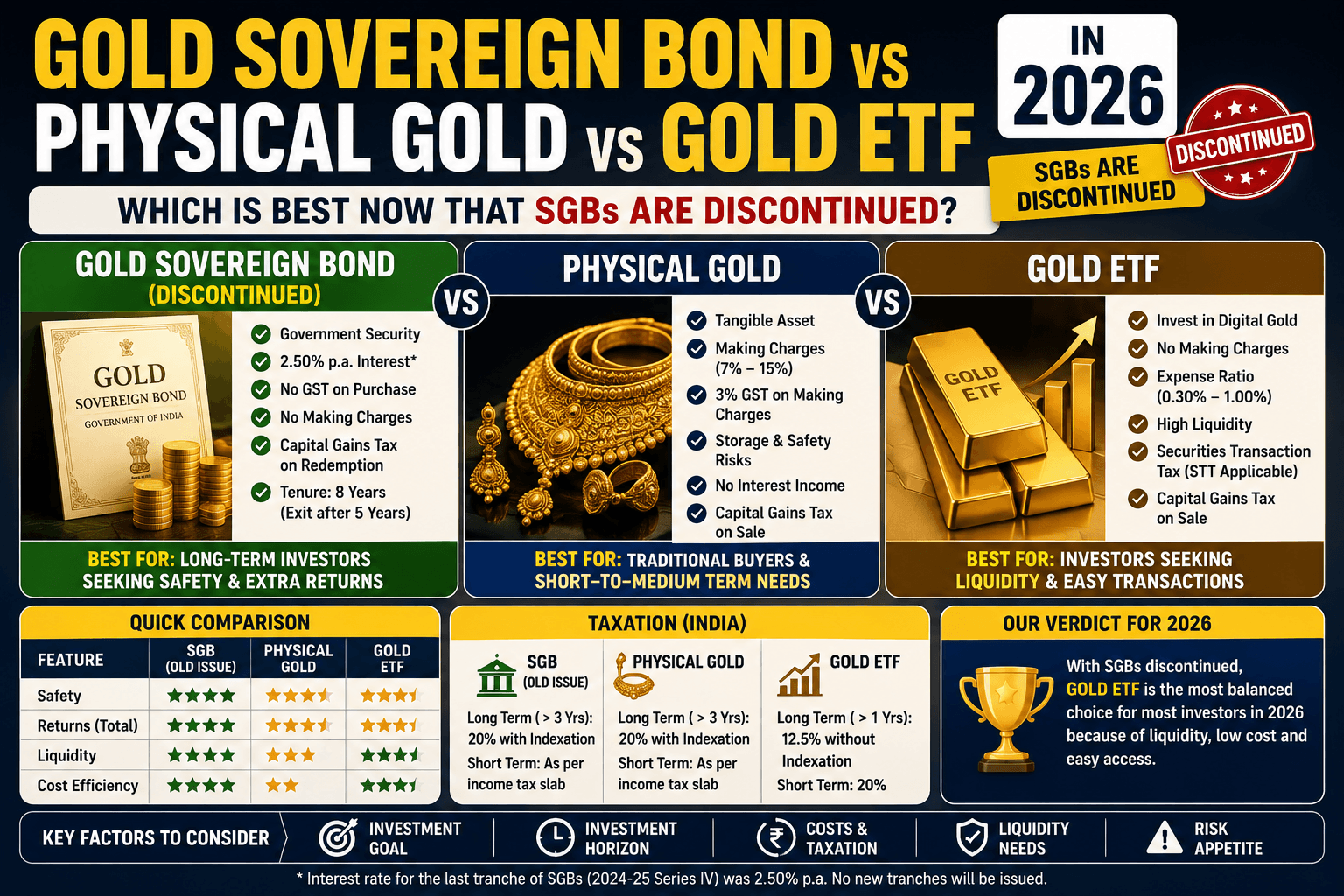
Quick Comparison: At a Glance
| Feature | Sovereign Gold Bond (SGB) | Gold ETF | Physical Gold |
|---|---|---|---|
| Availability for new investors | ❌ Not available (discontinued Feb 2024) | ✅ Available anytime on NSE/BSE | ✅ Available anytime |
| Minimum investment | 1 gram (secondary market, 1 unit) | ~₹70–80 per unit (0.01 gram equivalent) | Varies (1 gram = ~₹16,000) |
| Annual interest | 2.5% on issue price | Nil | Nil |
| Storage required | No (demat) | No (demat) | Yes (locker/safe) |
| Making charges | Nil | Nil | 8–25% on jewellery |
| LTCG tax (on gains) | Nil on maturity (held 8 years) | 12.5% after 12 months | 12.5% after 24 months |
| Liquidity | Low (secondary market, thin volume) | High (real-time trading) | Moderate (jeweller/bank) |
| Expense ratio | Nil | 0.10%–0.55% per year | Nil (but storage costs) |
| Purity risk | None (government guaranteed) | None (99.5% purity guaranteed) | High (hallmarking needed) |
| Loan against investment | Yes | Yes (some banks) | Yes (gold loan) |
| Govt guarantee | Yes (existing bonds) | No (fund house backed) | No |
Sovereign Gold Bonds in 2026: What Happens to Existing Investors
If you already hold SGBs from earlier tranches, here is what you need to know for 2026.
Your existing bonds are completely unaffected by the discontinuation. They continue to earn 2.5% annual interest paid semi-annually, and will mature at the gold price prevailing 8 years from their issuance date. The government guarantee on your existing bonds remains fully in force.
Several SGB tranches are eligible for premature redemption in 2026 — investors can exit after completing 5 years from issuance on the specified interest payment dates. The April 2026 premature redemption window for the SGB 2020 series saw redemption at approximately ₹15,254 per unit. Investors who subscribed at ₹5,051 in 2020 realised gains of over 200% — in addition to the 2.5% annual interest earned over 6 years. This is one of the strongest investment returns achieved by any Indian retail instrument in recent history.
If you hold SGBs and are considering premature redemption, check the RBI's official premature redemption calendar. Between April and September 2026, multiple series are eligible. The redemption price is the simple average of IBJA's 999 purity gold closing price for the three business days before the redemption date.
Buying SGBs in the Secondary Market: Is It Worth It?
Since new government issuances are not available, the only way to buy SGBs in 2026 is through the secondary market — the NSE or BSE, where existing SGB holders can sell their bonds before maturity.
This comes with important considerations that most investors overlook:
Premium or discount to NAV: Secondary market SGB prices may trade at a premium or discount to the actual gold price depending on supply and demand. In thin trading days, you might pay 1–3% above the gold price — effectively negating the cost advantage over a Gold ETF. Always compare the secondary market SGB price to the equivalent gold price on IBJA before buying.
The 2.5% interest advantage still applies: If you buy an SGB in the secondary market, you still receive the 2.5% interest on the original face value (issue price) — not on what you paid in the secondary market. This means if you buy at a premium to the original issue price, the effective interest yield on your investment is lower than 2.5%.
Tax treatment changes: The zero-LTCG benefit on SGB maturity applies to bonds held from original issuance. Secondary market purchases may not qualify for the full tax exemption — consult a tax advisor before purchasing SGBs in the secondary market specifically for the tax benefit.
Liquidity risk: SGB trading volumes on exchanges are thin for many series. You may not always find a buyer when you want to sell before maturity. Gold ETFs have significantly better liquidity for investors who may need to exit at short notice.
Verdict on secondary market SGBs: Potentially worth it for investors who specifically want the 2.5% interest component and are comfortable with 8-year lock-in and thin liquidity. Not suitable for investors who value flexibility. For most new gold investors in 2026, Gold ETFs are the more practical choice.
Gold ETFs in 2026: The Best Practical Alternative
With SGBs no longer available from the government, Gold ETFs have become the default recommendation for new investors wanting exposure to gold without the hassles of physical gold. Here is the full picture.
Gold ETFs track the price of 99.5% purity gold and are listed on stock exchanges. Each unit typically represents approximately 0.01 grams of gold (varies by fund), making them accessible at very low minimum investment amounts.
Top Gold ETFs in India — May 2026
| Fund | AUM | Expense ratio | 1-year return | 5-year return (CAGR) | Tracking error |
|---|---|---|---|---|---|
| Nippon India Gold BeES | ₹12,000+ crore | 0.82% | ~38% | ~16% | Low |
| HDFC Gold ETF | ₹8,000+ crore | 0.59% | ~38% | ~16% | Very low |
| SBI Gold ETF | ₹7,000+ crore | 0.53% | ~38% | ~16% | Low |
| Axis Gold ETF | ₹3,000+ crore | 0.49% | ~38% | ~16% | Low |
| Kotak Gold ETF | ₹5,000+ crore | 0.55% | ~38% | ~16% | Very low |
| ICICI Pru Gold ETF | ₹4,000+ crore | 0.50% | ~38% | ~16% | Low |
Returns approximate as of May 2026. Source: AMFI India, Value Research. Past performance does not indicate future returns.
How to choose between Gold ETFs: Since all Gold ETFs track the same underlying asset (gold price), the primary differentiator is expense ratio and tracking error. Choose the fund with the lowest expense ratio and lowest tracking error from a reputable fund house. HDFC, Kotak, and SBI Gold ETFs currently offer the best combination of low cost and minimal tracking error among large-AUM funds.
Gold ETF vs SGB: The Key Difference in 2026
| Advantage | Winner | How much it matters |
|---|---|---|
| 2.5% annual interest | SGB (existing holders only) | On ₹5 lakh investment: ₹12,500/year extra income |
| Zero LTCG on maturity | SGB (existing holders, 8 years) | On ₹5L gain: saves ₹62,500 in tax |
| Liquidity | Gold ETF (clear winner) | Sell any amount any trading day at market price |
| Flexibility | Gold ETF (clear winner) | No lock-in, invest any amount |
| Availability | Gold ETF (clear winner) | SGBs not available from government |
| Expense cost | SGB (0% vs 0.5%) | On ₹5L for 8 years: ~₹20,000 in ETF fees |
The conclusion is clear: if you are an existing SGB holder, hold till maturity and collect the 2.5% interest and tax-free gains. If you are a new investor in 2026, Gold ETF is your best practical option for paper gold exposure.
Physical Gold in 2026: When It Still Makes Sense
Physical gold — jewellery, coins, and bars — is the form most Indian households hold and have always held. Despite its financial disadvantages, it serves important purposes that paper gold cannot replicate.
The True Cost of Physical Gold
| Form | Making charges | Storage cost | Purity risk | Resale value |
|---|---|---|---|---|
| Gold jewellery | 8–25% of gold value | Locker: ₹2,000–₹6,000/year | High without BIS hallmark | Gold value minus making charges |
| Gold coins (bank) | 2–5% premium | Locker needed | Low (bank certified) | Close to gold price but banks don't buy back |
| Gold bars (999 purity) | 1–2% premium | Locker or safe | Very low if MMTC/PAMP certified | Close to IBJA rate |
| Gold ETF (for comparison) | 0% | ₹0 (demat) | None (99.5% guaranteed) | Exact gold price (market) |
The making charge on jewellery is the most significant financial disadvantage of physical gold. A 15% making charge on a ₹5 lakh jewellery purchase means ₹75,000 is immediately lost on Day 1 — you would need gold prices to rise 15% just to break even on the jewellery purchase. For pure investment purposes, this makes jewellery the worst-performing gold vehicle available.
When physical gold still makes sense:
- Weddings and gifting: Physical gold has cultural, emotional, and practical value as jewellery that paper gold cannot replicate. The making charge is the price of utility — wearing gold jewellery provides value beyond investment return.
- Emergency access: Gold coins and bars can be pledged for a gold loan (typically within 30 minutes at a Muthoot or Manappuram branch) at very low interest rates (7–10%). This emergency liquidity option is not available with Gold ETFs.
- Portfolio hedge without market risk: For investors who do not have a demat account and are not comfortable with digital investments, physical gold in certified bar form (MMTC-PAMP, PAMP Suisse) provides genuine inflation hedge with minimal counterparty risk.
- Sovereign guarantee alternative: For investors who trusted SGB specifically because of the government guarantee, physical gold bars stored in a bank locker offer the next-closest thing in terms of zero counterparty risk.
Digital Gold: Proceed With Caution
No comparison of gold investment options in 2026 is complete without addressing Digital Gold — offered by platforms like Paytm, PhonePe, and MMTC-PAMP through apps. While convenient, Digital Gold has important limitations:
- It is not regulated by SEBI or RBI — unlike Gold ETFs (regulated by SEBI) or SGBs (government of India)
- There is counterparty risk — if the platform goes bankrupt, your digital gold holdings could be at risk
- Storage charges of 0.5–0.6% per year apply after the first few months
- Tax treatment is the same as physical gold (12.5% LTCG after 24 months)
- SEBI has been considering regulatory oversight of Digital Gold but no final framework exists as of 2026
Verdict on Digital Gold: Acceptable for very small amounts (under ₹10,000) for convenience or for gifting micro-amounts of gold. Not suitable as a primary gold investment vehicle due to regulatory uncertainty and counterparty risk. Gold ETFs are a strictly superior alternative for any meaningful investment amount.
Tax Treatment: The Critical Differentiator
Tax treatment is where the three options differ most significantly and where choosing wrong can meaningfully impact post-tax returns.
| Investment | STCG (held less than threshold) | LTCG (held beyond threshold) | Annual interest tax | Notes |
|---|---|---|---|---|
| SGB (held to maturity — 8 years) | N/A | Zero — completely tax free | Added to income, taxed at slab | Best tax treatment of any gold option |
| SGB (sold before maturity) | Slab rate (under 12 months) | 12.5% (after 12 months) | Added to income, taxed at slab | Tax benefit applies only on full-term maturity |
| Gold ETF | Slab rate (under 12 months) | 12.5% (after 12 months) | No interest income | Same as equity after Budget 2024 changes |
| Physical Gold | Slab rate (under 24 months) | 12.5% (after 24 months) | No interest income | Longer holding period for LTCG qualification |
Tax rates per Finance Act 2024 as applicable for FY 2026-27. Consult a tax advisor for your specific situation.
The SGB's zero-LTCG on full-term maturity was its single greatest advantage — and it remains valid for existing SGB holders who bought through government issuances and hold for 8 years. This is why existing SGB holders should strongly consider holding to maturity rather than selling in the secondary market: the tax-free gain at maturity is genuinely valuable, especially with gold having appreciated 200%+ since the 2020 issuances.
What Should You Do Right Now? A Decision Framework
If you hold existing SGBs:
Hold to maturity wherever possible. The combination of 2.5% annual interest + full gold price appreciation + zero LTCG tax at maturity makes the 8-year hold the most financially optimal outcome. Only consider premature redemption if you have an immediate financial need that cannot be met otherwise.
If you are a new investor wanting gold exposure:
Gold ETF is your primary option. Choose a fund with low expense ratio (HDFC, Kotak, or SBI Gold ETF at 0.49–0.59%). Start a monthly SIP in a Gold ETF if you want systematic gold accumulation — most platforms support Gold ETF SIPs with minimum investments as low as ₹500/month. This gives you gold price exposure with high liquidity, zero storage cost, and no purity risk.
If you want to buy secondary market SGBs:
Compare the secondary market price to the equivalent IBJA gold price on the same day. Only buy if the premium is below 1–1.5%. Verify with your tax advisor whether the zero-LTCG benefit applies to secondary market purchases in your specific case. Ensure you have a demat account and understand that liquidity will be thin.
If you need to buy physical gold for a wedding or ceremony:
Always buy BIS-hallmarked jewellery (HUID hallmark since 2022). For pure investment allocation within a wedding purchase, consider buying gold coins or bars rather than jewellery for the investment portion — coins have 2–5% premium vs 15–25% making charges on jewellery. Recycle the coins into jewellery at the time of need if required.
If you want to allocate gold within a broader investment portfolio:
Most financial planners recommend 5–15% gold allocation in a balanced portfolio as an inflation hedge and diversifier. For this purpose, Gold ETF through a monthly SIP is the most practical implementation — it averages your purchase price, keeps costs low, and maintains liquidity.
Historical Returns: What Gold Has Actually Delivered
| Period | Gold CAGR (₹ terms) | Nifty 50 CAGR | Context |
|---|---|---|---|
| 1 year (May 2025–May 2026) | ~38% | ~18% | Import duty hike + rupee weakness drove extraordinary returns |
| 3 years (2023–2026) | ~22% | ~16% | Gold outperformed — geopolitical uncertainty, central bank buying |
| 5 years (2021–2026) | ~16% | ~17% | Roughly comparable — equity has a slight edge |
| 10 years (2016–2026) | ~13% | ~14% | Long term — equity marginally better but gold more stable |
| 20 years (2006–2026) | ~14% | ~15% | Broadly comparable over very long periods |
Returns approximate, in INR terms. Source: IBJA historical gold prices, NSE Nifty 50 total return index. Past performance does not indicate future returns.
The 1-year return of approximately 38% is extraordinary and driven by two exceptional factors — the import duty hike of May 2026 and significant rupee depreciation. This is not a sustainable base rate. Over 5 and 10 year periods, gold delivers 13–16% CAGR in INR terms — comparable to Nifty 50 returns but with lower volatility and better performance during economic uncertainty. Gold's role in a portfolio is as a hedge and diversifier, not as a primary wealth-creation engine — equity SIPs serve that purpose better over long horizons.
Frequently Asked Questions
Can I still buy Sovereign Gold Bonds in 2026?
Not from the government — new issuances were discontinued in February 2024 and Finance Minister Nirmala Sitharaman confirmed no new tranches are planned. You can buy existing SGBs in the secondary market through NSE or BSE using a demat and trading account. Secondary market SGBs may trade at a premium to gold price and have thin liquidity — compare prices carefully before buying.
Is Gold ETF better than physical gold for investment in 2026?
For pure investment purposes, yes — Gold ETF has no making charges (vs 8–25% for jewellery), no storage cost, 99.5% purity guaranteed, and can be bought/sold at real-time gold prices. Physical gold makes sense for jewellery, ceremonial use, and emergency liquidity through gold loans, but not as a standalone investment vehicle.
Which Gold ETF has the lowest expense ratio in India in 2026?
Among large-AUM funds, Axis Gold ETF (0.49%) and ICICI Prudential Gold ETF (0.50%) currently have the lowest expense ratios. However, tracking error matters as much as expense ratio — a fund with 0.05% higher expense ratio but significantly lower tracking error may deliver better net returns. Check both metrics before choosing.
How is Gold ETF taxed in 2026?
Gains on Gold ETF held for more than 12 months are taxed at 12.5% LTCG (after Finance Act 2024 amendments). Gains on Gold ETF held for less than 12 months are taxed at your applicable income slab rate. There is no annual interest income from Gold ETFs — returns come entirely from gold price appreciation.
What is the minimum amount to invest in Gold ETF?
One unit of most Gold ETFs costs approximately ₹70–90 (representing roughly 0.01 gram of gold). Some platforms support SIPs in Gold ETFs starting at ₹500 per month. There is no maximum limit. This makes Gold ETF accessible for very small investments that physical gold cannot accommodate.
Should I sell my existing SGBs now given high gold prices?
Only if you need the money urgently. If your SGB has 3+ years to maturity, the remaining 2.5% annual interest plus zero LTCG tax at maturity makes holding the better financial decision in most scenarios. The secondary market exit price may also be at a discount to what you would receive at government-mandated maturity redemption. Run the numbers for your specific SGB series before deciding to sell early.
Use our calculator: FD Calculator | SIP Calculator | Live Gold Rate Today | Related reading: Gold vs FD in 2026 | Why Falling Rupee Makes Gold Expensive | SIP vs Gold Investment 2026
Disclaimer: This article is for informational and educational purposes only and does not constitute financial or investment advice. SGB issuance status, Gold ETF expense ratios, tax rates, and other data are subject to change. All return figures are historical and do not guarantee future performance. Please verify all information on official government and RBI websites before making investment decisions. Consult a SEBI-registered financial advisor before investing. gpaisa.in is not registered with SEBI.