RBI Repo Rate at 5.25% in 2026: How 125 Basis Points of Cuts Changed Your EMI, FD and SIP
By Satyapal Khakhal, Personal Finance Writer | Last Updated: 30 May 2026
Repo rate data sourced from RBI Monetary Policy Committee statements and BankBazaar rate tracker. Home loan, FD, and EMI calculations use current bank rates as of May 2026. This article is for informational purposes only. gpaisa.in is not registered with SEBI.
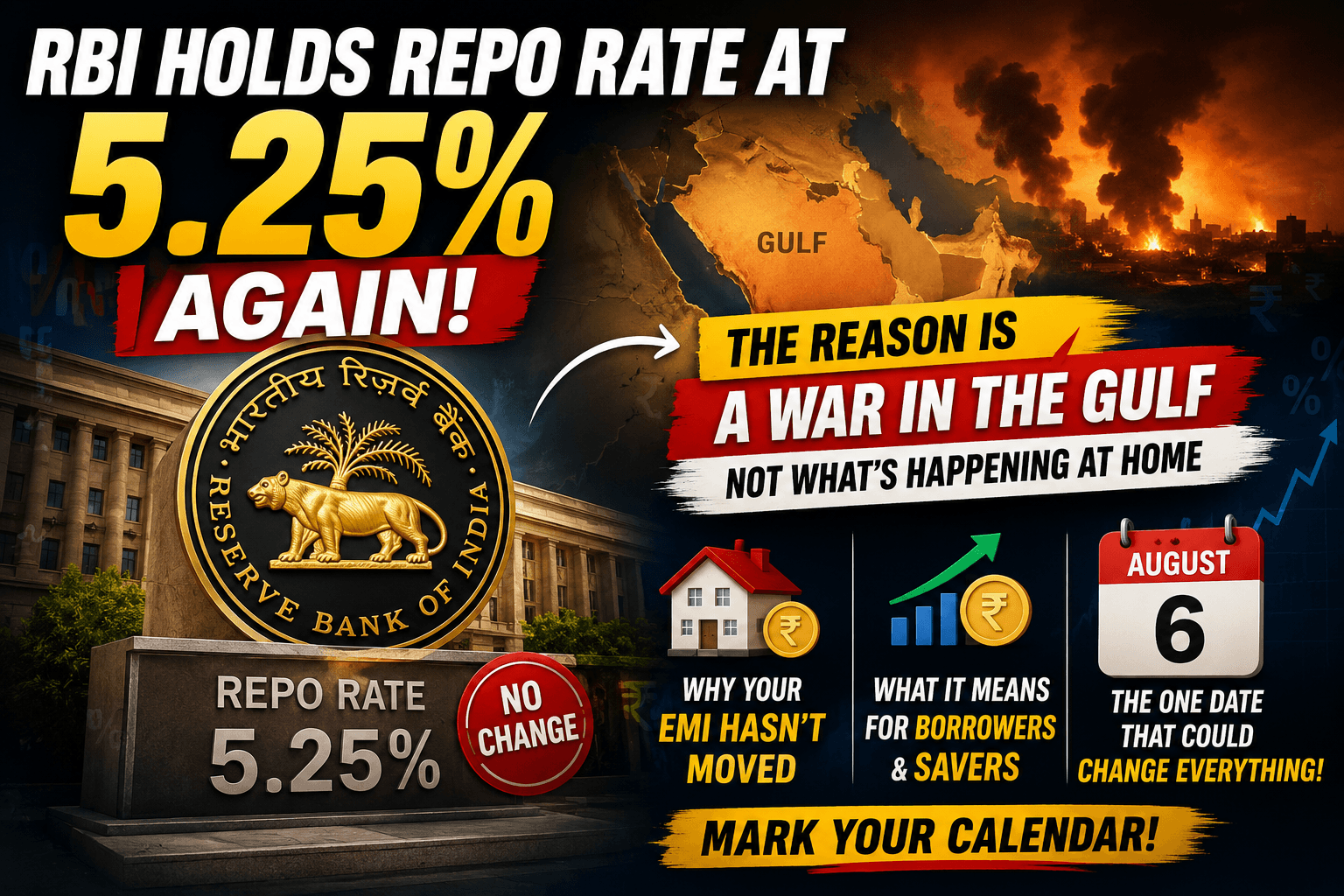
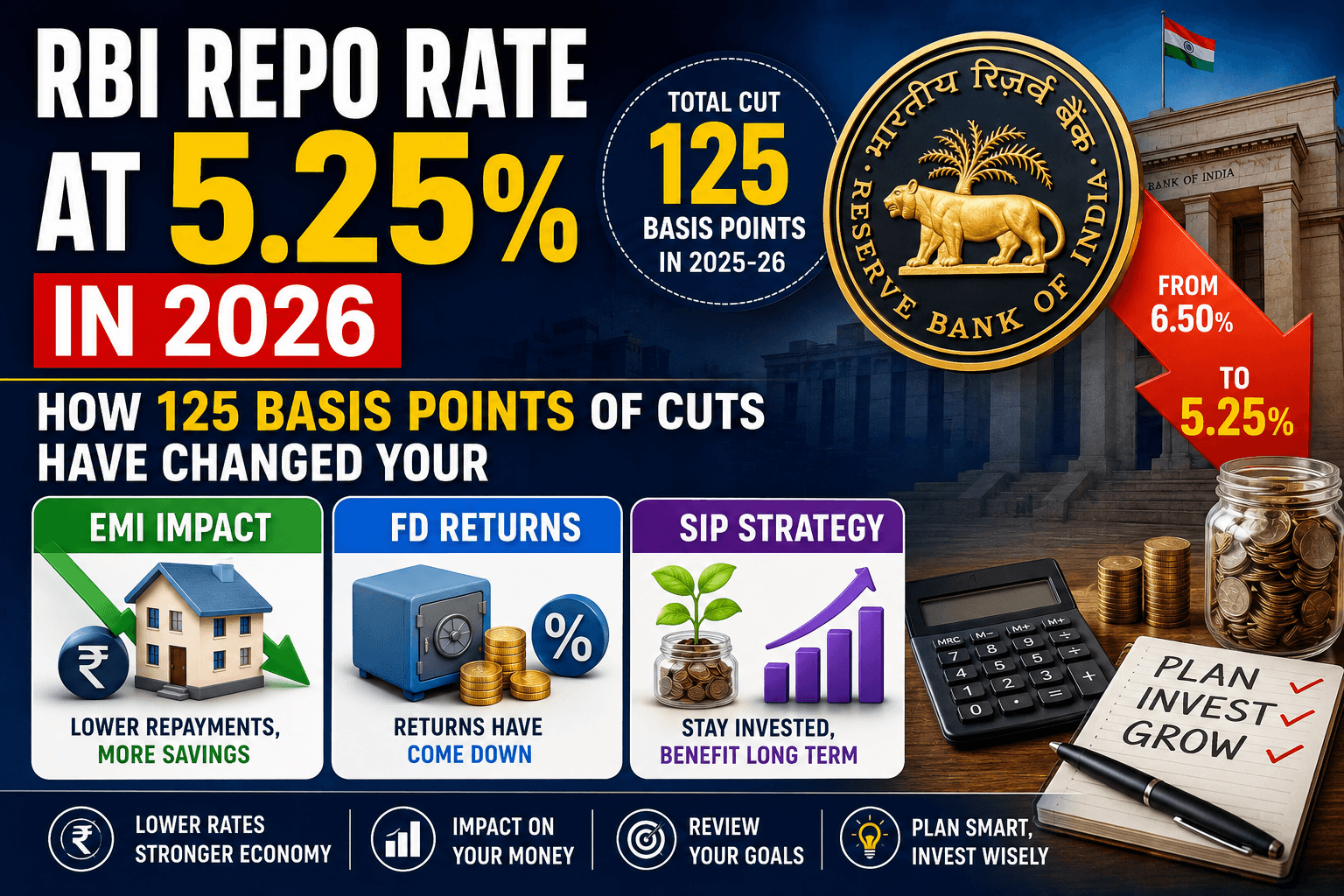
Between February 2025 and December 2025, the Reserve Bank of India cut its benchmark repo rate four times — from 6.50% to 5.25%. That is a total reduction of 125 basis points in under 12 months, the most aggressive rate-cutting cycle India has seen since 2019. The RBI held the rate unchanged at 5.25% in its February 2026 and April 2026 meetings, signalling a pause while it monitors inflation and GDP growth.
For most Indian households, these cuts have had three distinct effects — some welcome, some not. Home loan EMIs have become cheaper for floating rate borrowers. FD interest rates have fallen, hurting savers and retirees. And the case for equity SIPs has strengthened relative to debt instruments. This article explains each effect with real numbers so you can make informed decisions with your money in the current rate environment.
The Complete RBI Rate Cut Timeline: February 2025 to April 2026
| MPC Meeting Date | Decision | Repo Rate After | Key reason |
|---|---|---|---|
| February 2025 | Cut 25 bps | 6.25% | Inflation easing, growth support needed |
| April 2025 | Cut 25 bps | 6.00% | US tariff uncertainty, global slowdown risk |
| June 2025 | Cut 50 bps + CRR cut 100 bps | 5.50% | Inflation at record low, aggressive growth push |
| August 2025 | Hold | 5.50% | US tariff impact being assessed |
| October 2025 | Hold | 5.50% | Monitoring transmission to lending rates |
| December 2025 | Cut 25 bps | 5.25% | Inflation at record low (0.25% in October), GDP strong at 8.2% |
| February 2026 | Hold | 5.25% | Pausing to assess impact, stance neutral |
| April 2026 | Hold | 5.25% | FY27 inflation projected at 4.6%, growth stable |
Sources: RBI Monetary Policy Statements, BankBazaar, Business Standard. Total cuts: 125 basis points from February 2025 to December 2025.
The June 2025 meeting was the most consequential — a 50 basis point cut combined with a 100 basis point CRR (Cash Reserve Ratio) reduction. Lowering the CRR meant banks were required to hold less cash in reserve, releasing significant liquidity into the banking system simultaneously with the rate cut. This double action was designed to ensure banks actually passed the rate reduction on to borrowers, rather than holding it as margin.
Effect 1: What Happened to Your Home Loan EMI
This is where the rate cuts are most directly felt. If you have a floating rate home loan linked to an external benchmark — which most home loans sanctioned after October 2019 are required to be under RBI guidelines — your interest rate should have reduced by the full 125 basis points since February 2025, subject to your lender's reset cycle.
Here is what that reduction means in actual EMI terms:
| Loan amount | Tenure | EMI at 8.75% (Feb 2025) | EMI at 8.50%* (May 2026) | Monthly saving | Annual saving |
|---|---|---|---|---|---|
| ₹30 lakh | 20 years | ₹26,411 | ₹26,035 | ₹376 | ₹4,512 |
| ₹50 lakh | 20 years | ₹44,018 | ₹43,391 | ₹627 | ₹7,524 |
| ₹75 lakh | 20 years | ₹66,028 | ₹65,087 | ₹941 | ₹11,292 |
| ₹1 crore | 20 years | ₹88,037 | ₹86,782 | ₹1,255 | ₹15,060 |
| ₹50 lakh | 30 years | ₹39,157 | ₹38,446 | ₹711 | ₹8,532 |
*SBI's current starting home loan rate is 8.50% as of May 2026 for salaried borrowers with CIBIL 750+. Actual rate varies by lender and borrower profile. Use gpaisa.in's Home Loan Calculator for your exact EMI.
The savings look modest on a monthly basis — ₹627/month on a ₹50 lakh loan — but remember this compounds over the remaining loan tenure. A borrower with 15 years remaining on a ₹50 lakh loan saves approximately ₹1.13 lakh in total interest from a 0.25% rate reduction.
Important: Has your lender actually passed on the cuts?
This is the question most home loan borrowers are not asking. Under RBI's external benchmark lending rate (EBLR) framework, banks are required to reset floating rates within one interest rate reset cycle — typically every 3 months for most lenders. However, not all banks have fully transmitted the 125 basis point reduction.
Check your home loan account statement. Look at the interest rate applied to your most recent EMIs. If your rate is still above 9.0% and your loan was sanctioned after 2019, call your bank and ask why the full reduction has not been applied. Banks are legally required to pass on repo-linked rate reductions under EBLR. If your loan is on the older MCLR (Marginal Cost of Lending Rate) system, transmission is slower and you may want to request a switch to EBLR — this typically costs a nominal processing fee but can deliver significant savings.
Effect 2: What the Rate Cuts Have Done to FD Returns
The same cuts that reduced your home loan EMI have reduced returns for FD investors. Banks fund their lending partly from deposits — when lending rates fall, deposit rates follow. This is the unavoidable flip side of rate cuts for savers.
| Bank | 1-year FD rate (Feb 2025) | 1-year FD rate (May 2026) | Reduction |
|---|---|---|---|
| SBI | 6.80% | 6.30% | −0.50% |
| HDFC Bank | 7.10% | 6.35% | −0.75% |
| ICICI Bank | 7.10% | 6.25% | −0.85% |
| Post Office (5yr) | 7.50% | 7.50% | 0% — unchanged |
The Post Office Time Deposit stands out: the Finance Ministry has kept the 5-year rate at 7.50% unchanged through four consecutive quarterly reviews, making it the single best opportunity for savers to lock in a government-backed rate that has not moved with the repo rate cycle.
What this means for FD investors in May 2026:
If you have FDs maturing in the next 3–6 months, you will be rolling them over at lower rates than before. A ₹10 lakh FD at 7.10% (HDFC, Feb 2025 rate) earned ₹71,000 per year. At today's 6.35%, the same FD earns ₹63,500 — a reduction of ₹7,500 per year in interest income.
For retirees and senior citizens who depend on FD interest as regular income, this is a meaningful reduction. The best mitigation strategies are: lock in longer tenures now before further potential rate cuts, diversify into Post Office 5-year TD at 7.50%, and consider RBI Floating Rate Savings Bonds (currently offering 8.05% — 35 basis points above National Savings Certificate rate) as a complement to bank FDs.
Use gpaisa.in's FD Calculator to calculate how much your maturing FD will earn at current rates and compare across banks.
Effect 3: What Lower Rates Mean for Your SIP and Investments
Rate cut cycles have a well-established historical relationship with equity market performance — and therefore with SIP returns. Understanding this relationship helps you position your SIP portfolio correctly in the current environment.
Why rate cuts are generally positive for equities:
When the repo rate falls, banks' borrowing costs reduce. Companies that borrow from banks — which includes most Indian businesses — face lower interest expenses, which boosts their profitability. Higher corporate profits translate to higher stock prices. Additionally, lower fixed deposit rates make equities relatively more attractive — when FD rates fall from 7.10% to 6.35%, the equity market's expected return premium over risk-free rates increases, drawing more investment toward stocks.
Historically, major rate cut cycles in India have coincided with strong equity rallies:
- 2019–2020 rate cuts (from 6.50% to 4.00%): Nifty 50 rose approximately 80% from the March 2020 bottom to December 2021
- 2025–2026 rate cuts (from 6.50% to 5.25%): Nifty 50 has delivered positive returns through the cut cycle, supported by strong GDP growth of 8.2% in the September 2025 quarter
What this means for your SIP in 2026:
A rate cut environment is generally a good time to be running equity SIPs — not a reason to pause them. The macro tailwind of falling rates supports corporate earnings, which supports market returns over the medium term. Specifically:
- Continue or increase SIP amounts in diversified equity funds during this rate cut cycle — the macro backdrop is supportive
- Rate-sensitive sectors benefit more — banking, real estate, and consumer finance stocks historically outperform in rate cut cycles. Flexi cap and large cap funds with banking sector exposure benefit from this
- Shift away from pure debt funds for long-term goals — with FD rates at 6.25–6.50%, post-tax real returns on debt instruments are minimal or negative for investors in the 30% tax bracket. Equity SIPs with a 7+ year horizon deliver better inflation-adjusted returns in this environment
- Short duration debt funds benefit near-term — when rates fall, existing bond prices rise. Short duration or dynamic bond funds can deliver 7–9% returns in a falling rate environment, making them a reasonable complement to equity SIPs for 1–3 year money
The Real-World Impact: Three Household Scenarios
Scenario A: Salaried borrower with a ₹60 lakh home loan (20 years remaining)
Ramesh, 38, IT professional in Bangalore, has a ₹60 lakh floating rate home loan at SBI. In February 2025, his rate was 9.15%. After the 125 bps cut cycle, his revised rate (fully transmitted) is 8.65% — a reduction of 0.50% (full 1.25% transmission is taking longer due to MCLR elements in older loans).
Old EMI at 9.15%: ₹54,580/month
New EMI at 8.65%: ₹52,875/month
Monthly saving: ₹1,705
Annual saving: ₹20,460
Total saving over remaining 20 years (rough estimate): ₹2.7 lakh
Ramesh's action: He is using the ₹1,705 monthly saving to increase his SIP by ₹2,000/month — adding to his mid-cap fund SIP. At 14% CAGR over 20 years, this additional ₹2,000 SIP builds ₹22.4 lakh of additional corpus. A small EMI reduction compounding into significant wealth.
Scenario B: Retired senior citizen with ₹30 lakh in FDs
Meena, 67, retired teacher in Mumbai, has ₹30 lakh in bank FDs as her primary income source. In early 2025, her average FD rate was 7.25%. After renewals at lower rates through 2025–26, her average rate is now 6.40%.
Old annual interest: ₹30L × 7.25% = ₹2,17,500
New annual interest: ₹30L × 6.40% = ₹1,92,000
Annual income reduction: ₹25,500 per year
Meena's action: She moved ₹10 lakh from bank FDs to Post Office 5-year TD at 7.50%, increasing that portion's annual interest from ₹64,000 to ₹75,000. She also invested ₹5 lakh in RBI Floating Rate Savings Bonds at 8.05%. These two moves partially offset the income reduction from lower bank FD rates.
Scenario C: First-time home buyer making a purchase decision
Priya, 32, product manager in Hyderabad, was planning to buy a ₹70 lakh apartment. She was waiting for rates to fall before taking a home loan. With SBI now at 8.50% (vs 9.25% in early 2024), she is reconsidering.
Home loan ₹56 lakh (80% of property), 20 years:
At 9.25% (early 2024): EMI = ₹51,507
At 8.50% (May 2026): EMI = ₹48,609
Monthly saving: ₹2,898
Total interest saved over 20 years: ₹6.95 lakh
Additionally, with further rate cuts unlikely in the near term (RBI has held at 5.25% for two consecutive meetings), the window of current rates may be more valuable than waiting for rates that may not come. Priya's situation illustrates why the current rate environment, while not at historic lows, is genuinely more favourable than 2023–2024 for new home loan borrowers.
Will RBI Cut Rates Further in 2026?
This is the question every borrower, saver, and investor is asking. Based on current data:
Arguments for further cuts:
- India's inflation fell to a record low of 0.25% in October 2025 and remains well below the RBI's 6% upper tolerance band
- RBI's FY27 inflation projection of 4.6% gives room for further easing without breaching the 2–6% target band
- US–India trade deal expectations and robust GDP growth of 8.2% give the RBI confidence to support growth
Arguments against further cuts:
- RBI Governor noted in June 2025 that after 100 bps in quick succession, "monetary policy is left with very limited space to support growth" — signalling a cautious approach to further cuts
- The policy stance was changed to "Neutral" from "Accommodative" in June 2025 — neutral stance means RBI is not pre-committed to further cuts
- FPI outflows of $6.49 billion in April 2026 create currency pressure that a rate cut would worsen
- Some analysts are beginning to build the case for a rate hike in FY27 if inflation picks up
The most likely scenario for FY 2026-27: One more 25 basis point cut is possible in the June 2026 MPC meeting if inflation remains subdued. Beyond that, rates are more likely to hold or rise than to fall further. For home loan borrowers and FD investors, this means the current rate environment is approximately where rates will stay for the next 12–18 months — making now a reasonable time to lock in home loan decisions and longer-tenure FDs.
Action Plan: What to Do Right Now
If you have a floating rate home loan:
Check your current interest rate. If it has not reduced by at least 0.75–1.00% from your pre-February 2025 rate, contact your bank. For loans on old MCLR, request a switch to repo-linked EBLR. Use gpaisa.in's home loan calculator to model your EMI at different rates and see potential savings.
If you have FDs maturing in the next 6 months:
Compare rates before auto-renewal. Post Office 5-year TD at 7.50% is the best rate for long-tenure investment. For shorter tenures, compare Yes Bank (7.25% for 12–18 months) and Axis Bank before settling for SBI or ICICI. See our detailed Best FD Rates June 2026 comparison.
If you are running SIPs:
Do not pause. Rate cut environments are historically favourable for equity. If your SIP EMI has reduced due to home loan rate cuts, consider routing the saving into an additional SIP. Use gpaisa.in's SIP calculator to see what an additional ₹2,000–₹5,000 SIP contributes to your 10-year corpus.
If you are considering buying a home in 2026:
The current 8.50% starting rate is significantly better than the 9.25–9.50% rates of 2023–24. With further major cuts unlikely, the current environment is as favourable as it is likely to get in the near term. The decision to buy should still primarily depend on your price-to-rent ratio, tenure, and income stability — but the rate environment is not a reason to keep waiting. See our detailed Home Loan vs Rent 2026 analysis.
Frequently Asked Questions
What is the current RBI repo rate in 2026?
The current repo rate is 5.25% as of May 2026, following the December 2025 cut of 25 basis points. The RBI has held the rate at 5.25% in both its February 2026 and April 2026 MPC meetings. The total reduction since February 2025 is 125 basis points — from 6.50% to 5.25%.
How much has my home loan EMI reduced after RBI rate cuts?
For a floating rate home loan linked to repo rate (EBLR), the rate should have reduced by approximately 0.75–1.25% since February 2025, translating to ₹500–₹1,500 lower EMI per ₹50 lakh of loan. Check your loan statement to verify if your lender has transmitted the full reduction. Use gpaisa.in's home loan calculator to calculate exact savings.
Will RBI cut repo rate again in 2026?
One more 25 bps cut in June 2026 is possible given low inflation and strong GDP. However, the RBI has signalled a neutral stance since June 2025 and analysts are beginning to build the case for rate stability or even a hike in FY27. Do not count on significant further reductions when making FD or home loan decisions.
Why are FD rates falling when RBI cuts repo rate?
Banks fund their lending using deposit money. When lending rates fall, banks need to lower their cost of funds — which means reducing the interest they pay on deposits. FD rates typically move in the same direction as the repo rate with a lag of 1–6 months depending on the bank and market conditions.
What is the difference between repo rate and home loan rate?
The repo rate (5.25%) is what banks pay to borrow from RBI. Your home loan rate is what you pay to borrow from the bank — this is the repo rate plus a spread (typically 2.50–3.50%) that covers the bank's costs and profit margin. So a repo rate of 5.25% plus a spread of 3.25% gives a home loan rate of approximately 8.50%. When repo falls, the home loan rate reduces by an equal amount if the spread remains unchanged.
Does repo rate cut affect SIP returns?
Not directly — equity SIP returns depend on stock market performance, not the repo rate. However, rate cut cycles are historically positive for equity markets because lower borrowing costs boost corporate profitability. Indirectly, rate cuts create a favourable environment for equity SIP investors over a 3–5 year horizon.
Use our calculators: Home Loan Calculator | FD Calculator | SIP Calculator | EMI Calculator
Related reading: Best FD Rates India — June 2026 | Home Loan vs Rent in India 2026 | How to Improve Your CIBIL Score — 7 Steps
Disclaimer: Repo rate, home loan rates, and FD rates are subject to change. All calculations in this article are illustrative based on rates as of May 2026. This article is for informational and educational purposes only and does not constitute financial or investment advice. Please consult a SEBI-registered financial advisor before making any financial decisions. gpaisa.in is not registered with SEBI. Past returns are not indicative of future performance.