Updated: 23 October 2026
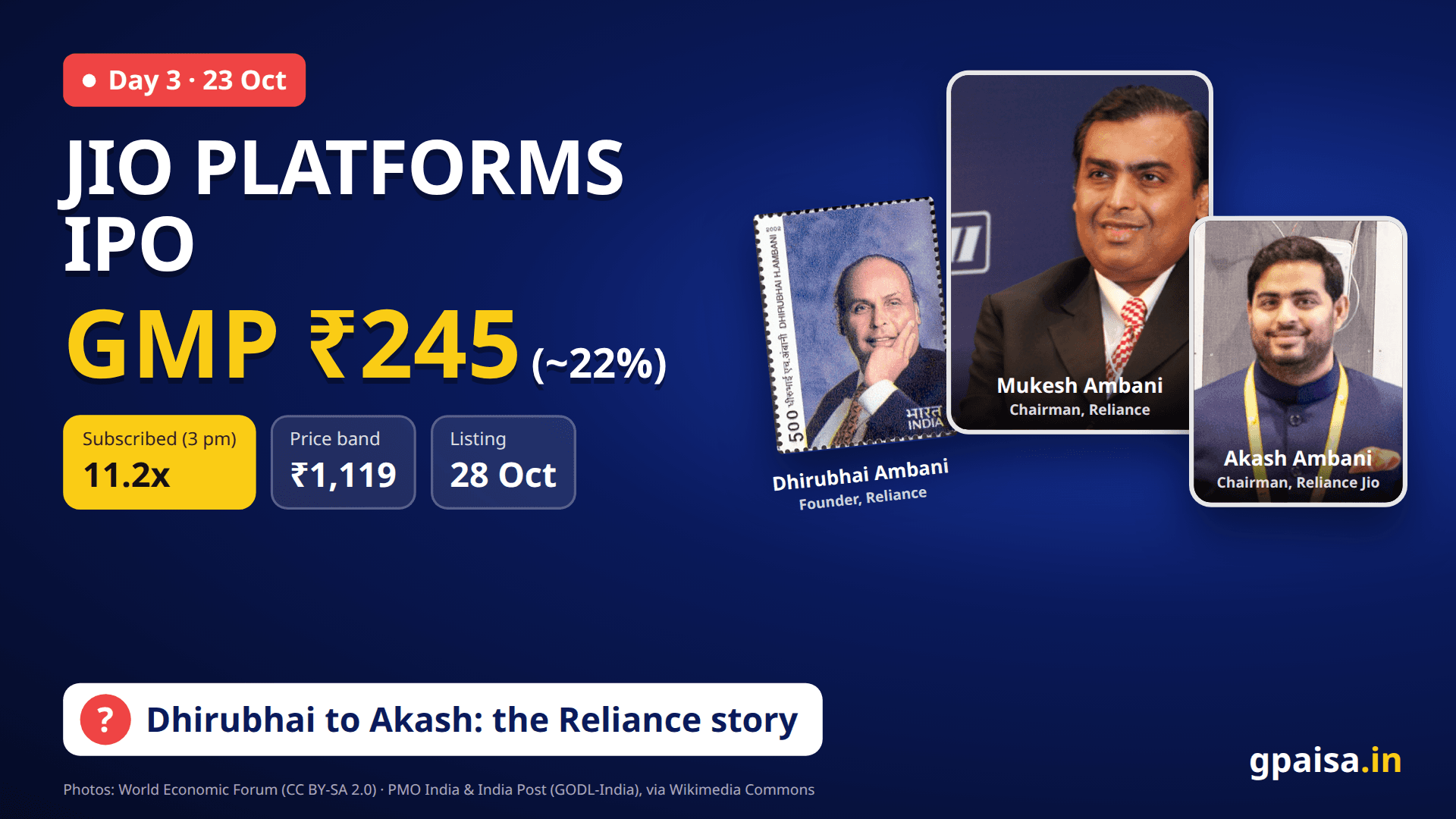
Bidding for the Jio Platforms IPO, India's largest public issue by size, ends at 5 pm today. By 3 pm on Friday the ₹30,213 crore issue was subscribed 11.21 times, according to exchange data compiled by Chanakya Nipothi. Qualified institutional buyers (QIBs) bid for 27.85 times their quota. Retail investors had covered 2.45 times theirs.
The grey market premium (GMP), an unofficial indicator, was about ₹245 a share on Friday afternoon, or about 22% above the ₹1,119 upper price band. That is below the peak of ₹270–273 seen on 20 October, the day before the issue opened.
The Reliance Industries (RIL) subsidiary will finalise allotment on Monday, 26 October. Shares are scheduled to list on BSE and NSE on Wednesday, 28 October. For live figures, see our Jio Platforms IPO page.
Lead image: Mukesh Ambani by the World Economic Forum (CC BY-SA 2.0); Akash Ambani by the Prime Minister's Office (GODL-India); Dhirubhai Ambani 2002 stamp by India Post (GODL-India), via Wikimedia Commons. The composite image is shared under CC BY-SA 2.0.
Read in Hindi: Jio Platforms IPO: subscription, GMP and allotment date (Hindi)
Jio Platforms IPO at a glance
- Price band: ₹1,065–1,119 per share; face value ₹10
- Issue size: about ₹30,213 crore at the upper band, entirely a fresh issue of 27 crore shares, with no offer for sale
- Lot size: 12 shares (₹13,428 at the upper band); the retail maximum is 14 lots (₹1,87,992)
- Net issue split: QIB 50%, non-institutional investors (NII) 15%, retail 35%
- Reservations: 46,94,836 shares for employees (about ₹500 crore) at a ₹54 discount, and 2,23,41,376 shares (about ₹2,500 crore) for eligible RIL shareholders
- Anchor book: ₹8,109.85 crore from 212 investors at ₹1,119 on 19 October
- Use of money: ₹27,500 crore to prepay borrowings of Reliance Jio Infocomm (RJIL); the rest for general corporate purposes
- Dates: open 21–23 October; allotment 26 October; refunds and demat credit 27 October; listing 28 October
- Registrar: KFin Technologies; Kotak Mahindra Capital and Morgan Stanley India head a syndicate of 19 lead managers
- Market value at ₹1,119: about ₹10.30 lakh crore after the issue
The promoter, RIL, holds 66.43% before the issue. That falls to 64.48% afterwards because only new shares are being sold.
Day 3 subscription: how the book built up
Demand built steadily through Friday. QIB bids rose from about 14 times their quota at noon to nearly 28 times by 3 pm. Big NIIs, who bid above ₹10 lakh, were at 15.02 times and small NIIs at 8.97 times. Retail demand rose more slowly.
| Time (23 Oct) | QIB | NII | Retail | Employee | Overall | Source |
|---|---|---|---|---|---|---|
| End of day 1 (21 Oct) | 9.04x | 1.61x | 0.73x | 1.33x | 3.04x | HDFC Sky |
| End of day 2 (22 Oct) | 12.87x | 5.67x | 1.55x | 2.05x | 5.40x | HDFC Sky / IIFL |
| 10:59 am | 13.83x | 8.11x | 1.92x | 2.36x | 6.39x | Chittorgarh |
| 11:48 am | 14.18x | 9.17x | 1.99x | 2.46x | 6.76x | Inc42 (BSE data) |
| 12:12 pm | 14.62x | 9.63x | 2.09x | 2.49x | 7.01x | IIFL |
| 3:00 pm | 27.85x | 13.00x | 2.45x | 2.72x | 11.21x | Chanakya Nipothi |
The RIL shareholder quota was 5.75 times subscribed at 12:12 pm, according to IIFL. One tracker, IPOJI, showed 13.22 times overall at 3:18 pm, with QIBs at 35.43 times and retail at 2.48 times. We could not match that figure with a second source.
Reports also differ on the first two days. Business Standard put the issue at 5.57 times at the end of day 2, with QIBs at 13.29 times and retail at 1.54 times. HDFC Sky and IIFL put it at 5.40 times. The gap probably reflects different cut-off times or category definitions.
Final subscription figures will come from BSE and NSE after bidding closes at 5 pm. They were not available when this article was published, and the closing numbers could be well above the 3 pm figures.
Jio Platforms IPO GMP today (unofficial)
GMP is the premium at which IPO shares change hands in an informal, unregulated market before listing. It is not published by SEBI, the exchanges or the company. It can change quickly and is often wrong.
- Latest: ₹245 at 2:30 pm on 23 October (IPOJI), which suggests a listing near ₹1,364. InvestorGain showed ₹250 at 2:37 pm. Chanakya Nipothi quoted ₹228–234 at 3 pm.
- Over the three bidding days: about ₹246 on 21 October, ₹240 on 22 October and ₹245 on 23 October (IPOJI's daily figures). InvestorGain's intraday readings ranged from ₹240 to ₹277 on day 1.
- Before the issue: about ₹125–140 in early October, rising to a peak of ₹270–273 on 20 October.
Track daily changes on our IPO GMP page.
Lot calculator and listing-gain scenarios
Retail investors can bid for up to 14 lots, keeping the application under ₹2 lakh. The amounts below are at the ₹1,119 cut-off price.
| Lots | Shares | Amount (₹) |
|---|---|---|
| 1 | 12 | 13,428 |
| 2 | 24 | 26,856 |
| 5 | 60 | 67,140 |
| 10 | 120 | 1,34,280 |
| 14 (retail maximum) | 168 | 1,87,992 |
The next table shows what one lot would gain or lose at four listing prices. These are illustrations based on the unofficial GMP, not forecasts. They ignore brokerage and taxes.
| Scenario | Listing price (₹) | Gain/loss per share (₹) | Per lot of 12 (₹) | Return |
|---|---|---|---|---|
| At latest GMP (₹245) | 1,364.00 | +245.00 | +2,940 | +21.9% |
| Half the GMP (₹122.50) | 1,241.50 | +122.50 | +1,470 | +10.9% |
| Flat listing | 1,119.00 | 0 | 0 | 0% |
| 10% below issue price | 1,007.10 | −111.90 | −1,342.80 | −10.0% |
For someone allotted 14 lots, the same scenarios work out to +₹41,160, +₹20,580, nil and −₹18,799.
Retail allotment odds: an estimate
The retail portion is 8,50,37,326 shares, worth about ₹9,516 crore at ₹1,119. Divided by the ₹13,428 lot value, that is 70,86,443 lots, so about 70.9 lakh retail applicants can each receive one lot.
Under SEBI rules, when the retail book is oversubscribed, the registrar gives one lot to as many applicants as possible by lottery. Bidding for 14 lots does not improve your chance much. Each valid application, whatever its size, is entered once.
The final retail figure was not available at the time of writing, so this estimate uses the 3 pm figure of 2.45 times:
- Lots bid for ≈ 2.45 × 70.86 lakh ≈ 1.74 crore lots.
- If every applicant bid for just one lot, there would be about 1.74 crore applications competing for 70.86 lakh lots. The odds would be about 1 in 2.45, or roughly 41%.
- Many investors bid for more than one lot, so there are fewer applications than lots bid for. That makes the real odds per application higher than 41%.
This is an estimate, not a forecast. The actual odds depend on the final retail subscription and the number of valid applications, which KFin Technologies will disclose in the basis of allotment. Eligible RIL shareholders also had a separate quota, at 5.75 times as of 12:12 pm.
What Jio's numbers say
According to the restated consolidated figures in the RHP:
- Revenue from operations: ₹1,28,218 crore in FY25 and ₹1,46,885 crore in FY26, up 14.6%. In the June 2026 quarter it was ₹39,173 crore.
- EBITDA (operating profit before interest, tax, depreciation and amortisation): ₹54,959 crore in FY24, ₹64,170 crore in FY25 and ₹76,255 crore in FY26. The FY26 margin was 51.9%.
- Net profit: ₹21,434 crore in FY24, about ₹26,109 crore in FY25 and ₹30,049 crore in FY26, up 15.1%.
- Borrowings: ₹70,781 crore at March 2026 and ₹61,372 crore at June 2026, before the ₹27,500 crore repayment from the IPO money.
- ARPU (average revenue per user per month): ₹181.7 in FY24, ₹214 in FY26 and ₹215.6 in the June 2026 quarter.
- Customers: 53.33 crore for RJIL as of 30 June 2026.
Valuation against Bharti Airtel. At ₹1,119, Jio is valued at about 33.2 times FY26 earnings after the issue, according to Chittorgarh's calculation from the RHP. The RHP's peer table puts Bharti Airtel at 40.71 times. Swastika Investmart put the discount at about 18% and called Jio's roughly 12 times EV/EBITDA reasonable, according to Goodreturns. Other brokers' EV/EBITDA estimates go up to about 15.6 times.
The comparison has limits. Airtel's consolidated numbers include Africa and Indus Towers. Airtel also earns more per user, with India mobile ARPU of about ₹257 in the March 2026 quarter against Jio's ₹214. Jio's return on net worth was 9.42% in FY26.
Several brokerages, including Arihant Capital, Emkay Global, Swastika Investmart and Ventura Securities, rated the issue "subscribe", mainly for the long term, Goodreturns reported. Valmiki Leela Capital told Business Today: "Jio Platforms is a fundamentally sound business at a full valuation."
Key risks flagged in reviews include:
- dependence on tariff increases;
- ₹1.04 lakh crore of deferred spectrum payments at June 2026;
- heavy capex needs;
- regulatory changes.
From Dhirubhai to Akash: the Reliance story
Jio's listing is the latest chapter in a company that began as a yarn trading business in Mumbai. Reliance's own history page dates that start to 1957. Britannica dates the founding of Reliance Commercial Corporation to 1958.
The 1977 public issue of Reliance Textile Industries was oversubscribed seven times. Reliance says it ushered in an "equity cult" among small investors in India. Nearly five decades later, the Jio issue again has a quota for retail investors and RIL's own shareholders.
| Year | Milestone |
|---|---|
| 1932 | Dhirubhai Ambani born on 28 December in Gujarat |
| 1957–58 | Returns from Aden and starts a yarn trading business in Mumbai (Reliance Commercial Corporation) |
| 1966 | First textile mill set up at Naroda, near Ahmedabad |
| 1977 | Reliance Textile Industries IPO, oversubscribed seven times |
| 1999–2000 | Jamnagar refinery commissioned; Mukesh Ambani led the project |
| 2002 | Dhirubhai dies on 6 July; Mukesh Ambani becomes chairman of Reliance |
| 2016 | Jio starts commercial services on 5 September, with free voice calls and low-priced data |
| 2020 | Jio Platforms raises ₹1,52,056 crore from 13 investors, including Facebook (₹43,574 crore for 9.99%) and Google (₹33,737 crore for 7.73%) |
| 2022 | Akash Ambani becomes chairman of Reliance Jio Infocomm on 27 June |
| 2023 | Isha, Akash and Anant Ambani join the RIL board |
| 2026 | Jio Platforms IPO, 21–23 October |
Dhirubhai's model. Britannica notes that Dhirubhai took Reliance public after nationalised banks would not finance him. He used the stock market to fund one expansion after another. Reliance later became the first private Indian company in the Fortune Global 500.
Mukesh Ambani's bets. Mukesh, on the Reliance board since 1977, led the building of the Jamnagar refinery. Reliance's history page calls it the world's largest grassroots refinery, built in 36 months. At the 2016 AGM he announced Jio's launch: "From the 5th of September, India will change forever." Jio offered free services until 31 December 2016 and said voice calls would always be free. Rival telecom shares fell sharply. In 2020, during the pandemic, Jio Platforms sold about a third of its equity to Facebook, Google and financial investors.
The next generation. Mukesh resigned from the RJIL board in June 2022, and Akash, then a non-executive director, was named chairman. Mukesh remains chairman of Jio Platforms. In 2023 the three children joined the RIL board. Isha leads Reliance Retail's expansion and Anant is involved in the new energy business, Outlook Business reported.
What happens next
- 26 October: basis of allotment. Check your status on the KFin Technologies IPO status page or on the BSE and NSE websites, using your PAN or application number.
- 27 October: UPI blocks released for unsuccessful bids, and shares credited to demat accounts.
- 28 October: listing on BSE and NSE.
See other open and upcoming issues on our IPO hub.
Frequently asked questions
What is the Jio IPO GMP today?
On 23 October 2026, trackers put the Jio Platforms IPO GMP at about ₹228–250. IPOJI showed ₹245 at 2:30 pm, about 22% above the ₹1,119 upper band. GMP is unofficial and unregulated, and it does not guarantee the listing price.
How many times has the Jio Platforms IPO been subscribed?
By 3 pm on 23 October, the last day, the issue was subscribed 11.21 times overall: QIB 27.85x, NII 13.00x and retail 2.45x. The final figures will be published by BSE and NSE after bidding closes at 5 pm.
When is the Jio IPO allotment date?
The basis of allotment is expected on Monday, 26 October 2026. Refunds and demat credits are due on 27 October, and listing on BSE and NSE on 28 October. The registrar is KFin Technologies.
What is the Jio Platforms IPO lot size and price band?
The price band is ₹1,065–1,119 and one lot is 12 shares, or ₹13,428 at the upper band. Retail investors can apply for up to 14 lots (168 shares, ₹1,87,992).
Who owns Jio Platforms?
Reliance Industries is the promoter and holds 66.43% before the IPO, falling to 64.48% after it. Meta (Facebook), Google and other investors bought stakes in 2020. Mukesh Ambani is chairman of Jio Platforms, and his son Akash Ambani chairs the main operating subsidiary, Reliance Jio Infocomm.
Sources
- Chittorgarh: Jio Platforms IPO details (reservation, financials, valuation)
- Chittorgarh: subscription status
- Chanakya Nipothi: day-3 subscription and GMP
- Inc42: IPO booked 6.76x on day 3
- IIFL: subscribed 7.01 times on day 3
- HDFC Sky: day-wise subscription and dates
- Business Standard: subscribed 5.57x on day 2
- Business Today: last day to subscribe
- Goodreturns: day-3 live updates
- IPOJI: GMP trend (unofficial)
- InvestorGain: GMP history (unofficial)
- IPO Watch: lot size, registrar, peer comparison
- TaxGuru: RHP financials summary
- INDmoney: ARPU and valuation review
- IPOScouter: Jio vs Airtel valuation
- SEBI: Jio Platforms offer document filing
- Reliance Industries: Our history
- Reliance Industries: Founder chairman
- Reliance Industries: Chairman and Managing Director
- Britannica: Dhirubhai Ambani
- Jamnagar refinery (commissioning date)
- DT Next: Mukesh Ambani's 20 years as RIL chief
- Moneylife: Facebook buys 9.99% of Jio Platforms
- Business Standard: Google to buy 7.73% of Jio Platforms
- Business Today: Jio launch, 2016
- The Week: Akash Ambani becomes Jio chairman
- Outlook Business: Isha, Akash and Anant join the RIL board
Disclaimer: This article is for information only and is not investment advice or a recommendation to apply for, buy or sell any security. Grey market premium (GMP) figures are unofficial, unregulated and can change sharply; they do not guarantee listing prices or returns. gpaisa.in is not registered with SEBI as an investment adviser or research analyst. Read the RHP and consult a SEBI-registered adviser before investing.